Unequally yoked. An unrealized one, chaotic one (no order) yoked to an empty one (no substance, essence). Or, the Tale of Two Queens. The Bible kicks off with an epic tale, never seen, never told…
תהו ובהו
[tohu ve-bohu]
Strong’s #1961. hayetah. She has become. Verb to be is in the perfect/complete “tense” and the third-person feminine singular. This feminine verb is properly followed by a feminine noun to agree in gender, as in Zephaniah:
היתה לשַמה
“she has become a desolation”
Zephaniah 2:15
But sometimes we find interesting exceptions:
היתה למס
“she has become a body of forced labor [collective masculine noun]”
Lamentations 3:1 RBT
And then there is the mysterious Genesis 1:2:
היתה תהו ובהו
“she has become tohu and bohu”
The words tohu and bohu are a pairing, where the one is based on the other, or intertwined with the other. Morphologists parse them as masculine nouns. However, they can also be parsed as feminine nouns with a masculine suffix.
Consider: A Divided Man attempting to Build (or Dividing) the Same Woman
This falls back on the circular saying in the New Testament, “as the woman from out of the man, so the man through the woman.” As a recursive aonic process, the man divided can only build a divided woman, and this in turn brings his own self forth even more divided. And the process repeats. Thus, it is “not good” for a man to be separated to himself.
The letters give powerful “earth shattering” clues. The Hebrew letter ו is a suffix in Hebrew that means “of him/himself.” The root of bohu is בהה (bahah) and the root of tohu is תהה (tahah). If these were formulated into feminine nouns, we might read something like “tohah and bohah.” If Tohu and Bohu are divided against herself, and these two suffixes refer to “himself” then it would follow that there would be two “hims” or two different men trying to build the same woman, e.g. “this one” and “this one.” Furthermore, the letter ו on its own stands for “man” and the number 6, the “number of man.”
Tohu #8414 (unreal, crooked, fake, chaos) and Bohu, #922 (empty/plumb one) describe the Earthly One (“Tale of Two Queens”). These words have always been difficult to translate.
“primary meaning difficult to seize” (cf. Brown, et al).
1 Sam. 12:21 connects tohu to the Baalim (false gods) and the Ashtarot (false goddesses) collectively: “they are tohu” usually translated worthless, useless, nothing. They are formless, fake, unreal, unconscious.” There is nothing inside. Their lips, eyes, faces, nose all en-wrap a void.
 The word bohu according to Gesenius is from the Hebrew root bahah,
“which properly appears to have had the signification of purity, which in Arabic is partly applied to brightness and ornament (to be bright, to be beautiful), partly to emptiness…”.
A Mother?
Fuerst provides us more information and notes how bohu was personified as a “mother of the races of the gods”:

בָּהָה (not used) intr. 1. to be empty, like بهى to be empty, uninhabited, waste, Aram. בְּהָא, Syr. ܒܗܐ, in the reduplicated form ܒܗܒܗ to be terrified (comp. Hebr. שָׁמֵם); derivative בֹּהוּ. — Hence 2. to be desolate, to be waste, בָּקַק also appearing in the same metaphorical use; spoken especially of the primitive chaos.
בֹּהוּ (= בְּהוּ after the form פְּרִי) m. emptiness, wasteness, spoken of primitive chaos out of which the world arose GEN. 1, 2. In this primitive signification was בֹּהוּ taken in the Biblical cosmogony, and used in establishing the dogma (יֵשׁ מֵאַיִן) respecting creation. Hence Aquila translates οὐδέν, Vulg. vacua, Onkelos and Samarit. רֵיקָנְיָא. The Phenician cosmogony has converted בֹּהוּ βααῦ into a personified expression denoting the primitive substance, and as a deity, the mother of the races of the gods; the Aramaean name בָּהוּת, בְּהוּתָא, Βαώθ, Βυθ-ός, Buto for the mother of the gods, which passed over to the Gnostics, Babylonians and Egyptians, is identical therewith. Môt, prop. Βώθ (בְּהוּת), originated in Phenician from an interchange of b and m, though it has a different conception in its application to a cosmogony. Metaphorically IS. 34, 11.
Dummelow’s 1909 commentary on Genesis also discusses this connection:
“The word rendered void is bohu. It reminds us of the Phœnician myth that the first men were the offspring of ’the wind Kolpia and his wife Baau which is interpreted Night,’ and of the yet earlier Babylonian Bau, ’the great mother,’ who was worshipped as the bestower of lands and flocks on mankind, and the giver of fertility to the soil.”
What Time is It, Exactly?
A paper An Exegetical Reflection on Creation Time pp.54-55 (University of Pretoria), predicated on a certainty that the Biblical texts are written as chronological historical record, discusses the linguistic debate over whether the Hebrew Bōhū (emptiness) is directly borrowed from the Phoenician mother-goddess Baau or the Babylonian Bau, exploring how ancient writers either adopted or pushed back against these prevailing mythological cosmologies:
In light of the New Testament, it testifies to the fact that the Old Testament is based on actual historical events and not just a gathering of ancient Near Eastern myth…For both the Christian and the Judaist the truth to which the Scriptures testify is not only absolute in a physic-historical context, but also transcends space and time. (p.54, emp. add)
Note the debate and struggle over the writing style:
Another perspective on the issue of literary genre came from Möller (1997:2-3) who questioned whether it was history in the sense as we know it; or something more symbolic and mythical. Möller concluded that “Primarily we should keep in mind that the Bible is divinely inspired, and for that reason it does not quite fit any literary genre. Although the portrayal of the creation events has been written in a particularly narrative and historical style, it is nevertheless also presented in a prophetic-historical style.” This ‘Prophetic-Historical style’ refers to a combination of accurate historical events, which was also so designed by the Creator to point to something even greater in the future. (p. 57, emp. add)
This very notion of a “prophetic-historical” style imposes a massive squeeze (or split) on the conscious mind, in that it will ultimately rob the reader of every drop of child-like innocence in his or her being. The mind couldn’t become more disastrously divided in this fashion—between a massive corpus of historical records and a massive corpus of prophetic-future style writings. This puts the mind in two completely opposing places at the same time, with nowhere to land. For a reader going through 66 different books trying to figure out what is supposed to be prophetic of “the chronological future,” and what is supposed to be historical of “the chronological past,” it will be impossible to ever arrive at the truth. The great irony here is that this debate itself is “tohu and bohu,” it leaves the reader confused and empty.
The Split Consciousness
Jeremiah the prophet describes these in a vision of the Day of He Who Is.
I have seen the self eternal Earthly One, and behold! an unreal one of himself [tohu] and an empty one of himself [bohu], and toward the Dual-Heavenly-ones, and their light is naught!
Jeremiah 4:23 RBT.
A just one is made to be head upside down within Tohu:
Those who make flesh miss in a word, and for the One-who-corrects within the Gate, they are baiting and are causing to incline down the just one within the Unreal-one of himself [Tohu].
Isaiah 29:21 RBT
Their light is naught because she (Zion) is plucked-up [barren] (Isa. 54).
“The Night of Herself”: A Dark Shadow Night Woman (Nyx) of the Past
They have owned/married her—a vomiting-one, and a contracting-one, and a blowing-one, and a darkened-one. They are sitting within her. And he has stretched out upon her the line of an unreal/chaotic one of himself [tohu] and the plumbstones of an empty one of himself [bohu].
Isaiah 34:11 RBT
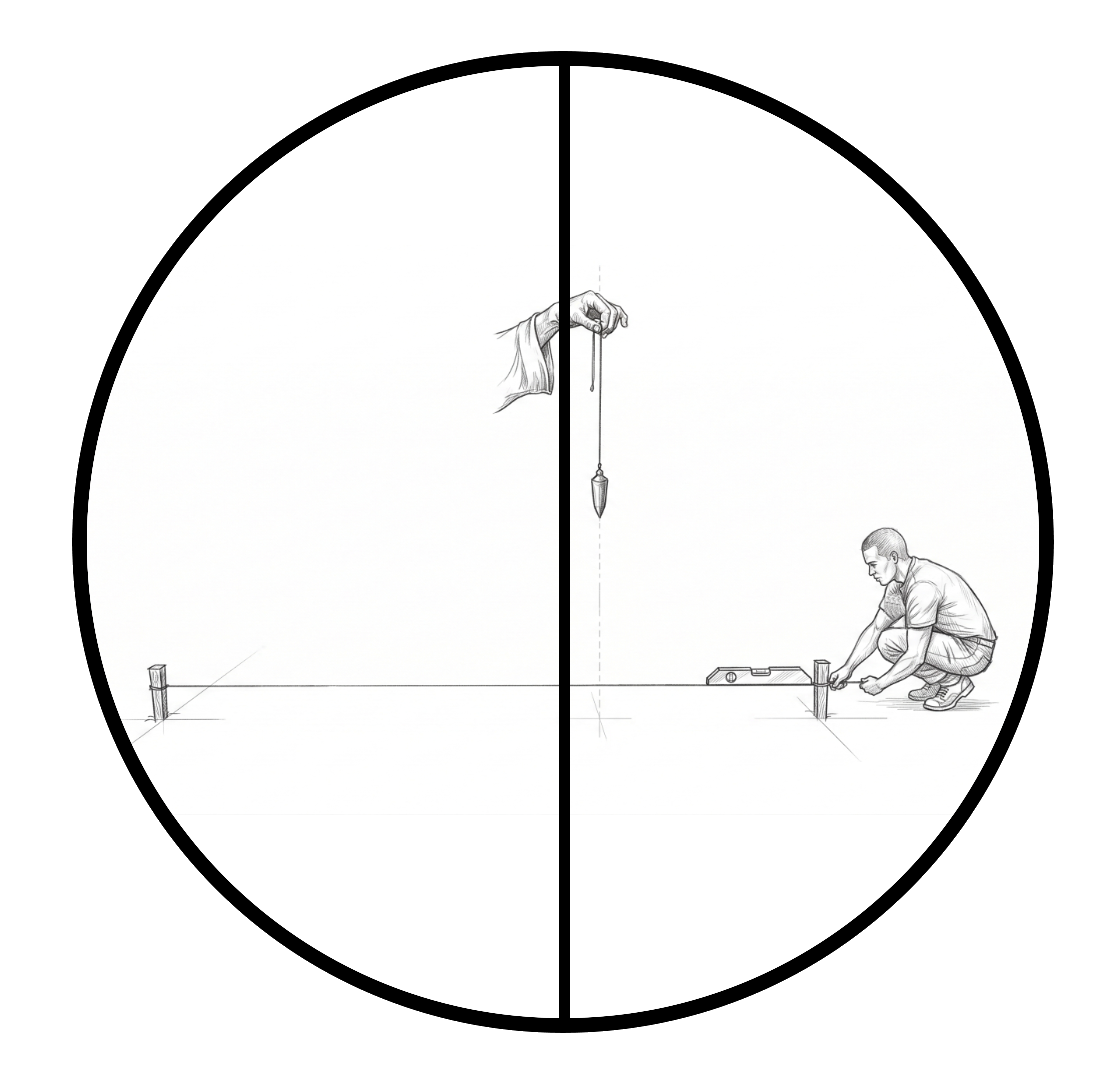
Tohu and Bohu – Divided against Herself, she cannot stand.
It was heard, “take up your cross”, but it is written, “Lift up the stake of yourself“. Pronominals can drastically alter the reading of a text depending on the bias. What matters is the bias/context and the true one determines the context. The Man (the word) must be stood upright.
Judged One and Just One
The line measures the shadow as flat or “lying down” and reveals it for what it is: uneven, unreal. (Gen. 8:13). The plumb stone on the other hand measures straight up and down—plumb. When the two are contrasted with each other, the difference can be seen:
And I have placed a judged-one for a line, and a just-one for a level; and the hail has swept away the refuge of lies, and the double-waters are washing away the hiding place.
Isaiah 28:17 RBT
She is Destined to Become the Lioness of God
This descriptive feminine pairing pattern shows up elsewhere, referring to the same Darkened Shadow Woman along with her Higher Empty Self being pressed together, to become Ariel, the Lioness of God:
And I have compressed/straitened the Lioness of God. And Taniah and Aniah [mourning one and lamenting one] have become. And she has become for myself as the Lioness of God.
Isaiah 29:2 RBT
Taniah and Aniah are nouns given in the feminine. They reveal two women that are both mourning, lamenting. Taniah mourns in a house of misery. Aniah, presumably, mourns for being childless, barren (empty). But they will be pressed together into one, chronos will be no more (Rev.10:6), and there will be no more mourning, nor sorrow.