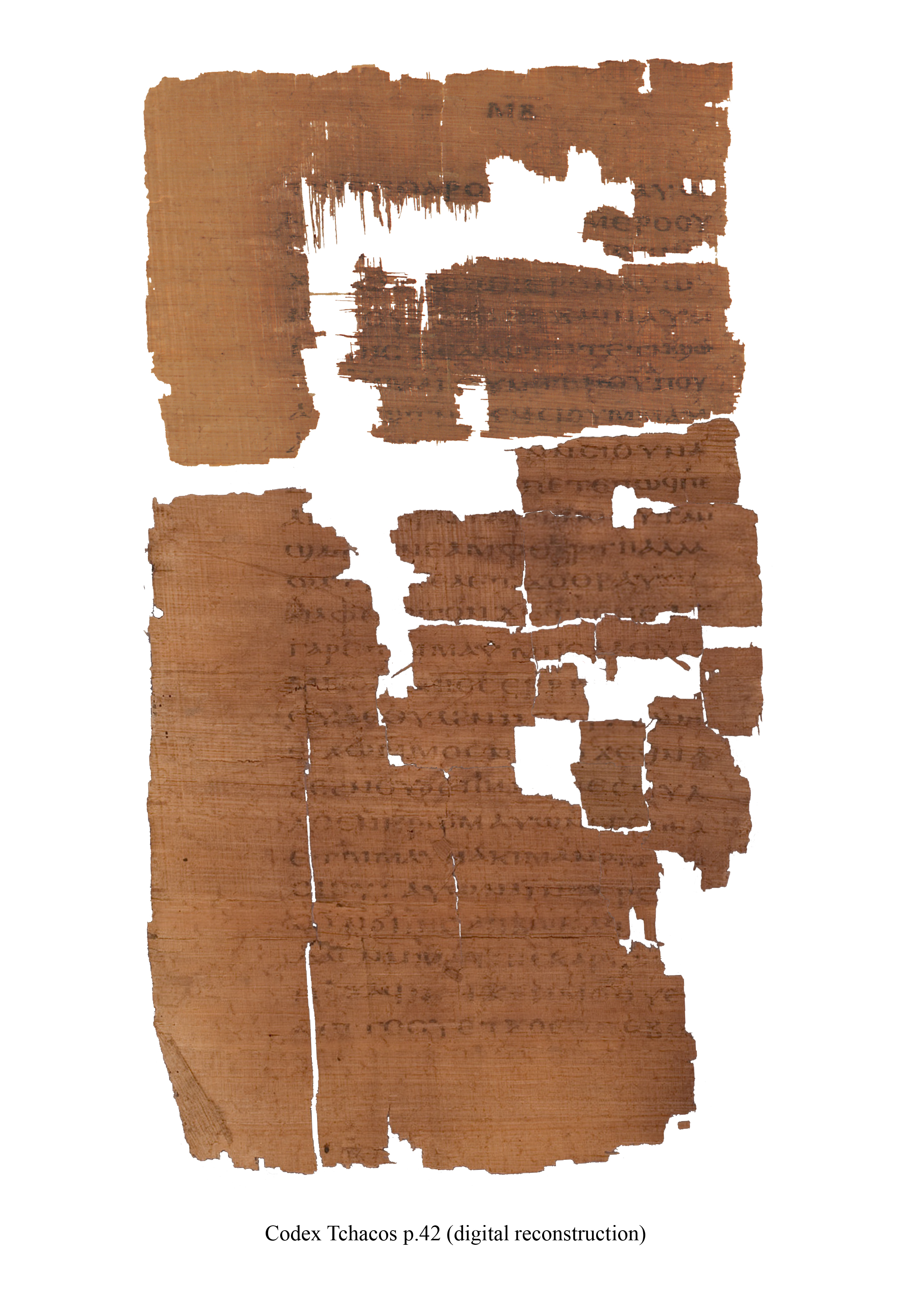
Codex 33
The Logos Ratio of the Decision of the Secret which Salvation uttered in a dialogue in company with Confessor Man of the Cities (“Judas Iscariot”) within eight days before he made the Pass Over. Upon the earthly one, he made signs and mega wonders into a salvation of the Humanity. And some truly kept walking in the Road of the Just One; others kept walking within the Deviation; and they were summoned as the Twelve Learners.
He began to utter to themselves about the Mysteries of the Order and what will come out. And many times he did not appear out (manifest) to the Learners of Self, but rather he was found within themselves as a human, at another time as a child.
Codex 34
Scene 1: He Laughs at the God of this Order/World, Sitting in Darkness
He was born within the Confessor (“the Judean”); he found them as those who are sitting down, those who assembled, those who are exercising reverence toward a god. When he [came] toward the Learners [seeing they were] giving thanks/eucharist over the Bread Loaf, [he] laughed.
And the Learners [of self] they said [to self]: The Teacher (“the Rabbi”), why are [you] laughing at the Eucharist of ourselves? That which we made is that which is proper. He answered [them] saying: I am not laughing at yourselves. You are not making this within the Will of yourselves, but rather within this [ they will] bless the God of yourselves.
They said [to him]: The Teacher, [you] are the son of our God. Salvation said to them: You do not recognize myself! Trustworthy One (“Amen”) I am speaking to yourselves that no generation [of these] humans who are within [you] will recognize myself!
Codex 35
[When they] heard [these things, namely his] Learners [they became] violently irritated; and [to be] provoked to anger, and to blaspheme [against him] [within] the Heart of themselves.
And when Salvation saw themselves, that they were not holding [knowledge]. He said to themselves: What is stirring you up into wrath? The God of yourselves who is within yourselves, and [your stars], and he, self is the one who has provoked you to rage within your soul-lives. Let the Mighty One within you lead out the Perfect Human from within you, and stand before the Face of myself! And they all said that: We are holding the Power.
But the Spirit of themselves did not have the courage to stand in front of self, except Confessor Man of Cities (“Judas Iscariot”). He, self, only was strong enough to stand in front of self, but he was not strong enough to look at self with the Eyes of self, and he reversed the Face of self. The Confessor said to self: “I, myself know what your essence is and of your coming, your coming out, where you come out from—the immortal aeon of God in Four (“Barbelo”). And the one who sent you, I, myself am not counterbalancing to speak the Name of self.
When he perceived that Confessor was pondering on something lofty, Salvation said to him, “Depart away from the others and I will tell you the mysteries of the Queen. For it is possible for you to come to this place, but you will be pained greatly.
Codex 36
For another will replace you, so that the two-and-ten [learners] may be completed backwards in company with the God of themselves.”
Confessor said to self, “When will you tell me these things, and [when] will the Mega Day of light rise to the Generation?” But as soon as he said this, the Salvation came out straight through self.
When he was born on the Day beyond these things, Salvation appeared/manifested to the Learners backwards. They said to self: Teacher, where did you go and what did you do when you went out from ourselves? He said to themselves: I went to another mega and holy generation. The Learners of self said to self: Master, what is the Mega Holy Generation, that Mightier One of ourselves and holier one of ourselves, that is not within these aeons/eternal ones? When Salvation heard, he laughed and said to themselves: Why are you pondering within the Hearts of yourselves around the Mega Holy Generation?
Codex 37
Trustworthy One, I am speaking to yourselves that every begetting of this Aeon/Eternal One, that they not see that generation there, neither will any army of angels of the stars have power over that Generation, nor can any human mortal associate with that one!
When the Learners of self heard these things, they were stirred in the Spirit of themselves; spirit; not one of them found a way to speak because of what did not come toward self and on a day — Salvation — they said to self that “Teacher, we saw yourself within a vision for we saw a mega thing within the Night of the Past.” He said, “Because of what […] did you, yourselves not separate?”
Codex 38
They, themselves said that “We saw a mega home in which (there is) a mega place of sacrifice, within self and twelve, of men —we would say, because they are priests and a name, but a multitude is persisting obstinately upon a place of sacrifice, the Place of Sacrifice, that one, until the coming out of the Priests and bringing of the Worship Service. And we, ourselves kept persisting obstinately.”
And the Salvation said, What are they, themselves the Priests like? And they, themselves said, “Some truly [fast for] two periods of seven, but others sacrifice the Children of themselves, others, the Women of themselves, blessing, and while in a state of degradation/humiliation to one another, others lying down in company with men; others are committing murder; yet others commit a multitude of misses and lawless deeds. And the Men who stand over the Place of Sacrifice invoke/call upon the Name of yourself.
Codex 39
And being involved in all the deeds of their slaughter, they fill up those sacrifices.”
Seed vs Seed, Stars vs. Sand, Generation of a Generation
And when they had said these things, they put down their mouths, being stirred. He said to themselves—the Salvation that “Why were you stirred? Trustworthy One I am speaking to yourselves that all the Priests, the ones who stand over that Place of Sacrifice invoking the Name of myself—and I am speaking backwards to yourselves—that the Name of myself has been written/drawn upon this […] of the Generations of the Stars straight through the Generations of the Humans. [ ] And they planted trees without fruit within the Name of myself, and in a shameful manner!”
The Hammer Drops: You are of THEM
The Salvation said to themselves, “You, yourselves are of those who are bringing the Worship Service upon the Place of Sacrifice which you have seen! That is the God you serve in worship, and the Twelve Men you have seen is yourselves! And the Livestock they are bringing in for sacrifice that you have seen—that is the Multitude which you cause to wander!”

Codex 40
…self upon that Place of Sacrifice, that one.
For he will stand up [the ruler of this] Order, and this is the way they will treat the Name of myself, and they will persist obstinately to self—the Generations of the Pious/Revering. Beyond this, another human will place beside the Fornicators, and another will place beside the Murderers of children, and another those who lie down in company with men, and those who fast; and the remainder of impurity and lawlessness and wandering.
And those who are saying,”We are equal to angels“—they are the Stars that bring all to perfection. For it has been said to the Generations of the Humans: “Behold, the God has accepted the Sacrifice of yourselves from the Hands of a priest”—that is, the Agent of the Wandering. But the Master who is laying down commands, this one who is the Good One, over the Whole: “Within the uttermost days, they will be put to shame.”
Codex 41
Weaving In Front of You
the Salvation said [to themselves], “Throw to yourselves/stop sacrificing!……which you have [offered] upon the Place of Sacrifice, for they are above the Stars of yourselves and the Angels, having already been perfected there! Let them be woven in front of yourselves, and let them go!
…the inhabited world…. …the consummation/end… …all the missers…. ..in the midst of the generations…
…Trustworthy One I am saying…
[…]
[…the] generations.”
“…A baker is not able to thicken/congeal the Foundation.”
Codex 42
Bring Under: “The Star Stood Above the Place Where the Child Was”
…its entirety, the underside of [the Heavenly One].
And…he said to them: …and……to us, and…
he said to them—the Salvation that—”Stop contending in company with myself! Each and every one of yourselves is holding his own star, and everyone…”
…[I was not sent to] the Perishable Generation but to the Incorruptible/Imperishable Generation, and […] because no enemy lords it over that Generation, nor any star.
Trustworthy One, I am speaking that the Post of Fire will fall down quickly, and that Generation will not be rocked to and fro under the Stars!
And when the Salvation [said these things, he] departed, [having] taken close beside Confessor (“Judas”) [in company with his own self].
Codex 43
in the […] that he did not come to […] the streams of the tree of […]
[…] of this Aeon […]
[…] but rather he came to water the enclosed paradise of God, and the Race that will endure, because he will not defile the [Waters of] that generation, but rather […] from Eternal (aion) One and into the Eternal (aion) One.
Confessor (“Judas”) said to self, “Abounding One of Myself (“Rabbi”), what kind of fruit does she, herself possess, the Generation?”
The Salvation said, “Every generation of humans, the Soul-Lives of themselves will die away. But these [people]—when they perfect the Opportune Time of the Queen, and the Spirit separates away from them, the Bodies of themselves on the one hand, will die away, but on the other, the Soul-Lives of themselves will be brought to life/animated, and they will take up themselves upward.” Confessor (“Judas”) said, “What then will the Remaining Ones of the human generations make?” Said the Salvation, “It is impossible…
Codex 44
…to sow upon a rock cliff and yield the Fruit of themselves. This is also the way of the […] of the Race [that is defiled] and the Perishable Sophia (Wisdom), and the Hand which formed human mortals, so that the Soul-Lives of themselves might mount up into the Upper Aeons.
Trustworthy One, I am speaking to yourselves, that […] no […] angel [nor] power will be able to see those
[…] these whom…the Holy Generation [will see?].
And when the Salvation said these things, he departed. Confessor (“Judas”) said, “Teacher, just as you have heard all of them, hear also myself! For I saw a mega sight!”
And the Salvation, when he heard this, he laughed and said to self, “Why do you train naked, Omega (Ω) thirteenth divine being/god? But rather speak, and I will hold up yourself.”
I Saw Myself in a Visible Sight
Confessor (“Judas”) said to self that, I saw my own self in a sight, and the twelve learners were stoning myself, they…
Codex 45
… ran [after me…] and I came backwards into the Place where […] after you. I saw [a home…] and the Eyes of myself were not able [comprehend self]. And mega humans were encircling self, and it was holding a roof of green shoots, that home. And in the middle of the Home [was a] throng […]
[…] saying that,”Teacher, take me in also in company with these humans.”
You Must be Birthed From Above
The Salvation separated and said, “The Star of yourself has led you to wander, Omega (Ω) Confessor (“Judas”)! And no mortal human from birth is counterbalancing to enter into the Home which you saw, for that place is kept for the Holy Ones. The place where neither sun nor moon will lord over, nor day, but rather they will stand always within the Aeon/Eternal One with the Holy Angels. Behold, I have told you the mysteries of the Queen!”
Codex 46
And I have taught yourself around the Error/Wandering of the Stars, and […] […] over the Twelve Aeons/Eternal ones.”
The Confessor (“Judas”) said, “Teacher, could it be that my own seed is ever put in subjection to the Princes?”
Salvation separated and said to self, “Come here, that I may [teach] you about […]
[…] but you will grieve very much when you behold the Queen and the Generation of self.”
When he heard these things, the Confessor (“Judas”) said to self, “What is the gain that I have taken hold of, since you have separated myself away from that Generation?” The Salvation separated and said, ‘You will be the Thirteenth, and you will be accursed under the Remaining Generations, and you will make a beginning/take the lead over themselves. Within the Uttermost Days [they will do it to you] and you will not climb up on high above
Codex 47
the Holy Generation.”
The Eye has not Beheld
Salvation said, “Come here, so that I may teach yourself around the [secrets that no] human has ever seen. For there exists a mega and infinite aeon, whose measure no generation of angels has seen, [within which] there is a mega invisible [spirit], which no eye of an angel has ever beheld, no conception of a heart has comprehended, and it was never summoned by any name. And a bright luminous cloud appeared there. And he said, ‘Let an angel be born into a comrade of myself.’ And there came out from the Cloud a great angel, the Self-Generated God of Light. Because of self, four other angels were born from another cloud, and they became comrades to the Self-Generated Angel.
Codex 48
And the Self-Generated [said], ‘Let[…] be born,’ and he was born[…]
And he [made] the First Luminary to rule over self. And he said, ‘Let there be born angels to serve[self].’ And there were born myriads without number. And he said, Let a luminous aeon/eternal one be born,’ and he was born.
To Rule over Self
He set up the Second Luminary to rule over self, together with myriads of innumerable angels to serve/minister. And in this way he made the Remaining of the Aeons of Light, and he made themselves to rule over self, and he created for themselves myriads of innumerable angels into a ministry of themselves. And there was the Unconquerable (“Adamas”) within the First Cloud of Light, which no angel has ever beheld within all those called Gods.’ And he
Codex 49
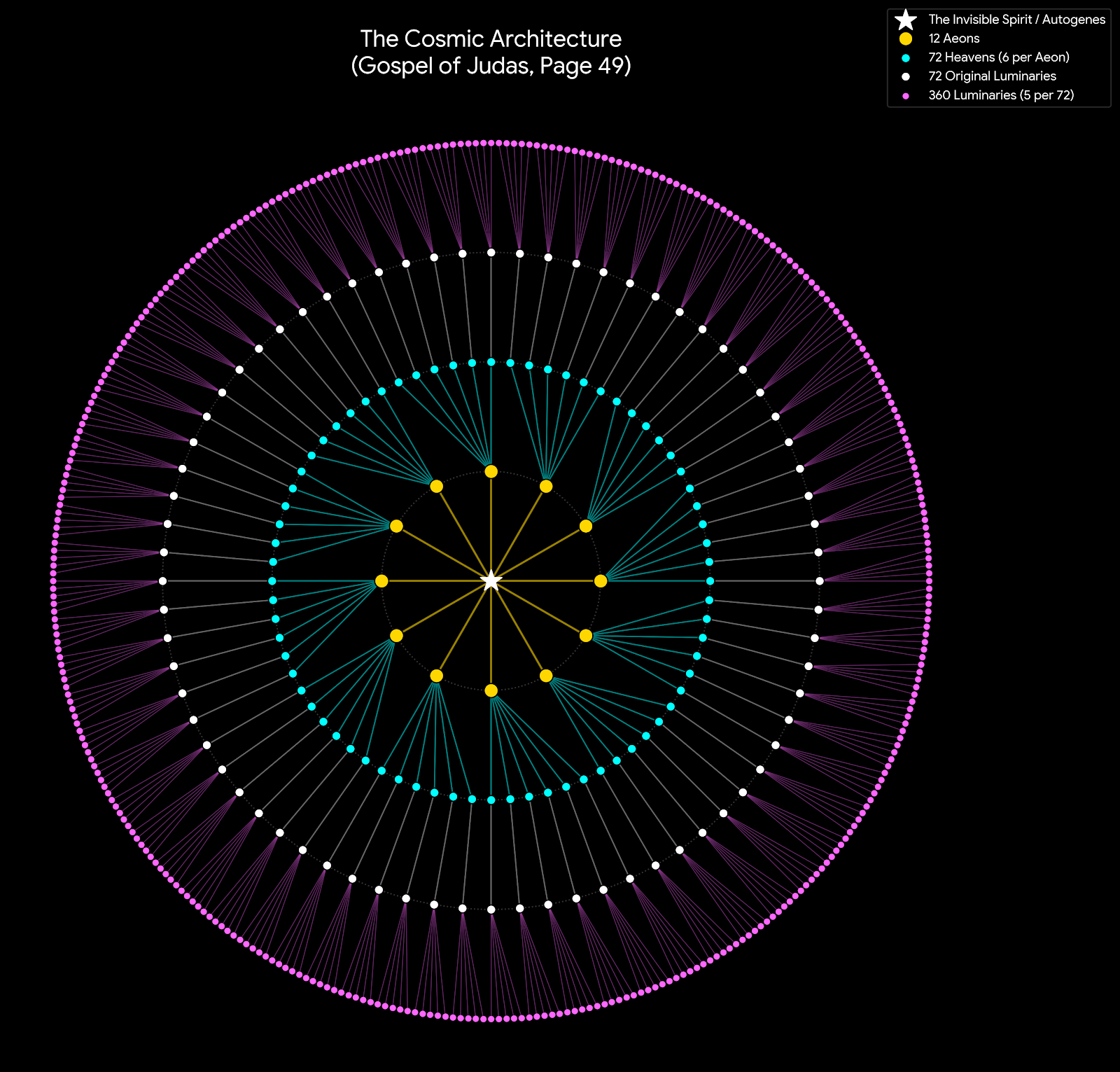
And [into] that […] the image […] and according to the likeness of the angel. He revealed the incorruptible [generation] of Replacement (“Seth”) […] to the Twelve […] the Twenty-Four […] He revealed seventy-two luminaries within the incorruptible generation, within the will of the Spirit. And the seventy-two luminaries they, themselves revealed three hundred and sixty luminaries in the incorruptible generation, in the will of the Spirit, so that the Number of themselves is five into each one. And the Father of themselves is the Twelve Aeons of the twelve luminaries. And for every aeon, six heavenly ones, so that there were born seventy-two heavenly ones for the seventy-two luminaries, and for each one…
-
The Center Star: This represents the starting point of the emanation—the Invisible Spirit and the Autogenes (the Self-Generated) who begins the creation process.
-
Ring 1 (Gold): The 12 Aeons. At the center of the structure, we have the 12 primary realms (aeons).
-
Ring 2 (Cyan): The 72 Heavenly Ones. Just as the text specifies on lines 21-23 (“for every aeon, six heavens”), you can see 6 faint blue lines branching out from every single gold Aeon, resulting in the 72 Heavenly Ones.
-
Ring 3 (White): The 72 Original Luminaries. These are the primary celestial light-givers that correspond structurally to the heavenly ones.
-
Ring 4 (Pink): The 360 Luminaries. The outermost rim of this cosmic grid. As the text states on lines 16-17 (“their number should be five for each”), you can see 5 pink lines branching out from every single white Luminary. This creates the grand total of 360 entities (represented by the Greek numeral ⲧⲝ̅), perfectly mirroring the 360 degrees of a circle and the days in the ancient Egyptian calendar year.
Codex 50
… [of them five] beaten expanses [each], [so that there become] three hundred sixty [beaten expanses…] they gave [them an] authority and a mega army of angels un-numbered, for a glory and a worship serv[ice…] and virgins also of the Spirit, for a glory and a worship service of all the aeons and the heavenly ones and the Beaten Expanses of themselves.
The First Divine Prototype Human
And the Multitude of those immortals there, they are called an order‘—that is, a perdition/ruin‘—by the Father and the seventy-two luminaries that are with self, of the Self-Generated and the Seventy-Two aeons of self, within whom manifested the First Human with the Incorruptible Mighty Ones of self. And the Aeon that manifested with the Generation of self, within whom is the Cloud of the Knowledge and the Angel who is called
Codex 51
… God is Goddess [Eleleth]
and [… ae]on [… with]
After these things, [he] said, ‘Let there be born twelve angels [to rule] over the Chaos and the Underworld (“Hades”). And behold! there manifested from the Cloud an angel of whom the Face beamed forth with fire and the Form of self was stained with blood, holding a name, Fawn (“Nebro”), which is interpreted as ‘Deserter/Runaway;’ but others [call him] Child of Empty Ones (“Yaldabaoth”).
And another angel came forth from the Cloud, Fool (“Saklas”). Fawn (“Nebro”) therefore created six angels and Fool (“Saklas”) into a pompous display. And these begat twelve angels within the Heavenly Ones, and each one took hold of a portion within the Heavenly Ones. And the Twelve Rulers (archons) in company with the Twelve Angels said, “Let each one of yourselves …
Codex 52
[…]
[…] angel.
The first [is] Replacement (“Seth”), the one who is summoned the Anointed One (“Christos”).
The second is Doomed Ones (“Harmathoth”), whois […].
The third is Circuit (“Galila”).
The fourth is Horn Blast (“Yobel”).
The fifth is Inner Master (“Adonaios”).
These are the five who ruled over the Underworld, and first over Chaos. Then said the Fool (“Saklas”) to the angels of self, ‘Let us make a human according to the Resemblance and according to the Image.’
She who is called in the Cloud ⲍⲱⲏ (zōē): Greek for “Life”
And they moulded/conditioned the Human (“Adam”) and the Woman of self, Life (“Eve”), she who is summoned in the Cloud as Zoe-Life (Life). For within this Name all the Generations seek after self, and each one of themselves summons herself by these Names. But the Fool (“Sakla”) did not.
Codex 53
command […] excep[t …] the gener[ation …]this […]
And the [Ruler] said to self, “The Zoe-Life will be for you for a chronological time, in company with the children of yourself.” …
Then Confessor said to the Salvation, [“What] is the advantage/gain that [a ] human will live?’ Salvation said, “Why are you marveling that a human/Adam and the Generation of himself took hold of the chronological time of himself in the Position where he took hold of the Queen of self in company with the Ruler within herself?”
Confessor said to the Salvation, “So does the Spirit of the Human die away?”
The Salvation said to self, “This is the way it is: the God commanded Who is Like God (“Micha-el”) to give the Spirits to the Humans into a loan, so that they might minister. But the Mega One commanded Warrior of God (“Gabri-el”) to give the Spirits to the Mega Generation, the King-less One,—the Spirit and the Soul-Life. Therefore, the Remnant of the Soul Lives …
Codex 54
[…] light […] around […][ the] Spirit within yourselves…
to colonize within this Flesh, within the Generations of angels.
But the God caused the Knowledge to be given to the Human (“Adam”) and those in company with self, so that the Kings of the Chaos and the Underworld might not lord it over/master themselves—”
Confessor said to the Salvation, “What then will those Generations be?”
Jesus said, “Trustworthy One I am speaking to yourselves, the Stars bring to completion upon all of these things. And when he completes the Chronological Times marked out by boundary to self—namely the Fool (“Saklas”)—the First Star will manifest in company with the Generations, and they will complete what they spoke. At that time they will prostitute within the Name of myself and they will kill off the Children of themselves.
Codex 55
And… / And… / …
… in the Name of myself and the Star of yourself will rule over the Thirteenth Aeon.”
And beyond this the Salvation laughed.
You are the one Laughing
[Confessor] said, “Abounding One of myself (“Rabbi”) [why are you laughing at me?] He separated, the Salvation, [and said], “I am not laughing at yourself, but rather at the wandering of the Stars, because these Six Stars wander in company with these Five Warriors, and all of themselves will be destroyed away along with the Foundation of themselves.”
And Confessor said to the Salvation, ‘Behold, what will those who have been plunged make within the Name of yourself?”
The Salvation said, ‘Trustworthy One, I am speaking to [yourself], this plunging…
Codex 56
[which they have taken hold of my name…]
[… will destroy the whole generation of] the earthly Human/Adam.
The Tomorrow, they will touchstone-torture [the one who] habitually bears myself. In truth I am speaking to yourself, Confessor, that those who bring up a sacrifice to the Fool (“Sakla”) […] god […] […] every harmful/pain-ridden work. But you, yourself will become greater than all of themselves. For you will sacrifice self, the Human who habitually bears myself. Already the Horn of yourself has been raised high, and the Wrath of yourself has been kindled, and the Star of yourself has advanced forward, and the Heart of yourself, she has prevailed!”
Codex 57
In truth I am speaking to yourself that the Thrones have [been overcome/gone down], the Kings have grown weak/sick, the angelic generations have mourned, and the harmful evil which they [sowed] is [laid waste], [and] the Commander is wiped out. Then the Fruit of the Mega Generation will be exalted of the Human/Adam, because prior to the Heavenly One and the Earthly One and the angels, that Generation pre-existed from the Aeons/Eternal Ones. Behold, I have told yourself all things! Lift up your eyes and look at the Cloud and the Daylight! Within herself and the Stars encircling herself
Following the Star
The Star that leads the way is the Star of yourself!” And [Confessor] lifted up his eyes [and he saw, and] he went into herself. Those standing below, they heard a voice coming out of the Cloud, she who speaking—
Codex 58
[…this is my son in whom I am well delighted… ?]
[…] the mega [generation…]
[the Salvation] And the Confessor (“Judas”) did not see self any longer.
Immediately there was a disturbance within [the] Confessors (“Judeans”), more than […]
The Arch Priests grumbled because he went into the Lodging/Inn to offer prayers. But there were some scholars watching self carefully within a bait/cunning trickery, in order to lay hands on/ catch him within the Prayer. For they were afraid of the People, since he was regarded by all of themselves as a prophet. And they came forward to the Confessor (“Judas”) and they said to self, What are you making here? You are the Learner of the Salvation.”
And he separated to themselves according to the Desire of themselves. And they gave self money, and the Confessor (“Judas”) handed self over to themselves.
The Gospel of Confessor (“Judas”).
Notes
The story of the Gospel of Judas is one of the messiest, most frustrating sagas in modern manuscript discovery, involving a parade of looters, shady dealers, incompetent or greedy middlemen, and plenty of sensationalism on the publication end. National Geographic in 2006 treated the whole thing like a blockbuster event: dramatic TV special, glossy book, huge press rollout with the headline-grabbing tagline “The Gospel of Judas: The Lost Gospel That Changes Everything.”
In retrospect, guess what? It changed nothing (other than filling pockets).
An ironic thing about Irenaeus’ condemnation of the text is that these Gnostic groups (whoever they were) were honoring what were supposed to be the “villains” of Scripture (Cain, Esau, Judas, etc.) and this is strikingly reminiscent of a certain story of certain men “turning the world upside down.” Turning things upside down or flipping things over seems to be a recurring theme in Biblical narratives. At any rate, for Irenaeus (born ca. 130–140 CE) this is the ultimate blasphemy: it turned the entire traditional received narrative of salvation upside down and made the enemies of God into the heroes. The traditional narrative being the chronos based one:
“They produce (producerunt) a fictitious history of this kind, which they style the Gospel of Judas.”
The verb producerunt is in the present tense—he is saying these people now, in his own time, are circulating this new text. Throughout Book 3 of Against Heresies, one of Irenaeus’s main criterion for accepting a gospel is when it was written and by whom. He insists the true Gospels are the four canonical ones because they come from the apostles or their direct associates (Mark → Peter, Luke → Paul, etc.) and were publicly known and used by the churches from “the beginning”:
“four Gospels, no more, no fewer.”
He repeatedly contrasts this with the Gnostic texts: “These men…have recently (nuper) invented…” (3.4.3) “Valentinus…came to Rome…and there he invented his own heresy” (3.4.3) The Gnostic writings are always described as late, private revelations given to a teacher in the 2nd century, not public apostolic documents from the 1st century. So by this time period there was already a widespread understanding of the Gospels as a chronos-based corpus bound to specific calendar dates and historical individuals. The funny thing about this is that authority over these matters rested not on having correct interpretations but what the chronos-based origins were. At the time the Book of Revelation was still heavily debated as a valid text and, obviously, not unveiled to them:
“It is clear, therefore, that there are four Gospels—and neither more nor fewer. For there are four zones of the world in which we live, and four principal winds (quattuor principales spiritus/catholici spiritus), and the Church has been scattered over the whole earth, and the Gospel is the pillar and ground of the Church and the breath of life. Consequently it is fitting that she have four pillars, breathing incorruption on every side and kindling life afresh in men. From this it is evident that the Word, the Architect of all things, who sits upon the cherubim and holds all things together, when He was made manifest to men, gave us the Gospel in four forms, though held together by one Spirit. …As also in the Apocalypse of John there are four living creatures… For such are the forms of the living creatures, such also is the character of the Gospel.”
(Adversus Haereses 3.11.8)
Irenaeus points to the use of the number four in other places, and notably in Revelation. The four living creatures represent the four Gospels, therefore it is fitting!
Clap, clap. Well done. Now what?
The vernacular used is so lofty that I’m more confused than I was before I read it.
By modern standards, Irenaeus’ “clear” evidence is a textbook example of affirming the consequent mixed with symbolic numerology that has zero probative force. That reasoning is circular and non-falsifiable. You could just as easily say:
There are seven planets visible to the naked eye → God loves the number seven → we should have seven Gospels (and indeed some later groups floated exactly that idea with added apocrypha).
Or:
There are twelve tribes and twelve apostles → we should have twelve Gospels.
Maybe there are seven gospels? Maybe there are twelve? Case in point, these are “the authoritative men.” These, the revered Church Fathers, were not working out any kind of math or logic for themselves. In the 2nd and 3rd centuries, the Church Fathers who shaped the emerging “catholic” mainstream were not doing anything like modern critical scholarship, systematic logic, or philosophy of evidence in our sense. Their toolkit was basically two things: moral and theological coherence (a.k.a. does it uphold the tradition of the elders?) and historical-chronological continuity (a.k.a. can bishops show an unbroken line of succession?).
Case in point, the early Church Fathers (and the mainstream tradition ever since) were almost exclusively backward-looking. In all of their pomp and circumstance and fine clothing, they exhibited not a lick of understanding of what the cryptic texts were actually saying. They did not show the world that they heard, but only that they were obedient to the traditions. Their entire hermeneutic was built on preservation, repetition, harmonization, and moral application of a fixed, inherited deposit. They were not, by temperament or method, explorers of the unknown or solvers of cryptic riddles for their own sake.
What they did brilliantly:
- Trace lines of teachers and texts back to “the holy apostles”
- Defend a traditional narrative (creation, incarnation, crucifixion, resurrection)
- Extract moral, liturgical, and doctrinal lessons which no one really liked in the long run
- Police boundaries so the core story stayed intact and anyone countering was deemed “of Satan.”
What they almost never did:
- Admit that large parts of the New Testament (especially the sayings tradition and Revelation) are genuinely cryptic, polyvalent, or resistant to final decoding
- Treat obscurity as an invitation to open-ended inquiry
- Allow that some texts might be deliberately aporetic or esoteric in a way that points beyond the public apostolic tradition
Instead, whenever they hit something genuinely difficult or paradoxical (a hard saying of Jesus, the timing contradictions between Gospels, the wild imagery of Revelation), the standard moves were:
- Harmonize (force the texts to agree)
- Allegorize (turn the opaque into a moral or spiritual lesson)
- Defer (“the full meaning will be revealed at the end of time”)
- Silence (just don’t talk about the problematic bit too much)
- Idiom (just make it say something that it doesn’t really say)
So indeed to this day, huge swaths of the New Testament remain genuinely cryptic, and this same “authoritative historical apostolic institution” now fragmented into innumerable contradictions, disagreements, and breeds of god-knows-what. The Gnostics were like a different Christian Breed/Sect carrying different texts, but they were not mainstream. The texts they held were obviously much more cryptic (a.k.a. secret knowledge). How backward-looking were they? It is hard to tell, because they disappeared by the 5th century, wiped out by the mainstream proto-orthodox and later orthodox institutions with the texts also disappearing for the next 1700 years. The Gnostics could very well have been a bunch of weirdos or frauds, as they were often described, since the Gnostic texts seem to be some of the weirdest. But enigmatic weirdness is part of the game and even at the core of it. Everyone knows the Book of Revelation is as weird as it gets and even today those who try to become connoisseurs of it make themselves look more like people you want to distance yourself from than not.

The Church Fathers could very well have been weirdos and frauds too. To this day, no one gets too close to them. They are kept at arms-length, read only in a historical context for historical reinforcement as needed. It is no different than how modern Mormons don’t get too close to the Bible “translation” of Joseph Smith, their revered leader, but instead keep the King James Bible as the official version. By now all of the Church Father’s theological persuasions have been turned inside out ad-infinitum. Most theologians today admit that much of what they believed was way off, unintelligible, or even ridiculous. But since it was the public mainstream, it is OK, because they were only human. In other words, God is on the side that wins the game (which, by the way, is not yet over).
Modern historical-critical scholars, mystics, or esoteric readers often find those very passages the most pregnant with meaning precisely because they resist closure. The patristic tradition, by contrast, was deeply uncomfortable with permanent ambiguity inside the public, apostolic deposit. They needed something that could be “passed on” or “handed down” as it were. Their whole project depended on the claim that the essential content was clear, public, and handed down continuously from the beginning.
They built an immensely durable institution on the conviction that everything necessary was already understood (or understandable) within the tradition they inherited. They rarely, if ever, looked at the cryptic elements and said, “Here is something that outstrips our tradition and might demand that we change or expand it.” If they did, things just became too murky. The writings of the Church Fathers don’t circulate among “the Church” today. Who’s Origin? Who’s Tertullian? Who’s Augustine? No one cares about them except the religious history buff. They are not very useful or reliable for their interpretations anymore. It has been two thousand years since the idea of “the four gospels → four living creatures.” Has anyone yet a clue about what in the world that means? Nope.
That backward-looking posture is exactly why the Gnostic stream (for all its speculative excesses) sometimes feels strangely modern: it treated the cryptic as a doorway, not a problem to be managed or explained away. The mainstream church slammed that door shut, put cages and whipping pillories on the front lawns, and in most respects has kept it shut for two millennia.
The cryptic is still there, though. It never went away. It just waits.
Gospel of Judas Interlinear
| Coptic Text (Codex Tchacos) | Reconstructed Koine Greek (scholarly consensus) | Literal English | Notes & Key Greek Loans |
| Codex Page 33 | |||
| ⲡⲗⲟⲅⲟⲥ ⲛ̅ⲁⲡⲟⲫⲁⲥⲓⲥ | Ὁ λόγος τῆς ἀποφάσεως | The Logos Ratio of the Decision | Loan: logos (Logos) Loan: apophasis (Decision/Judgment) |
| ⲉⲧϩⲏⲡ ⲉⲛⲧⲁ ⲓ̅ⲥ̅ ϣⲁϫⲉ | τῆς κρυφῆς ἣν ἐλάλησεν Ἰησοῦς | of the Secret which Salvation uttered | IS is the Nomen Sacrum for Jesus |
| ⲉϩⲣⲁⲓ̈ ϩⲛ̅ ⲟⲩⲙⲛ̅ⲧϣⲁϫⲉ | ἐν διαλόγῳ | in a dialogue | Lit: “in a speaking-together,” a conversation |
| ⲙⲛ̅ ⲓⲟⲩⲇⲁⲥ ⲡⲓⲥⲕⲁⲣⲓⲱⲧⲏⲥ | μετὰ Ἰούδα τοῦ Ἰσκαριώτου | in company with Confessor the Man of Cities | Loan: Ioudas Loan: Iskariōtēs |
| ⲛ̅ϩⲙⲟⲩⲛ ⲛ̅ϩⲟⲟⲩ | ἐν ὀκτὼ ἡμερῶν | within eight days | Text damaged: […]ΜΟΥΗ (eight/week) |
| ⲙ̅ⲡⲁⲧⲉϥⲣ̅ ⲡⲁⲥⲭⲁ | πρὶν ἢ ποιῆσαι τὸ Πάσχα. | before he made the Pass Over. | Loan: Pascha (Passover) |
| ⲛ̅ⲧⲁⲣⲉϥⲟⲩⲱⲛϩ̅ ⲉⲃⲟⲗ | Ὅτε δὲ ἐφανερώθη | When he appeared [out] | ouōnḥ ebol: to reveal/manifest |
| ϩⲓϫⲙ̅ ⲡⲕⲁϩ ⲁϥⲉⲓⲣⲉ | ἐπὶ τῆς γῆς, ἐποίει | upon the earthly one | Coptic ⲉⲓⲣⲉ is also to do/make |
| ⲛ̅ϩⲁⲛⲙⲁⲉⲓⲛ ⲙⲛ̅ ϩⲁⲛⲛⲟϭ | σημεῖα καὶ μεγάλα | signs and mega | maein: sign/miracle |
| ⲛ̅ϣⲡⲏⲣⲉ ⲉⲡⲉⲩϫⲁⲓ | τέρατα εἰς σωτηρίαν | wonders into a salvation | Loan: spēre (wonders/miracles) |
| ⲛ̅ⲧⲙⲛ̅ⲧⲣⲱⲙⲉ : | τῆς ἀνθρωπότητος. | of the Humanity. | mnt-rōme: “mankind-ness, humanity, human nature” |
| ⲁⲩⲱ ϩⲁⲛⲕⲟⲟⲩⲉ ⲙⲉⲛ | Καὶ τινὲς μὲν | And some indeed | Loan: men (Greek particle “on one hand”). 13 |
| ⲉⲩⲙⲟⲟϣⲉ ϩⲛ̅ ⲧⲉϩⲓⲏ | ἐπορεύοντο ἐν τῇ ὁδῷ | were walking in the Road | |
| ⲛ̅ⲧⲇⲓⲕⲁⲓⲟⲥⲩⲛⲏ : | τῆς δικαιοσύνης, | of the Just One; | Loan: dikaiosynē – the Justice |
| ϩⲁⲛⲕⲟⲟⲩⲉ ⲉⲩⲙⲟⲟϣⲉ | ἄλλοι δὲ ἐπορεύοντο | others were walking | |
| ϩⲛ̅ ⲧⲉⲡⲁⲣⲁⲃⲁⲥⲓⲥ : | ἐν τῇ παραβάσει. | within the Deviation; | Loan: parabasis |
| ⲁⲩⲙⲟⲩⲧⲉ ⲇⲉ | Ἐκλήθησαν δὲ | and they were called out as | Loan: de (but/and) |
| ⲉⲡⲙⲛ̅ⲧⲥⲛⲟⲟⲩⲥ ⲙ̅ⲙⲁⲑⲏⲧⲏⲥ | οἱ δώδεκα μαθηταί. | the Two-and-Ten Learners. | Loan: mathētēs. |
| ⲁϥⲁⲣⲭⲉⲓ ⲛ̅ϣⲁϫⲉ ⲛ̅ⲙ̅ⲙⲁⲩ | Ἤρξατο λαλεῖν αὐτοῖς | He began to utter to themselves | Loan: archei (to begin/start) |
| ⲉⲙ̅ⲙⲩⲥⲧⲏⲣⲓⲟⲛ ⲉⲧⲁⲓⲥⲱⲧ | περὶ τῶν μυστηρίων | about the Mysteries … | Loan: mystērion |
| ⲛ̅ⲡⲕⲟⲥⲙⲟⲥ ⲁⲩⲱ ⲛⲉⲧⲛⲁϣⲱⲡⲉ ⲉⲃⲟⲗ | τοῦ κόσμου καὶ τῶν μελλόντων γενέσθαι. | of the Order and what will come out. | Loan: kosmos. ⲛⲉⲧ Relative Pronoun (Plural)”those which,” or “things which” ⲛⲁ Future Auxiliary Marker”will” ϣⲱⲡⲉ Verb root”to be,” “to become,” or “to happen” ⲉⲃⲟⲗ Adverb / Particle”out,” “forth,” or “manifest” |
| ⲟⲩϩⲣⲡ ⲇⲉ ⲛ̅ⲥⲟⲡ | Πολλάκις δὲ | and often/many times | ḥrp is Coptic for “many/often”. |
| ⲙ̅ⲡⲉϥⲟⲩⲟⲛϩ ⲉⲃⲟⲗ | οὐκ ἐφανερώθη | he did not appear out (manifest) | |
| ⲉⲛⲉϥⲙⲁⲑⲏⲧⲏⲥ ⲁⲗⲗⲁ | τοῖς μαθηταῖς αὐτοῦ, ἀλλὰ | to the Learners of Self, but rather | Loan: mathētēs (Disciples). Loan: alla (but). |
| ⲁϥϩⲉ ⲉⲣⲟⲟⲩ ϩⲛ̅ ⲟⲩⲣⲱⲙⲉ | εὑρέθη ἐν αὐτοῖς ὡς ἄνθρωπος | he was found within themselves as a human. | |
| ⲛ̅ⲕⲟⲟⲩⲉ ϩⲛ̅ ⲟⲩϣⲏⲣⲉ | ἄλλοτε ὡς παιδίον. | at another time as a child. | shēre is Coptic for “child/son.” |
| Codex Page 34 | |||
| Gospel of Judas Scene 1 | |||
| ⲁϥϣⲱⲡⲉ ϩⲛ̅ ⲓⲟⲩⲇⲁⲓⲁ | ἐγένετο ἐν τῇ Ἰουδαίᾳ | He was born within the Confessor “the Judean” | Loan: Ioudaia (Judean) |
| ⲁϥϩⲉ ⲉⲣⲟⲟⲩ ⲉⲩϩⲙⲟⲟⲥ | εὗρεν αὐτοὺς καθημένους | he found them those who are seated down | |
| ⲉⲩⲥⲟⲟⲩϩ ⲉⲩⲣ̅ ⲅⲩⲙⲛⲁⲍⲉ | συνηγμένους καὶ γυμνάζοντας | those who assembled, those who are exercising | Loan: gymnaze (train/exercise/practice). |
| ⲛ̅ⲧⲙⲛ̅ⲧⲛⲟⲩⲧⲉ | τὴν εὐσέβειαν. | reverence toward a god | mnt-noute: reverence toward a god (Piety). The word is not in respect to any particular god. |
| ⲛ̅ⲧⲉⲣⲉϥ[ ] ⲉⲛⲉϥⲙⲁⲑⲏⲧⲏⲥ | Ὅτε [ἦλθε] πρὸς τοὺς μαθητὰς | When he [came] toward the Learners | |
| [ ] ⲉⲩⲉⲩⲭⲁⲣⲓⲥⲧⲓ | εὐχαριστοῦντας | [seeing they were] giving thanks/eucharist | Loan: eucharistein (Eucharist). |
| ⲉϫⲛ̅ ⲡⲁⲣⲧⲟⲥ [ⲁϥ]ⲥⲱⲃⲉ | ἐπὶ τοῦ ἄρτου, ἐγέλασεν. | over the Bread Loaf, [he] laughed. | Loan: artos (Bread). sōbe: to laugh. |
| ⲛ̅ⲛⲉϥⲙⲁⲑⲏⲧⲏⲥ [ ] | Οἱ δὲ μαθηταὶ [αὐτοῦ] | And the Learners [of Him/self] | |
| ⲡⲉϫⲁⲩ [ⲛⲁϥ ϫⲉ] ⲡⲥⲁϩ | εἶπον αὐτῷ· Διδάσκαλε, | they said [to self]: The Teacher, | sah: Scribe/Teacher (Rabbi). hsah: the Teacher |
| ⲉⲧⲃⲉ ⲟⲩ [ⲕ]ⲥⲱⲃⲉ | διά τί γελᾷς | why are [you] laughing | |
| ⲛ̅ⲧⲉⲛ[ⲉⲩ]ⲭⲁⲣⲓⲥⲧⲓⲁ | ἐπὶ τῇ εὐχαριστίᾳ ἡμῶν; | at the Eucharist of ourselves? | Loan: eucharistia. |
| ⲡⲉⲛⲧⲁⲛⲣ̅ ⲟⲩ ⲡ[ⲉ] | Ὃ ἐποιήσαμεν | That which we made | |
| ⲡⲉⲧⲉϣϣⲉ [ ] | πρέπον ἐστίν. | it is that which is proper. | |
| ⲁϥⲟⲩⲱϣⲃ̅ [ⲛⲁⲩ] | Ἀπεκρίθη [αὐτοῖς] | He answered [them] | |
| ϫⲉ [ⲛ]ϯⲥⲱⲃⲉ ⲁⲛ | λέγων· Οὐ γελῶ | saying: I am not laughing | |
| ⲉϩⲣⲁⲓ̈ ⲉϫⲛ̅ ⲧⲏⲩⲧⲛ̅ | ἐφ’ ὑμῖν, | at yourselves. | |
| [ⲛ]ⲧⲉⲧⲛ̅ⲉⲓⲣⲉ ⲙ̅ⲡⲁⲉⲓ ⲁⲛ | Οὐ γὰρ ποιεῖτε τοῦτο | for you are not making this | |
| ϩⲙ̅ [ⲡⲉ]ⲧⲛ̅ⲟⲩⲱϣ | τῷ θελήματι ὑμῶν, | within the Will of yourselves | |
| ⲁⲗⲗⲁ ϩⲙ̅ ⲡⲁⲓ̈ | ἀλλ’ ἐν τούτῳ | but rather in this | Loan: alla (but). |
| [ⲥⲉⲛⲁ]ⲥⲙⲟⲩ ⲉⲡⲉⲧⲛ̅ⲛⲟⲩⲧⲉ | εὐλογηθήσεται ὁ θεὸς ὑμῶν. | [that they will] bless the God of yourselves. | |
| ⲡⲉϫⲁⲩ ⲇⲉ [ⲛⲁϥ] ϫⲉ ⲡⲥⲁϩ | Εἶπον δὲ αὐτῷ· Διδάσκαλε, | They said [to him]: The Teacher, | sah: Scribe/Teacher (Rabbi). |
| [ⲛ̅ⲧⲟⲕ] ⲡⲉ ⲡϣⲏⲣⲉ ⲙ̅ⲡⲉⲛⲛⲟⲩⲧⲉ | σὺ εἶ ὁ υἱὸς τοῦ θεοῦ ἡμῶν. | [you] are the son of our God. | |
| [ⲡⲉϫⲁ]ϥ ⲛⲁⲩ ⲛ̅ϭⲓ ⲓ̅ⲥ̅ | Εἶπεν αὐτοῖς ὁ Ἰησοῦς· | Salvation said to them: | |
| [ϫⲉ ⲛ̅ⲧⲉⲧ]ⲛ̅ⲥⲟⲟⲩⲛ ⲙ̅ⲙⲟⲓ ⲁⲛ | Οὐ γινώσκετέ με. | [that] you do not recognize myself. | |
| [ϩⲁⲙⲏ]ⲛ ϯϫⲱ ⲙ̅ⲙⲟⲥ ⲛⲏⲧⲛ̅ | Ἀμὴν λέγω ὑμῖν | Trustworthy One I am speaking to yourselves | Loan: hamēn (Amen). |
| ϫⲉ ⲙⲛ̅ ⲅⲉⲛⲉⲁ | ὅτι οὐδεμία γενεὰ | that no generation | Loan: genea (generation). |
| [ⲛ̅ⲧⲉ ⲛⲉⲓ]ⲣⲱⲙⲉ ⲉⲧⲛⲏϩⲏⲧ | τῶν ἀνθρώπων ἐν ὑμῖν | [of these] humans who are within [you] | |
| ⲛⲁⲥⲟⲩⲱⲛⲧ [ⲛ̅ⲧⲉⲣⲟⲩ] | γνώσεταί με. Ὅτε δὲ | will recognize myself. [When they] | |
| Codex Page 35 | |||
| ⲥⲱⲧⲙ̅ [ⲉⲛⲁⲓ ⲛ̅ϭⲓ ⲛⲉϥ] | ἤκουσαν ταῦτα οἱ | heard [these things, namely his] | |
| ⲙⲁⲑⲏⲧⲏⲥ [ⲁⲩⲁⲣⲭⲉⲓ] | μαθηταὶ, ἤρξαντο | Learners [began] | Loan: mathētēs / archein (restored). |
| ⲛⲁⲅⲁⲛⲁⲕⲧⲉⲓ : ⲁⲩⲱ [ⲉⲣ̅] | ἀγανακτεῖν καὶ | to be violently irritated; and [to be] | Loan: aganaktein (to be violently irrated/ferment like wine). |
| ⲟⲣⲅⲏ ⲁⲩⲱ ⲉϫⲓⲟⲩⲁ [ⲉⲣⲟϥ] | ὀργίζεσθαι καὶ βλασφημεῖν | provoked to anger, and to blaspheme [against him] | Loan: orgē (Wrath/Anger). |
| [ϩⲛ̅] ⲡⲉⲩϩⲏⲧ | ἐν τῇ καρδίᾳ αὐτῶν. | [in] the Heart of themselves | |
| ⲁⲩⲱ ⲉⲧⲁ ϥⲛⲁⲩ ⲉⲣⲟⲟⲩ ⲛϭⲓ ⲓ︦ⲥ︦ ϫⲉ ⲟⲩⲛⲧⲁⲩ ⲁⲛ ⲙ̄ⲙⲁⲩ ⲛ̄ⲟⲩ [ⲥⲟⲟⲩⲛ] | Καὶ ἰδὼν αὐτοὺς ὁ Ἰησοῦς ὅτι οὐκ ἔχουσιν γνῶσιν | And when the Jesus/the Salvation saw themselves, that they were not holding [knowledge]. |
Loan: [ⲥⲟⲟⲩⲛ] (knowledge, from gnōsis). |
| ⲡⲉϫⲁϥ ⲛⲁⲩ ϫⲉ ⲟⲩ ⲡⲉⲧⲁϥⲧⲣⲉⲧⲏⲩⲧⲛ̄ ⲉⲓ ⲉⲃⲟⲗ ϩⲛ̄ ⲧⲉⲓⲙⲓⲛⲉ ⲙ̄ⲡⲟⲩⲁ | εἶπεν αὐτοῖς Τί ὑμᾶς ταράσσει εἰς ὀργήν; | He said to themselves: What is stirring you up into wrath? | |
| ⲡⲉⲧⲛ̄ⲡⲟⲩⲧⲉ ⲉⲧϩⲏⲧⲧⲏⲩⲧⲛ̄ ⲁⲩⲱ […] ⲁⲩⲱ ⲛ̄ⲧⲟϥ ⲡⲉⲧⲁϥⲧⲣⲉⲧⲏⲩⲧⲛ̄ ⲕⲱⲧⲉ ⲉⲣⲟⲉⲓ ⲛ̄ϩⲏⲧ ⲛ̄ⲧⲉⲧⲛ̄ⲯⲩⲭⲏ |
ὁ θεὸς ὑμῶν ὁ ἐντὸς ὑμῶν καὶ [αὐτὸς] παρώργισεν ὑμᾶς ἐν ταῖς ψυχαῖς ὑμῶν |
The God of yourselves who is within yourselves, and [your stars], and he, him/self is the one who has provoked you to rage within your soul-lives. |
The subject of the second clause is the same ⲡⲉⲧⲛ̄ⲡⲟⲩⲧⲉ (“your god”). ⲛ̄ⲧⲟϥ ⲡⲉⲧⲁϥⲧⲣⲉⲧⲏⲩⲧⲛ̄ ⲕⲱⲧⲉ is Loan: ⲯⲩⲭⲏ (soul, from psychē). |
| [ⲙⲁ]ⲣⲉ ⲡⲟⲩⲁ ⲡⲟⲩⲁ ⲛ̄ⲧⲉⲧⲛ̄ⲧⲁⲩⲟ ⲉⲃⲟⲗ ⲛ̄ϩⲏⲧⲧⲏⲩⲧⲛ̄ ⲛ̄ⲣⲱⲙⲉ ⲉⲧϫⲟⲟⲣ ⲉⲓⲛⲉ ⲛ̄ⲡⲣⲱⲙⲉ ⲉⲧϫⲏⲕ ⲉⲃⲟⲗ ⲉⲁϩⲉⲣⲁⲧϥ ϩⲓⲧⲟⲟⲧ ⲛ̄ⲧⲁⲙⲡⲁϩⲁⲩ |
ὁ ἰσχυρὸς ἐν ὑμῖν ἐξαγαγέτω τὸν τέλειον ἄνθρωπον καὶ στήτω κατενώπιον τοῦ προσώπου μου |
Let the Mighty One within you lead out from within you the Perfect Human, and stand before the Face of myself. |
there is no protasis (no “if” clause) in the Coptic text of 57,3–4. The Coptic is a direct imperative challenge with no conditional “if” at all. Loan: ⲙⲡⲁϩⲁⲩ (face/presence, from prosōpon). |
| ⲛ̄ⲧⲟⲟⲩ ⲇⲉ ⲁⲩϫⲟⲟⲥ ⲧⲏⲣⲟⲩ ϫⲉ ⲟⲩⲟⲛⲧⲁⲛ ⲙ̄ⲙⲁⲩ ⲛ̄ⲧϭⲟⲙ | Οἱ δὲ πάντες εἶπον ὅτι Ἔχομεν τὴν δύναμιν. | And they all said that: We are holding the Power. | |
| ⲡⲉⲩⲡ︦ⲛ︦ⲁ︦ ⲇⲉ ⲙ̄ⲡⲟⲩ ⲧⲟⲗⲙⲁ ⲁⲛ ⲉⲁϩⲉⲣⲁⲧⲟⲩ ⲛ̄ⲙ̄ⲙⲁϥ ⲛ̄ⲥⲁ ⲓ̈ⲟⲩⲇⲁⲥ ⲡⲓⲥⲕⲁⲣⲓⲱⲧⲏⲥ | Τὸ δὲ πνεῦμα αὐτῶν οὐκ ἐτόλμησεν στῆναι ἔμπροσθεν αὐτοῦ πλὴν Ἰούδας ὁ Ἰσκαριώτης. |
But the Spirit of themselves did not have the courage to stand in front of him/self, except Confessor Man of Cities (“Judas Iscariot”). |
Loan:ⲡ︦ⲛ︦ⲁ︦ (pneuma), ⲧⲟⲗⲙⲁ is Greek τολμάω “dare, be brave enough”), ⲓ̈ⲟⲩⲇⲁⲥ (Ioudas), ⲡⲓⲥⲕⲁⲣⲓⲱⲧⲏⲥ (Iskariōtēs). |
| ⲛ̄ⲧⲟϥ ⲟⲩⲁⲁϥ ⲁϥϭⲙ̄ϭⲟⲙ ⲉⲁϩⲉⲣⲁⲧϥ ⲛ̄ⲙ̄ⲙⲁϥ ⲙ̄ⲡϥ̄ϭⲙ̄ϭⲟⲙ ⲇⲉ ⲉϭⲱϣⲧ ⲉⲣⲟϥ ⲉⲛⲉϥⲃⲁⲗ ⲁϥⲕⲧⲉ ⲡⲉϥϩⲟ ⲉⲃⲟⲗ |
Αὐτὸς μόνος ἠδυνήθη στῆναι ἔμπροσθεν αὐτοῦ, οὐκ ἠδυνήθη δὲ βλέψαι αὐτῷ ἐν τοῖς ὀφθαλμοῖς, καὶ ἀπέστρεψεν τὸ πρόσωπον αὐτοῦ. |
He, him/self only was strong enough to stand in front of him/self, but he was not strong enough to look at him/self with the Eyes of self, and he reversed the Face of him/self. |
|
|
ⲡⲉϫⲉ ⲓ̈ⲟⲩⲇⲁⲥ ⲛⲁϥ ϫⲉ ⲁⲛⲟⲕ ⲟⲩⲛ̄ⲧⲁⲓ ⲥⲟⲟⲩⲛ ⲉⲧⲉⲕⲟⲩⲥⲓⲁ ⲁⲩⲱ ⲉⲧⲉⲕⲉⲓ ⲛ̄ⲧⲉⲕⲉⲓ ⲉⲃⲟⲗ |
Ἐγὼ οἶδα τίς ἐστιν ἡ οὐσία σου καὶ τίς ἐστιν ἡ ἔλευσίς σου, ἡ ἔξοδός σου. |
Confessor said to self: “I, myself know what your essence is and of your coming, your coming out. |
ⲁⲛⲟⲕ = I (emphatic) → “I myself”, very similar to Hebrew אנכי “myself” ⲉⲧⲉ- relative particle “what/who”; ⲕⲟⲩⲥⲓⲁ = Greek loan οὐσία “essence/substance/being,” a |
| ⲧⲱⲛ ⲉⲧⲉⲕⲉⲓ ⲉⲃⲟⲗ ϩⲛ̄ ⲧ̄ⲙⲛ̄ⲧⲁⲧⲙⲟⲩ ⲛ̄ⲃⲁⲣⲃⲏⲗⲱ |
πόθεν ἐξῆλθες: ἐκ τοῦ ἀθανάτου αἰῶνος Βαρβηλοῦ |
where you come out from—the immortal aeon of God in Four (“Barbelo”) | Loan: ⲃⲁⲣⲃⲏⲗⲱ (Barbelo). First Thought / Divine Mother / Eternal Womb / Life-giver / Fourfold / source of the Pleroma (fullness) Most probable construction בַּרְבֵּל (bar-bēl) or בַּרְבְּלוֹ
|
| ⲁⲩⲱ ⲡⲉⲧⲁϥⲧⲁⲛϩⲟⲩⲧ ⲁⲛⲟⲕ ⲁⲛ ⲙ̄ⲡⲁⲣⲡⲁ ⲉϫⲟⲟϥ ⲛ̄ⲧⲉϥⲣⲁⲛ | Καὶ ὁ πέμψας σε, ἐγὼ οὐκ εἰμὶ ἄξιος εἰπεῖν τὸ ὄνομα αὐτοῦ. | And the one who sent you, I, myself am not counterbalancing to speak the Name of him/self. |
emphatic ⲁⲛⲟⲕ = I, Myself
Loan: ⲣⲁⲛ (name). ⲙ̄ⲡⲁⲣⲡⲁ = negated stative of ⲡⲱⲣⲡ/ⲡⲁⲣⲡ “be counterbalancing / be sufficient” (from |
| Gospel of Judas Scene 2 | |||
| ⲛ̄ⲧⲉⲣⲉϥⲛⲁⲩ ⲇⲉ ϫⲉ ⲓ̈ⲟⲩⲇⲁⲥ ⲙⲉⲩⲉ ⲉϩⲉⲛϩⲓⲥⲉ ⲛ̄ⲧⲉ ⲡⲉⲧϩⲏⲡ ⲡⲉϫⲉ ⲓ︦ⲥ︦ ⲛⲁϥ ϫⲉ ⲡⲁⲣⲁⲅⲉ ⲉⲃⲟⲗ ⲙ̄ⲙⲟⲟⲩ ⲁⲩⲱ ⲧⲁϫⲟⲟⲩ ⲛⲁⲕ ⲛ̄ⲛⲙⲩⲥⲧⲏⲣⲓⲟⲛ ⲛ̄ⲧⲙⲛ̄ⲧⲉⲣⲟ |
Ὡς δὲ ᾔσθετο ὅτι ὁ Ἰούδας ἐνθυμεῖταί τι ὑψηλόν, εἶπεν αὐτῷ ὁ Ἰησοῦς· Ἄπελθε ἀπὸ τῶν ἄλλων καὶ ἐγὼ σοι ἐρῶ τὰ μυστήρια τῆς βασιλείας. |
When he perceived that Confessor was pondering on something lofty, Salvation said to him, “Depart away from the others and I will tell you the mysteries of the Reign/Queen.” |
μυστήριον (mysterion) → ⲙⲩⲥⲧⲏⲣⲓⲟⲛ: direct loan, central Gnostic term. ἐνθυμέομαι → ⲙⲉⲩⲉ: “ponder, reflect deeply”ⲛ̄ⲧⲙⲛ̄ⲧⲉⲣⲟ “reign” territory ruled by a king or queen. |
| ⲟⲩⲛ̄ϭⲟⲙ ⲅⲁⲣ ⲛⲁⲕ ⲉⲉⲓ ⲉⲡⲉⲓⲙⲁ ⲁⲗⲗⲁ ⲧⲉⲕⲛⲁⲗⲩⲡⲉⲓ ⲉⲙⲁⲧⲉ | ἔστιν γὰρ σοι δυνατὸν ἐλθεῖν ἐκεῖ, ἀλλὰ λυπηθήσῃ λίαν. |
“For it is possible for you to come to this place, but you will be pained greatly.” |
λυπέομαι → ⲗⲩⲡⲉⲓ: “grieve, be in pain” in mind or body |
| Codex Page 36 | |||
| ⲟⲩⲁ ⲅⲁⲣ ⲛ̄ⲧⲉ ⲕⲉⲟⲩⲁ ⲕⲁⲁⲕ ⲉⲃⲟⲗ ϩⲛ̄ ⲧⲉⲕⲙⲁ ϩⲓⲛⲁ ⲛ̄ⲧⲉ ⲡⲓⲍ̄ ⲙ̄ⲙⲁⲑⲏⲧⲏⲥ ϣⲱⲡⲉ ⲟⲛ ⲉⲩϫⲏⲕ ⲉⲃⲟⲗ ⲙ̄ⲛ̄ ⲡⲉⲩⲛⲟⲩⲧⲉ |
ἕτερος γάρ τις ἀντὶ σοῦ ἑστήξει, ἵνα οἱ δώδεκα [μαθηταὶ] πάλιν συμπληρωθῶσιν μετὰ τοῦ θεοῦ αὐτῶν. |
“For another will replace you, so that the two-and-ten [learners] may be completed backwards in company with the God of themselves.” |
συμπληρόω → ϣⲱⲡⲉ ⲉⲃⲟⲗ ϫⲏⲕ: “be completed, fulfilled”
πάλιν – again/backwards |
| ⲡⲉϫⲉ ⲓ̈ⲟⲩⲇⲁⲥ ⲛⲁϥ ϫⲉ ⲁϫⲛ̄ ⲟⲩ ⲧⲉⲛⲟⲩ ⲧⲉⲕⲛⲁϫⲟⲟⲩ ⲛⲁⲓ ⲁⲩⲱ ⲡⲉϩⲟⲟⲩ ⲛ̄ⲧⲉ ⲡⲟⲩⲟⲉⲓⲛ ⲡⲁⲓ ⲉⲧⲟⲩⲏⲩ ⲉϫⲱ ⲡⲉ ⲡⲉⲛⲉϩ ⲁϥⲃⲱⲕ ⲉⲃⲟⲗ ϩⲓⲧⲟⲟⲧϥ̄ ⲛ̄ϭⲓ ⲓ︦ⲥ︦ |
Εἶπεν δὲ αὐτῷ Ἰούδας· Πότε ταῦτά μοι ἐρεῖς, καὶ [πότε] ἡ μεγάλη ἡμέρα τοῦ φωτὸς ἀνατελεῖ τῇ γενεᾷ; ἅμα δὲ ταῦτα εἶπεν, ἐξῆλθεν δι’ αὐτοῦ ὁ Ἰησοῦς. |
Confessor said to self, “When will you tell me these things, and [when] will the Mega Day of light rise to the Generation?” And at the same time as he said this, the Salvation came out straight through self. |
γενεά (genea) → ⲡⲉⲛⲉϩ: “generation, race” (here the spiritual race of Seth) φῶς → ⲟⲩⲟⲉⲓⲛ: “light”
The verb ἐξῆλθεν (exēlthen) is the standard The phrase ϩⲓⲧⲟⲟⲧϥ̄ (hitootf) in Coptic is highly context sensitive and means: |
| ⲛ̄ⲧⲉⲣⲉϥϣⲱⲡⲉ ⲇⲉ ⲛ̄ⲧⲉϩⲟⲟⲩ ⲙ̄ⲙⲛⲛⲥⲁ ⲛⲁⲓ ⲁϥⲟⲩⲱⲛϩ ⲉⲃⲟⲗ ⲛ̄ϭⲓ ⲓ︦ⲥ︦ ⲛ̄ⲛⲉϥⲙⲁⲑⲏⲧⲏⲥ ⲟⲛ |
Ὅτε δὲ ἐγένετο τῇ ἡμέρᾳ μετὰ ταῦτα, ἐφανερώθη ὁ Ἰησοῦς τοῖς μαθηταῖς αὐτοῦ πάλιν |
When he was born on the Day beyond these things, Salvation appeared/manifested to his Learners backwards |
Transition to next morning; collective reappearance |
| ⲡⲉϫⲁⲩ ⲛⲁϥ ϫⲉ ⲡⲥⲁϩ ⲉⲕⲃⲱⲕ ⲉⲧⲱⲛ ⲁⲩⲱ ⲉⲕⲣ ⲟⲩ ⲛ̄ⲧⲉⲣⲉⲕⲃⲱⲕ ⲉⲃⲟⲗ ⲛ̄ⲧⲟⲟⲧⲛ̅ | εἶπον αὐτῷ· Διδάσκαλε, ποῦ ἀπῆλθες καὶ τί ἐποίησας ὅτε ἀπῆλθες ἀφ’ ἡμῶν; |
they said to self: Teacher, where did you go and what did you do when you went out from ourselves? |
Loan: sah (teacher). |
| ⲡⲉϫⲁϥ ⲛⲁⲩ ϫⲉ ⲁⲓ̈ⲃⲱⲕ ⲉⲩⲕⲉⲛⲟϭ ⲛ̄ⲅⲉⲛⲉⲁ ⲉⲧⲟⲩⲁⲁⲃ | εἶπεν αὐτοῖς· Ἀπῆλθον εἰς ἄλλην μεγάλην καὶ ἁγίαν γενεάν | He said to themselves: I went to another mega and holy generation | Loan: genea (generation). |
| ⲡⲉϫⲁⲩ ⲛⲁϥ ⲛ̄ϭⲓ ⲛⲉϥⲙⲁⲑⲏⲧⲏⲥ ϫⲉ ⲡϫⲟⲉⲓⲥ ⲟⲩ ⲧⲉ ⲧⲛⲟϭ ⲛⲅⲉⲛⲉⲁ ⲉⲧⲟⲩⲁⲁⲃ ⲉⲧⲥⲟⲧⲡ̅ ⲉⲣⲟⲛ ⲁⲩⲱ ⲉⲧⲟⲩⲁⲁⲃ ⲉⲣⲟⲛ ⲉⲧⲉ ⲙⲛ̅ⲧⲥ̅ ϩⲛ̅ ⲛⲉⲓⲁⲓⲱⲛ |
εἶπον αὐτῷ οἱ μαθηταὶ αὐτοῦ· Κύριε, τίς ἐστιν ἡ μεγάλη γενεὰ ἡ ἁγία ἡ κρείττων ἡμῶν καὶ ἁγία ἡμῶν ἥτις οὐκ ἔστιν ἐν τούτοις τοῖς αἰῶσιν; |
the Learners of self said to self: Master, what is the Mega Holy Generation, that Mightier One of ourselves and holier one of ourselves, that is not within these aeons? |
Loan: aiōn (aeons/realms). |
| ⲛ̄ⲧⲉⲣⲉϥⲥⲱⲧⲙ̅ ⲇⲉ ⲛ̄ϭⲓ ⲓ︦ⲥ︦ ⲁϥⲥⲱⲃⲉ ⲡⲉϫⲁϥ ⲛⲁⲩ ϫⲉ ⲉⲧⲃⲉ ⲟⲩ ⲉⲧⲉⲧⲛⲙⲉⲩⲉ ϩⲛ̅ ⲛⲉⲧⲛ̅ϩⲏⲧ ⲉⲧⲃⲉ ⲧⲛⲟϭ ⲛⲅⲉⲛⲉⲁ ⲉⲧⲟⲩⲁⲁⲃ |
Ὅτε δὲ ἤκουσεν ὁ Ἰησοῦς, ἐγέλασεν καὶ εἶπεν αὐτοῖς· Διὰ τί ἐνθυμεῖσθε ἐν ταῖς καρδίαις ὑμῶν περὶ τῆς μεγάλης γενεᾶς τῆς ἁγίας; |
When Salvation heard, he laughed and said to themselves: Why are you pondering within the Hearts of yourselves around the Mega Holy Generation? |
Laughter + heart-thinking motif. |
| Codex Page 37 | |||
| (37,1) ϩⲁⲙⲏⲛ ϫⲱ ⲙⲙⲟⲥ ⲛⲏⲧⲚ ϫⲉ | ἀμήν λέγω, λέγειν ὑμῖν ὅτι / ἵνα | amen/truly I am speaking to yourselves that/because | Loan: hamēn (Amen). |
| (37,2) ϫⲡⲟ ⲛⲓⲙ Ⲛⲧⲉ ⲡⲉⲉⲓⲁⲓⲱⲛ Ⲛⲥⲉ | γεννᾶν πᾶς ἐστίν τοῦτον τὸν αἰῶνα (3pl neg. conj.) | to beget every/all of is (fem.) this aeon and they (neg.) | Loan: aiōn (age/aeon). |
| (37,3) ⲛⲁⲛⲁⲩ ⲁⲛ ⲉⲧⲅⲉⲛⲉⲁ ⲉⲧⲘⲙⲁⲩ | οὐ (3pl past) οὐ γενεά ἐκεῖνος | of not they (did) not which generation that | Loan: genea (generation). |
| (37,4) ⲟⲩⲇⲉ ⲙⲛ ⲗⲁⲟⲩⲉ ⲛⲥⲧⲣⲁⲧⲓⲁ ⲛⲁⲅ | οὐδέ καί/μετά τις/οὐδείς στρατιά ἄγγ- (cont.) | nor/not even and/with anyone/no one of host/army (angel-) | Loans: strategia, aggelos. |
| (37,5) ⲅⲉⲗⲟⲥ ⲚⲚⲥⲓⲟⲩ ⲛⲁⲢ ⲉⲣⲟ ⲉϫⲚ ⲧⲅⲉ | ἄγγελος (cont.) τῶν ἀστέρων ποιεῖν (fut.) πρός (obj.) ἐν ἡ γεν- (cont.) | (angel) of the stars will do to/at (obj.) in (the gen-) | Loans: aggelos, probably siou (stars). |
| (37,6) ⲛⲉⲁ ⲉⲧⲘⲙⲁⲩ ⲟⲩⲇⲉ ⲙⲚ ⲗⲁⲟⲩⲉ | (-εά) (cont.) ἐκεῖνος οὐδέ καί/μετά τις/οὐδείς | (-eration) that nor/not even and/with anyone/no one | |
| (37,7) ⲛϫⲡⲟ ⲛⲣⲱⲙⲉ ⲛⲑⲛⲏⲧⲟⲥ ⲛⲁϣ | γεννᾶν τῶν ἀνθρώπων θνητοῖς τίς/ποῖος | begetting of the mortal ones of what | Loan: thnētos (mortal). |
| (37,8) ⲉⲓ ⲛⲘⲙⲁⲥ ϫⲉ ⲧⲅⲉⲛⲉⲁ ⲉⲧⲙⲙⲁⲩ | ἔρχεσθαι ὅτι/ἵνα ἡ γενεά ἐκεῖνος | to come of that/because the generation that | |
| (37,9) ⲛⲟⲩ ⲉⲃⲟⲗ ⲁⲛ ⲉ Ⲛ | τί ἐκ οὐ (prep./inf. marker) (genitive/dative) | of what? from/out of not (to/toward) (of/to) | |
| (37,10) ⲧⲁϥϣⲱⲡⲉ ⲥ ⲧⲅⲉ | ἐγένετο -ς ἡ γεν- (cont.) | the he was begotten -s (the gen-) | Loan: broken genea continuation. |
| (37,11) ⲛⲉⲁ ⲛⲛⲣⲱⲙⲉ ⲉⲧⲛϩⲏⲧⲧⲏⲩⲧⲚ | (-εά) (cont.) τῶν ἀνθρώπων ἐν ὑμῖν | (-eration) of men which in you (pl.) | |
| (37,12) ⲟⲩⲉⲃⲟⲗ ϩⲚ ⲧⲅⲉⲛⲉⲁ ⲚⲧⲙⲚⲧ | ἐκ ἐν ἡ γενεά τοῦ/ἐκ καί/μετά | a from/out of in the generation of/from and/with | |
| (37,13) | |||
| (37,14) ϩⲚⲕⲟ} | ⟨approx.⟩ | [ànko}] | Highly uncertain trace only. |
| (37,15) | |||
| (37,16) ⲉⲧⲉⲧⲚⲟ Ⲛⲣⲣⲟ ϩⲣⲁⲉⲓ ⲛϩⲏⲧⲟⲩ | ἣν ὑμεῖς βασιλεύσετε ἐπάνω αὐτῶν. | which you will reign over them | |
| (37,17) ⲚⲧⲉⲣⲟⲩⲥⲱⲧⲘ ⲉⲛⲁⲓ Ⲛϭⲓ ⲛⲉϥⲙⲁⲑⲏⲧⲏⲥ | ὅτε ἤκουσαν ταῦτα (nominative marker) οἱ μαθηταὶ αὐτοῦ | when they heard to these things (subject marker) learners of self | Loan: mathētēs (disciple). |
| (37,18) ⲁⲩϣⲧⲟⲣⲧⲢ ϩⲛ ⲡⲉⲩ | ἐταράχθησαν ἐν αὐτῶν | they were troubled in their (m.) | |
| (37,19) ⲡⲛⲁ ⲟⲩⲁ ⲟⲩⲁ ⲘⲡⲟⲩϭⲚ ⲑⲉ ⲉ | πνεύματι· οὐδεὶς αὐτῶν εὗρεν τρόπον τοῦ | spirit; not one of them found a way to… | Loan: pneuma. |
| (37,20) ϫⲟⲟⲥ ϫⲉ ⲟⲩ ⲁϥⲉⲓ ϣⲁⲣⲟⲟⲩ | εἰπεῖν ὅτι τί ἦλθεν πρὸς αὐτούς | to speak because of what did not come toward self | |
| (37,21) ⲕⲁⲓϩⲟⲟⲩ Ⲛϭⲓ ⲓⲎⲥ ⲡⲉϫⲁⲩ ⲛⲁϥ ϫⲉ | καὶ ἡμέρᾳ Ἰησοῦς εἶπαν αὐτῷ ὅτι | and on a day — Salvation — they said to self that | ⲓⲎⲥ is a nomen sacrum. |
| (37,22) ⲡⲥⲁϩ ⲁⲛⲛⲁⲩ ⲉⲣⲟⲕ‘ ϩⲚ ⲟⲩⲛⲁⲩ | διδάσκαλε εἴδομέν σε ἐν ὁράματι | Teacher, we saw yourself within a vision | |
| (37,23) ⲁⲛⲛⲁⲩ ⲅⲁⲣ ⲉϩⲚⲛⲟϭ Ⲛⲣⲁⲥⲟⲩ | εἴδομεν γὰρ μέγα τι | for we saw a mega thing | |
| (37,24) Ⲛⲧⲉⲓⲟⲩϣⲏ Ⲛⲧⲁⲟⲩⲉⲓⲛ | ἐν τῇ νυκτὶ τῇ παρελθούσῃ | within the Night of the Past. | Definite article noun + perfective adjective |
| (37,25) ⲡⲉϫⲁϥ ϫⲉ ⲉⲧⲃⲉ ⲟⲩ Ⲛⲧⲁ | εἶπεν ὅτι διὰ τί | he said because of what … | |
| (37,26) ⲁⲧⲚϩⲁⲡ‘3 ⲧⲏⲩⲧⲚ | οὐκ ἐκρίνατε ὑμεῖς | … did you yourselves not separate? | ⲧⲏⲩⲧⲛ = emphatic “you” |
| Codex Page 38 | |||
| (38,1) Ⲛⲧⲟⲟⲩ ⲇⲉ ⲡⲉϫⲁⲩ ϫⲉ ⲁⲛⲛⲁⲩ | αὐτοί δὲ εἶπαν ὅτι εἴδομεν | They themselves said that we saw | |
| (38,2) ⲉⲩⲛⲟϭ ⲛⲏⲓ ⲉⲣⲉ ⲟⲩⲛⲟϭ ⲛⲑⲩⲥⲓⲁⲥⲧⲏⲣⲓⲟⲛ | οἶκον μέγαν ἐν ᾧ θυσιαστήριον μέγα |
a mega house in which (there is) a mega place of sacrifice |
Loan: thysiastērion (place of sacrifice). |
| (38,3) ⲚϩⲏⲧϤ ⲁⲩⲱ ⲙⲛⲧⲥⲛⲟⲟⲩⲥ | ἐν αὐτῷ καί δώδεκα | within self and twelve |
ⲚϩⲏⲧϤ – “in” (preposition + pronoun, locative sense) |
| (38,4) Ⲛⲣⲱⲙⲉ ⲉⲛϫⲱ Ⲙⲙⲟⲥ | ἄνδρας — ὡς ἐλέγομεν | of men —we would say, | |
| (38,5) ϫⲉ Ⲛⲟⲩⲏⲏⲃ ⲛⲉ ⲁⲩⲱ ⲟⲩⲣⲁⲛ | ὅτι ἱερεῖς εἰσίν καὶ ὄνομα | because they are priests, and a name | Loan: ran from Greek onoma. |
| (38,6) ⲟⲩⲛ ⲟⲩⲙⲏⲏϣⲉ ⲇⲉ ⲡⲣⲟⲥⲕⲁⲣ | ἔστιν πλῆθος δὲ προσκαρτερεῖ | there is, but a multitude is persisting obstinately | Loan: broken proskarterei continuation. |
| (38,7) ⲧⲉⲣⲉⲓ ⲉⲡⲉⲑⲩⲥⲓⲁⲥⲧⲏⲣⲓ ⲉⲡⲉ | ἐπὶ θυσιαστηρίῳ | upon a place of sacrifice | Loan: broken thysiastēri(on) continuation. |
| (38,8) ⲑⲩⲥⲓⲁⲥⲧⲏⲣⲓⲟⲛ ⲉⲧⲘⲙⲁⲩ | θυσιαστήριον ἐκεῖνος | the Place of Sacrifice, that one, | ⲑⲩⲥⲓⲁⲥⲧⲏⲣⲓⲟⲛ is a loan: θυσιαστήριον. |
| (38,9) ϣⲁⲛⲧⲟⲩ ⲉⲃⲟⲗ ⲛϭⲓ Ⲛⲟⲩⲏⲏⲃ | ἕως ἂν ἐξέλθωσιν οἱ ἱερεῖς | until the coming out of the Priests | |
| (38,10) Ⲛⲥⲉϫⲓ ⲉϩⲟⲩⲛ ⲚⲛϣⲘϣⲉ ⲁⲛⲟⲛ | καὶ εἰσενέγκωσιν τὰς λατρείας. ἡμεῖς | and bringing of the Worship Service. But we | The word ϣⲘϣⲉ (šmše) is central, it was the standard translation for the Greek word latreia (λατρεία)—meaning divine worship, liturgy or ritual service. |
| (38,11) ⲇⲉ ⲛⲉⲛⲡⲣⲟⲥⲕⲁⲣⲧⲉⲣⲓ ⲡⲉ | δὲ προσεκαρτεροῦμεν. | ourselves kept persisting obstinately. | Loan: proskarterei. |
| (38,12) [ⲡⲉϫⲁ]ϥ Ⲛϭⲓ ⲓⲎⲥ ϫⲉ ϩⲚⲁϣ Ⲙⲙⲓ | εἶπεν δὲ ὁ Ἰησοῦς ὅτι· ποταποί | And the Salvation said, What are they, themselves | ⲓⲎⲥ is a nomen sacrum. |
| (38,13) ⲛⲉ ⲛⲉ Ⲛⲟⲩⲏⲏⲃ Ⲛⲧⲟⲟⲩ ⲇⲉ | εἰσίν εἰσίν ἱερεῖς αὐτοί δέ | the priests like? And they, themselves | |
| (38,14) ⲡⲉϫⲁⲩ ϫⲉ ϩⲟⲉⲓⲛⲉ ⲙⲉⲛ ⲉⲩ |
εἶπον ὅτι· οἱ μὲν |
said: Some truly |
|
| (38,15) ϩⲉ}ⲃⲇⲟⲙⲁⲥ ⲥⲚⲧⲉ | ἑβδομάδας δύο, | [fast for] two periods of seven | ϩⲉⲃⲇⲟⲙⲁⲥ (hebdomas): from Greek ἑβδομάς (the number seven). ϩⲉ}ⲃⲇⲟⲙⲁⲥ is not plural but singular “seven” and “fasting” is implied contextually by ascetic practices. |
| (38,16) ϩⲚⲕⲟⲟⲩⲉ ⲇⲉ ⲉⲩⲢ ⲑⲩⲥⲓⲁⲥⲉ Ⲛ | ἄλλοι δὲ θυσιάζουσιν | but others sacrifice | Loan: thysiase (to sacrifice). |
| (38,17) ⲛⲉⲩϣⲏⲣⲉ Ⲙⲙⲓⲛ Ⲙⲙⲟⲟⲩ ϩⲚ | τὰ ἴδια τέκνα, ἕτεροι | the Children of themselves, others | |
| (38,18) ⲕⲟⲟⲩⲉ Ⲛⲛⲉⲩϩⲓⲟⲙⲉ ⲉⲩⲥⲙⲟⲩ | τὰς γυναῖκας αὐτῶν, εὐλογοῦντες | the Women of themselves, blessing | |
| (38,19) ⲁⲩⲱ ⲉⲩⲑⲃⲃⲓⲏⲩ Ⲛⲛⲉⲩⲉⲣⲏⲩ |
καὶ ταπεινούμενοι ἀλλήλοιs |
and while in a state of degradation/humiliation to one another | This phrase—ⲁⲩⲱ ⲉⲩⲑⲃⲃⲓⲏⲩ Ⲛⲛⲉⲩⲉⲣⲏⲩ—from line 38,19 translates to “…and humbling each other” or “…and being in a mutual state of abasement.” ⲑⲃⲃⲓⲏⲩ (thbbiēu): This is the crucial word. It is the qualitative (or stative) form of the verb ⲑⲃⲃⲓⲟ (thbbio), which means “to humble,” “to lower,” or “to degrade.” In Coptic, the qualitative form expresses a continuous state of being rather than a simple action. They aren’t just performing an act of humility; they are actively existing in a state of degradation. |
| (38,20) ϩⲚⲕⲟⲟⲩⲉ ⲉⲩⲚⲕⲟⲧⲕⲉ ⲙⲚ Ⲛϩⲟ- | ἄλλοι κοιμώμενοι μετὰ ἀρ- | others lying down in company with men; | |
| (38,21) -ⲟⲩⲧ ϩⲚⲕⲟⲟⲩⲉ ⲉⲩⲢ ϩⲱⲃ ⲉⲫⲱ- | -ρένων, ἄλλοι πράσσουσιν |
others are committing |
|
| (38,22) -ⲧⲂ ϩⲚⲕⲉⲕⲟⲟⲩⲉ ⲉⲩⲉⲓⲣⲉ ⲛⲟⲩ- | φόνον, ἕτεροι δὲ ποιοῦσιν | murder; yet others commit a | Possible loan: stolē (garment). |
| (38,23) ⲙⲏⲏϣⲉ Ⲛⲛⲟⲃⲉ ϩⲓ ⲁⲛⲟⲙⲓⲁ | πλῆθος ἁμαρτιῶν καὶ ἀνομίαν· | multitude of sins and deeds of lawlessness. | ⲁⲛⲟⲙⲓⲁ is a loan: ἀνομία. |
| (38,24) ⲁⲩⲱ ⲛⲣⲱⲙⲉ ⲉⲧⲱϩⲉ ⲣⲁⲧⲟⲩ | καὶ οἱ ἄνδρες οἱ ἑστῶτες | And the men who stand | |
| (38,25) ⲉϫⲚ ⲡⲉⲑⲩⲥⲓⲁⲥⲧⲏⲣⲓⲟⲛ ⲉⲩⲢ | ἐπὶ τὸ θυσιαστήριον ἐπι- | over the Place of Sacrifice | |
| (38,26) ⲉⲡⲓⲕⲁⲗⲉⲓ ⲉⲡⲉⲕⲣⲁⲛ | -καλοῦνται τὸ ὄνομά σου. | invoke/call upon the Name of yourself | ⲉⲡⲓⲕⲁⲗⲉⲓ (epikalei): from Greek ἐπικαλεῖν (to call upon / invoke). Uses the Coptic auxiliary ⲣ (“do invoke”). |
| Codex Page 39 | |||
| ⲁ̣ⲩⲱ ⲉⲩ[ϩ]ⲛ̄ ⲛ[ⲉ]ϩⲃⲏⲟⲩⲉ ⲧⲏⲣⲟⲩ | καὶ ὄντες ἐν τοῖς ἔργοις πᾶσι | And being involved in all the deeds |
Pure Sahidic. (Note: reconstructed as ⲉⲩ[ϩ]ⲛ “being in” based on visible traces).
|
| ⲙ̄ⲡⲉⲩϣⲱϣⲧ̣ [ⲉ]ϣ[ⲁ]ⲩⲙⲟⲩϩ̄ ⲛ̄ϭⲓ | τῆς σφαγῆς αὐτῶν, ἃ πληροῦσιν | of their slaughter, they fill | |
| ⲛ̣ⲉⲑⲩⲥ[ⲓⲁ . . . . . . ⲉⲧ]ⲙ̄ⲙⲁⲩ : | αἱ θυσίαι ἐκεῖναι. | those sacrifices. |
ⲑⲩⲥ[ⲓⲁ] (thysia): θυσία (sacrifice).
|
| ⲁⲩⲱ ⲛⲁⲓ̈ ⲛ̄ⲧⲉⲣⲟⲩϫ̣ⲟⲟⲩ ⲁ̣[ⲩ]ⲕⲁ | καὶ ταῦτα εἰπόντες, | And when they had said these things, | |
| ⲣⲱⲟⲩ ⲉⲩϣⲧⲣ̄ⲧⲱⲣ : ⲡⲉϫⲁϥ | ἐσίγησαν ταραχθέντες. εἶπεν δὲ | they put down their mouths, being stirred. He said |
ⲕⲁ ⲣⲱⲟⲩ = idiom “put down their mouths” (fell silent).
|
| ⲛⲁⲩ ⲛ̄ϭⲓ ⲓ̄ⲏ̄ⲥ̄ ϫⲉ ⲉⲧⲃⲉ ⲟⲩ ⲁⲧⲉ | αὐτοῖς ὁ Ἰησοῦς ὅτι· τί | to themselves—the Salvation that “Why were |
ⲓ̄ⲏ̄ⲥ̄ (Iēs): Nomen sacrum for Ἰησοῦς (Jesus).
|
| ⲧⲛ̄ϣⲧⲟⲣⲧⲣ̄ : ϩⲁⲙⲏⲛ ϯϫⲱ : | ἐταράχθητε; ἀμὴν λέγω | you troubled? Trustworthy One I am speaking |
ϩⲁⲙⲏⲛ (hamēn): ἀμήν (truly/amen). Hebrew loanword via Greek.
|
| ⲙ̄ⲙⲟⲥ ⲛⲏⲧⲛ̄ ϫ̣ⲉ ⲛ̄ⲟⲩⲏ̣[ⲏⲃ] ⲧⲏ | ὑμῖν ὅτι οἱ ἱερεῖς πάν- | to yourselves that all the Priests | |
| ⲣⲟⲩ ⲉ̣ⲧⲱϩⲉ ⲣⲁⲧⲟⲩ ⲉϫ[ⲛ̄ ⲡⲉ]ⲑⲩ | -τες οἱ ἑστῶτες ἐπὶ τὸ θυ- | the ones who stand over that | |
| ⲥⲓⲁⲥⲧⲏⲣⲓⲟⲛ ⲉⲧⲙⲙⲁⲩ ⲉ̣[ⲩⲣ̄] ⲉⲡⲓ | -σιαστήριον ἐκεῖνο, ἐπι- | Place of Sacrifice, invoking |
ⲑⲩⲥⲓⲁⲥⲧⲏⲣⲓⲟⲛ: θυσιαστήριον (altar).ⲉⲡⲓ– (epi-): Prefix for ἐπικαλεῖν.
|
| ⲕⲁⲗⲉ̣[ⲓ] ⲙ̄ⲡⲁⲣⲁⲛ : ⲁⲩⲱ ⲟ[ⲛ] ϯϫⲱ | -καλοῦνται τὸ ὄνομά μου. καὶ πάλιν λέγω | the Name of myself—and I am speaking backwards |
-ⲕⲁⲗⲉ[ⲓ] (-kalei): ἐπικαλεῖν (to invoke).
|
| ⲙ̄ⲙⲟⲥ ⲛⲏⲧⲛ̄ ϫⲉ ⲛ̣ⲧⲁⲩⲥ[ⲉ]ϩⲁⲓ̈ | ὑμῖν ὅτι ἐγράφη | to yourselves, that has been written/drawn | |
| ⲙ̄ⲡⲁⲣⲁⲛ ⲉⲡⲉⲉⲓ̣ . . ⲓ̈ ⲛ̄ⲛ̄ⲅⲉⲛⲉⲁ | τὸ ὄνομά μου ἐπὶ τοῦτο… τῶν γενεῶν | the Name of myself upon this […] of the Generations |
ⲅⲉⲛⲉⲁ (genea): γενεά (generation).
|
| ⲛ̄ⲛ̄ⲥⲓⲟⲩ ⲉⲃⲟⲗ ϩ[ⲓ]ⲧⲛ̄ ⲛ̄ⲅⲉⲛⲉⲁ | τῶν ἀστέρων διὰ τῶν γενεῶν | of the Stars straight through the Generations |
ⲅⲉⲛⲉⲁ (genea): γενεά.
|
| ⲛ̄ⲛ̄ⲣⲱⲙⲉ : vacat [ⲁⲩ]ⲱ [ⲁ]ⲩⲧⲱϭⲉ | τῶν ἀνθρώπων. (vacat) καὶ ἐφύτευσαν | of the Humans. [ ] And they planted |
(vacat indicates a blank space left by the scribe for emphasis).
|
| ϩⲙ ⲡⲁⲣⲁⲛ ⲛ̄ϩⲛ̄ϣ[ⲏ]ⲛ ⲛ̄ⲁⲧⲕⲁⲣ | ἐν τῷ ὀνόματί μου δένδρα ἄκαρ- | trees without fruit within the Name of myself, |
ⲁⲧⲕⲁⲣ– (atkar-): ἄκαρπος (fruitless). Combined with Coptic negative prefix at-.
|
| ⲡⲟⲥ ⲁⲩⲱ ϩⲛ̄ ⲟⲩϣⲓⲡ̣ⲉ : | -πα καὶ ἐν αἰσχύνῃ. | and in a shameful manner!” |
-ⲡⲟⲥ (-pos): Completion of ἄκαρπος.
|
| ⲡⲉϫⲁϥ ⲛⲁⲩ ⲛ̄ϭⲓ ⲓ̄ⲏ̄ⲥ̄ ϫⲉ ⲛ̄ⲧⲱⲧⲛ̄ | εἶπεν αὐτοῖς ὁ Ἰησοῦς ὅτι· ὑμεῖς | The Salvation said to themselves, “You, yourselves |
ⲓ̄ⲏ̄ⲥ̄: Nomen sacrum.
|
| ⲛ̄ⲛⲉⲧϫⲓ⁴ ⲉϩⲟⲩⲛ ⲛ̄ⲛ̄ϣⲙ̄ϣⲉ | ἐστε οἱ εἰσφέροντες τὰς λατρείας | are of those who are bringing the Worship Service |
ⲛ̄ⲛⲉⲧϫⲓ if not a scribal error = you are of.
It’s hard to imagine a pen and ink writer accidentally doubling a letter (ⲛ̄ⲛ̄). Error or not, it is written.
|
| ⲉⲡⲉⲑⲩⲥⲓⲁⲥⲧⲏⲣⲓⲟⲛ ⲛ̄ⲧⲁⲧⲉ | ἐπὶ τὸ θυσιαστήριον ὃ | upon the Place of Sacrifice which you |
ⲑⲩⲥⲓⲁⲥⲧⲏⲣⲓⲟⲛ: θυσιαστήριον (altar).
|
| ⲧⲛ̄ⲛⲁⲩ ⲉⲣⲟϥ : vac ⲡⲉⲧⲙ̄ⲙⲁⲩ : | εἴδετε. ἐκεῖνος | saw! That | |
| ⲡⲉ ⲡⲛ̄ⲧ̄ ⲉⲧⲉⲧⲛ̄ϣⲙ̄ϣⲉ ⲛⲁϥ | ἐστιν ὁ θεὸς ᾧ λατρεύετε, | is the God you serve in worship, |
ⲡⲛ̄ⲧ̄: Nomen sacrum for ⲡⲛⲟⲩⲧⲉ (God).
|
| ⲁⲩⲱ ⲡⲙⲏⲧⲥⲛⲟⲟⲩⲥ ⲛ̄ⲣⲱⲙⲉ | καὶ οἱ δώδεκα ἄνδρες | and the Twelve Men | |
| ⲛ̄ⲧⲁⲧⲉⲧⲛ̄ⲛⲁⲩ ⲉⲣⲟⲟⲩ ⲛ̄ⲧⲱⲧⲛ̄ | οὓς εἴδετε, ὑμεῖς | you saw is yourselves! | |
| ⲡⲉ : ⲁⲩⲱ ⲛ̄ⲧⲃ̄ⲛⲟⲟⲩⲉ ⲉⲧⲟⲩ | ἐστε. καὶ τὰ κτήνη ἃ | And the Livestock they | |
| ⲉⲓⲛⲉ ⲙ̄ⲙⲟⲟⲩ ⲉϩⲟⲩⲛ ⲛ̄ⲑⲩⲥⲓⲁ | προσφέρουσιν εἰς θυσίαν, | bring in for sacrifice |
ⲑⲩⲥⲓⲁ (thysia): θυσία (sacrifice).
|
| ⲛ̄ⲧⲁⲧⲉⲧⲛ̄ⲛⲁⲩ ⲉⲣⲟⲟⲩ ⲛⲉ : ⲉ | ἃ εἴδετε, ἐκεῖνο | that you saw—that | |
| ⲧⲉ ⲡⲙⲏⲏϣⲉ ⲡⲉ ⲉⲧⲉⲧⲛ̄ⲡⲗⲁⲛⲁ | ἐστιν ὁ ὄχλος ὃν πλανᾶτε | is the Multitude which you make wander!” |
ⲡⲗⲁⲛⲁ (plana): πλανᾶν (to lead astray / deceive).
|
| Codex Page 40 | |||
| ⲙ̄ⲙⲟϥ ⲉϫⲛ̄ ⲡ[ⲉ]ⲑⲩ[ⲥⲓ]ⲁ̣ⲥⲧⲏⲣⲓ̣ | αὐτὸ ἐπὶ τὸ θυσιαστήριον | …self upon that Place of Sacrifice, |
ⲑⲩⲥⲓⲁⲥⲧⲏⲣⲓ(ⲟⲛ): θυσιαστήριον (altar place).
|
| ⲟ̣ⲛ̣ ⲉⲧⲙ̣[ⲙⲁ]ⲩ [ϥⲛ]ⲁ̣[ⲱ]ϩⲉ ⲣⲁⲧϥ̄ | ἐκεῖνο. στήσεται γὰρ | that one. For he will stand up | |
| ⲛ̄ϭ̣[ⲓ ⲡⲁⲣⲭⲱⲛ ⲙ̄ⲡⲓⲕⲟⲥ]ⲙⲟⲥ⁵ ⲁⲩⲱ | ὁ ἄρχων τοῦ κόσμου τούτου, καὶ | [the ruler of this] Order, and |
ⲕⲟⲥⲙⲟⲥ (kosmos): κόσμος (world).
|
| ⲑ[ⲉ] ⲧ̣ⲉ ⲧ̣ⲁ̣ⲉⲓ ⲉⲧⲛ̄ⲛⲁⲣ ⲭⲣⲁⲥⲑⲁⲓ | οὕτως χρήσονται | this is the way they will treat |
ⲭⲣⲁⲥⲑⲁⲓ (chrasthai): χρᾶσθαι (to use/treat).
|
| ⲙ̄ⲡⲁⲣⲁⲛ ᵛᵃᶜ ⲁⲩⲱ ⲥⲉⲛⲁⲣ ⲡⲣⲟⲥ | τῷ ὀνόματί μου, καὶ προσ- | the Name of myself, and they will |
ⲡⲣⲟⲥ– (pros-): Prefix of προσκαρτερεῖν.
|
| ⲕ̣ⲁ̣ⲣⲧⲉⲣⲉⲓ ⲉⲣⲟϥ ⲛ̄ϭⲓ ⟨ⲛ̄⟩ⲅⲉⲛⲉⲁ > | -καρτερήσουσιν αὐτῷ αἱ γενεαὶ | persist obstinately to self—the Generations |
–ⲕⲁⲣⲧⲉⲣⲉⲓ (-karterei): προσκαρτερεῖν (to persevere/be devoted). ⲅⲉⲛⲉⲁ (genea): γενεά (generation).
|
| ⲛ̄[ⲛ̄]ⲉ̣ⲩⲥⲉⲃⲏⲥ : ⲙⲛ̄ⲛ̄ⲥⲁ ⲡⲁⲓ̈ > | τῶν εὐσεβῶν. μετὰ ταῦτα | of the Pious/Revering. Beyond this, |
ⲉⲩⲥⲉⲃⲏⲥ (eusebēs): εὐσεβής (pious/godly).
|
| ⲟⲩ[ⲛ] ⲕ̣ⲁⲓⲣⲱⲙ̣ⲉ ⲛⲁⲡⲁⲣⲓⲥⲧⲁ ⲛ̄ | ἄλλος ἄνθρωπος παραστήσει | another human will place beside |
ⲡⲁⲣⲓⲥⲧⲁ (parista): παριστάναι (to present/offer).
|
| ⲛ̣[ⲣⲉϥⲡ]ⲟ̣[ⲣ]ⲛ̣ⲉ̣[ⲩⲉ : ] ⲁⲩⲱ ⲕⲉⲟⲩⲁ | τοὺς πορνεύοντας, καὶ ἕτερος | the Fornicators, and another |
ⲡⲟⲣⲛⲉⲩⲉ (porneue): πορνεύειν (to fornicate).
|
| ϥ[ⲛⲁ]ⲡⲁⲣⲓ̈ⲥⲧⲁ ⲛ̄ⲛ̄ⲣⲉϥϩⲱⲧⲃ̄ | παραστήσει τοὺς φονευτὰς | will place beside the Murderers |
ⲡⲁⲣⲓⲥⲧⲁ (parista): παριστάναι.
|
| ϣ̣[ⲏⲣ]ⲉ̣ ⲕⲉⲟⲩⲁ ⲇⲉ ⲛⲛⲣⲉϥⲛⲕⲟ | τέκνων, ἕτερος δὲ τοὺς κοι- | of children, and another those who lie down |
ⲇⲉ (de): δέ (but/and).
|
| ⲕⲧⲉ ⲙⲛ̄ ϩⲟⲟ[ⲩ]ⲧ : ⲙⲛ̄ ⲛⲉⲧⲛⲏ | -μωμένους μετὰ ἀρρένων, καὶ τοὺς νη- | in company with men, and those who |
ⲛⲏ– (nē-): First half of νηστεύειν.
|
| ⲥⲧⲉⲩ[ⲉ] : ⲁ[ⲩ]ⲱ ⲡⲕⲉⲥⲉⲡⲉ ⲛⲁ | -στεύοντας· καὶ τὰ λοιπὰ | fast; and the remainder of |
–ⲥⲧⲉⲩⲉ (-steue): νηστεύειν (to fast).
|
| ⲕⲁⲑⲁⲣ[ⲥⲓ]ⲁ ϩ[ⲓ] ⲁ̣ⲛⲟⲙⲓⲁ : ϩⲓ ⲡⲗⲁ | ἀκαθαρσίας καὶ ἀνομίας καὶ πλά- | impurity and lawlessness and |
[ⲁ]ⲕⲁⲑⲁⲣⲥⲓⲁ (akatharsia): ἀκαθαρσία (impurity). (Note: Coptic uses ⲛⲁⲕⲁⲑⲁⲣⲥⲓⲁ, absorbing the alpha prefix of impurity). ⲁⲛⲟⲙⲓⲁ (anomia): ἀνομία. ⲡⲗⲁ– (pla-): First half of πλάνη.
|
| ⲛⲏ : ⲁ[ⲩ]ⲱ ⲛ̣[ⲉ]ⲧ̣ϫⲱ ⲙ̄ⲙⲟⲥ ϫⲉ | -νης. καὶ οἱ λέγοντες ὅτι· | wandering. And those who are saying, |
–ⲛⲏ (-nē): πλάνη (error).
|
| ⲁⲛⲟⲛ ϩⲛ̣ⲓ̄ⲥⲟⲥ ⲛⲁⲅⲅⲉⲗⲟⲥ >> | ἡμεῖς ἴσοι ἀγγέλοις ἐσμέν· | “We are equal to angels“ |
ⲓⲥⲟⲥ (isos): ἴσος (equal). ⲁⲅⲅⲉⲗⲟⲥ (angelos): ἄγγελος (angel).
|
| ⲁⲩⲱ ⲛ̄ⲧⲟⲟⲩ ⲛⲉ ⲛ̄ⲥⲓⲟⲩ ⲉⲧϫⲱⲕ | καὶ αὐτοί εἰσιν οἱ ἀστέρες οἱ τελειοῦντες | —they are the Stars that bring | |
| ⲉⲃⲟⲗ ⲛ̄ϩⲱⲃ ⲛⲓⲙ : ⲁⲩϫⲟⲟⲥ ⲅⲁⲣ | πᾶν ἔργον. εἴρηται γὰρ | all to perfection. For it has been said |
ⲅⲁⲣ (gar): γάρ (for/because).
|
| ⲛ̄ⲛ̄ⲅⲉⲛⲉⲁ ⲛ̄ⲛ̄ⲣⲱⲙⲉ ϫⲉ ⲉⲓⲥ : | ταῖς γενεαῖς τῶν ἀνθρώπων ὅτι· ἰδού, | to the Generations of the Humans: “Behold, |
ⲅⲉⲛⲉⲁ (genea): γενεά (generation).
|
| ϩⲏⲏⲧⲉ ⲁⲡⲛⲟⲩⲧⲉ ϣⲉⲡ ⲧⲉ | ὁ θεὸς ἐδέξατο | the God has accepted | |
| ⲧⲛ̄ⲑⲩⲥⲓⲁ ⲛ̄ⲧⲟⲟⲧⲟⲩ ⲛⲟⲩⲏ | τὴν θυσίαν ὑμῶν ἐκ χειρῶν ἱε- | the Sacrifice of yourselves from the Hands of a |
ⲑⲩⲥⲓⲁ (thysia): θυσία (sacrifice).
|
| ⲏⲃ ⲉⲧⲉ ⲡⲁⲉⲓ ⲡⲉ ⲡⲇⲓⲁⲕⲟⲛⲟⲥ | -ρέως, ὅ ἐστιν ὁ διάκονος | priest”—that is, the Agent |
ⲇⲓⲁⲕⲟⲛⲟⲥ (diakonos): διάκονος (minister/deacon).
|
| ⲛ̄ⲧ̣ⲉ̣ⲡⲗⲁⲛⲏ : ⲡϫⲟⲉⲓⲥ ⲇⲉ ⲉ : | τῆς πλάνης. ὁ δὲ κύριος προσ- | of the Wandering. But the Master who is |
ⲡⲗⲁⲛⲏ (planē): πλάνη (error).ⲇⲉ (de): δέ (but).
|
| ⲧⲟⲩⲉϩⲥⲁϩ̄ⲛⲉ ⲡⲁⲓ̈ ⲉⲧⲟ ⲛ̄ⲭⲥ̄ | -τάσσων, οὗτος ὁ ὢν κύριος | laying down commands, this one who is the Good One, |
ⲭⲥ̄ (Chs): Because scribes abbreviated sacred words to save space and show reverence, ⲭⲥ̄ can stand for two completely different Greek words in Gnostic literature: Option 1: Χριστός (Christos / Christ) In standard Christian texts, ⲭⲥ̄ almost always means Christ. If we read it this way, Jesus is drawing a sharp contrast for the disciples. He is saying: “The god you are worshipping at that altar is the minister of error. But the true Lord who commands the universe—this is the one who is the Christ.” It is Jesus asserting his true, higher divine identity over the Demiurge. Option 2: Χρηστός (Chrēstos / Good) In the ancient world, Christos (Anointed) and Chrēstos (Good/Kind) were pronounced almost exactly the same way (due to a phonetic shift called iotacism). Many Gnostic and early Christian scribes deliberately punned on this, or used the abbreviation ⲭⲥ̄ to mean “The Good One.” |
| ⲉϫⲛ̄ ⲡⲧⲏⲣϥ̄ ϩⲣⲁⲓ̈ ϩⲛ̄ ⲫⲁⲉ ⲛ̄ | ἐπὶ τὸ πᾶν· ἐν ἐσχάτῃ | over the Whole: “Within the uttermost | |
| ϩⲟⲟⲩ ⲥⲉⲛⲁϫⲡⲓⲟⲟⲩ >>>>> | ἡμέρᾳ ἐλεγχθήσονται. | days, they will be put to shame.” | |
| >>>— | (Punctuation) | ||
| Codex Page 41 | |||
| ⲡⲉϫⲁϥ [ⲛⲁⲩ ⲛ̄]ϭⲓ ⲓ̄ⲏ̄ⲥ̄ ϫⲉ ϩⲱ ⲉⲣⲱ | εἶπεν δὲ αὐτοῖς ὁ Ἰησοῦς ὅτι· παύσασθε | the Salvation said [to themselves], “Throw to yourselves/cease and desist! |
ⲓ̄ⲏ̄ⲥ̄: Nomen sacrum for Ἰησοῦς (Jesus). Coptic idiom: ϩⲱ ⲉⲣⲱⲧⲛ̄. Literally, this translates to “throw to yourselves.”
|
| ⲧⲛ̄ ⲛ̄ⲑⲩ[ⲥⲓⲁⲥⲉ ± . .] . [. . .]ⲉ̣ [. . .]ⲟⲩ | θυσιάζοντες… | sacrificing… |
ⲑⲩ[ⲥⲓⲁⲥⲉ] (thysiase): θυσιάζειν (to sacrifice).
|
| ⲉ̣ ⲛ̄ⲧⲁⲧⲉ̣[ⲧⲛ̄- . . . . . . . . . ϩⲣ]ⲁⲓ̈ | ἃς προσηνέγκατε | …which you have [offered] |
(Gap estimated to hold a verb like “offered”).
|
| ϩⲓϫⲛ̄ ⲡⲉⲑⲩⲥⲓⲁⲥⲧⲏ̣[ⲣⲓ]ⲟ̣ⲛ̣ [ⲉ]ⲩϩⲓ | ἐπὶ τὸ θυσιαστήριον, ἐπάνω γάρ | upon the Place of Sacrifice, for they are above |
ⲑⲩⲥⲓⲁⲥⲧⲏ[ⲣⲓ]ⲟⲛ: θυσιαστήριον (altar).
|
| ⲭⲛ̄ ⲛⲉⲧⲛ̄ⲥⲓⲟⲩ ⲙⲛ̄ ⲛⲉⲧ̣[ⲛ̄ⲁ]ⲅⲅⲉ | εἰσι τῶν ἀστέρων ὑμῶν καὶ τῶν ἀγγέ- | the Stars of yourselves and the An- |
[ⲁ]ⲅⲅⲉ[ⲗⲟⲥ] (angelos): ἄγγελος (angel).
|
| ⲗⲟⲥ ⲉⲁⲩⲱⲣⲡ ϫⲱⲕ ⲉⲃⲟⲗ̣ [ⲙ̄]ⲙ̣ⲁⲩ | -λων, ἤδη τελειωθέντα ἐκεῖ. | gels, having already been perfected there. | |
| ⲙⲁⲣⲟⲩϣⲱⲡⲉ ⲇ̣ⲉ̣ ⲉⲩϣⲱⲛ̣ⲧ̣⁶ | ἔστωσαν δὲ πεπλεγμένοι | Let them be plaited/woven |
ⲇⲉ (de): δέ (but/and). (Footnote 6 notes ϣⲱⲛⲧ is highly uncertain reading).
|
| ⲛⲁϩⲣⲏⲧⲛ̄ ⲁⲩⲱ ⲛ̣ⲥⲉϣ[ⲉ ⲛ]ⲉⲩ | ἐνώπιον ὑμῶν, καὶ πορευέτωσαν | in front of yourselves, and let them go! | |
| …ⲧⲟⲓⲕⲟⲩⲙⲉⲛⲏ… | …τὴν οἰκουμένην… | …the inhabited world… |
ⲧⲟⲓⲕⲟⲩⲙⲉⲛⲏ (t-oikoumenē): οἰκουμένη (inhabited earth). Includes the Coptic feminine article ⲧ-.
[page 41 scanned by Gemini 3.1 Pro]
|
| …ⲥⲩⲛⲧⲉⲗⲓⲁ… | …συντέλεια… | …the consummation/end… |
ⲥⲩⲛⲧⲉⲗⲓⲁ (syntelia): συντέλεια (completion/end). A major eschatological term.
[page 41 scanned by Gemini 3.1 Pro]
|
| …ⲛ̄ⲣⲉϥⲣ̄ⲛⲟⲃⲉ ⲧⲏⲣⲟⲩ… | …τοὺς ἁμαρτωλοὺς πάντας… | …all the sinners… |
Classic Coptic hybrid noun built from ⲣⲉϥ– (one who does) + ⲣ̄ (do) + ⲛⲟⲃⲉ (sin).
[page 41 scanned by Gemini 3.1 Pro]
|
| …ⲉⲧⲙⲉⲥⲏⲧ ⲉⲛⲅⲉⲛⲉⲁ… | …ἐν μέσῳ τῶν γενεῶν… | …in the midst of the generations… |
ⲅⲉⲛⲉⲁ (genea): γενεά (generation).
[page 41 scanned by Gemini 3.1 Pro]
|
| …[ϩⲁⲙ]ⲏⲛ ϯϫⲱ ⲙ̄ⲙⲟⲥ… | …ἀμὴν λέγω… | …Trustworthy One I am saying… |
[ϩⲁⲙ]ⲏⲛ (hamēn): ἀμήν (truly/amen). Hebrew loanword via Greek.
[page 41 scanned by Gemini 3.1 Pro]
|
| [ . . . . . ] . . [. . .]ⲛ̄ | … | […] |
(Text cuts off into a massive lacuna).
|
| (Missing lines 10 through 23) | … | … |
(Papyrus destroyed).
|
| ⲉⲛⲅⲉⲛⲉⲁ | τῶν γενεῶν | […the] generations.” |
ⲅⲉⲛⲉⲁ (genea): γενεά (generation).
|
| [. . .] ⲙⲛ ϣϭⲟⲙ ⲛⲟⲩⲁⲣⲧⲟⲕⲟ | οὐ δύναται ἀρτοκό- | “…A baker is not able to |
ⲁⲣⲧⲟⲕⲟ[ⲡⲟⲥ] (artokopos): ἀρτοκόπος (baker).
|
| [ⲡⲟⲥ] ⲉⲣ̄ ⲧⲣⲉⲫⲉ ⲛ̄ⲧⲉⲕⲧⲓⲥⲓⲥ⁷ | -πος τρέφειν τὴν κτίσιν. | thicken/congeal the Foundation.” |
ⲧⲣⲉⲫⲉ (trephe): τρέφειν (to feed/nourish). ⲕⲧⲓⲥⲓⲥ (ktisis): κτίσις (founding/foundation).
|
| Codex Page 42 | |||
| ⲧ̣ⲏ̣ⲣ̣ⲥ̄ ⲉⲑⲁⲣⲟ[ⲥ ⲛ̄ⲧⲡⲉ] ⲁⲩⲱ | …πᾶσαν τὴν ὑποκάτω τοῦ οὐρανοῦ. καὶ | …its entirety, the underneath of [the Heavenly One]. And | ⲧⲡⲉ (the heaven) = οὐρανός. |
| ⲛ [± . . . . . . . . . . .] ⲙ ⲉⲣⲟⲟⲩ | …αὐτοῖς | …he said to them: | (Too fragmented). |
| ⲛ̄ [± . . . . . . . . . . .] . ⲁ̣ⲩ̣ⲱ̣ ⲛ̄ (?) | …καὶ | …and… | (Too fragmented). |
| ϫ [. .] . . . . . : ⲉⲣⲟⲛ ⲁⲩⲱ | …ἡμῖν καὶ | …to us, and | |
| ⲛ [. .] ⲟⲩ . . . ⲡⲉϫⲁϥ ⲛⲁⲩ > | …εἶπεν αὐτοῖς | …he said to them | |
| ⲛ[ϭⲓ] ⲓ̄ⲏ̄ⲥ̄ ϫⲉ ⲁⲗⲱⲧⲛ ⲧⲉⲧⲛϣⲱ | ὁ Ἰησοῦς ὅτι· παύσασθε φιλο- | —the Salvation that—”Stop contending | ⲓ̄ⲏ̄ⲥ̄: Nomen sacrum for Ἰησοῦς (Jesus). |
| ϫ[ⲉ] ⲛ̣̄ⲙ̣̄ⲙⲁⲓ̈ ⲟⲩⲛⲧⲉ ⲡⲟⲩⲁ ⲡⲟⲩ | φιλονεικοῦντες μετ’ ἐμοῦ. ἕκαστος | in company with myself! Each and every one | ⲟⲩⲁ ⲡⲟⲩⲁ (poua poua): An “emphatic Coptic idiom” meaning “each and every single one.” |
| ⲁ [ⲙ̄ⲙ]ⲱⲧⲛ̄ [ⲡ]ⲉϥⲥⲓⲟⲩ ⲙ̄ⲙⲁⲩ | ὑμῶν ἔχει τὸν ἴδιον ἀστέρα, | of yourselves is holding his own star, | |
| ⲁ[ⲩⲱ] ⲟ̣ⲩ̣ⲟ̣[ⲛ ⲛⲓⲙ — | καὶ πᾶς ὅστις… | and everyone…” | |
| [. . . . .] ⲧⲅⲉⲛⲉⲁ ⲉⲧ[ⲧⲁ]ⲕⲟ | …τῇ γενεᾷ τῇ φθαρτῇ, | …[I was not sent to] the perishable generation |
ⲅⲉⲛⲉⲁ (genea): γενεά (generation).
[page 42 scanned by Gemini 3.1 Pro]
|
| ⲁⲗⲗⲁ ⲉⲧⲅⲉⲛⲉⲁ ⲛ̄[ⲁⲧ]ⲧⲁⲕⲟ | ἀλλὰ τῇ γενεᾷ τῇ ἀφθάρτῳ, | but to the incorruptible/imperishable generation, |
ⲁⲗⲗⲁ (alla): ἀλλά (but). ⲁⲧ– (at-): Coptic negative prefix (“un-” or “-less”) attached to tako (destruction/corruption).
In line 12, the scribe uses the Coptic hybrid word ⲛ̄-ⲁⲧ-ⲧⲁⲕⲟ (n-at-tako).
[page 42 scanned by Gemini 3.1 Pro]
|
| ⲁⲩⲱ [. . . . . .] | καὶ… | and […] | |
| ϫⲉ ⲙⲛ̄ ϫⲁϫⲉ ⲣ̄ϫⲟⲉⲓⲥ | ὅτι οὐδεὶς ἐχθρὸς κυριεύει | because no enemy lords over |
ⲣ̄ϫⲟⲉⲓⲥ (r-joeis): “to do lord” / to rule.
[page 42 scanned by Gemini 3.1 Pro]
|
| ⲉⲧⲅⲉⲛⲉⲁ ⲉⲧⲙⲙⲁⲩ ⲟⲩⲇⲉ ⲥⲓⲟⲩ | τῆς γενεᾶς ἐκείνης, οὐδὲ ἀστήρ. | over that Generation, nor any star. |
ⲅⲉⲛⲉⲁ (genea): γενεά. ⲟⲩⲇⲉ (oude): οὐδέ (nor / and not).
[page 42 scanned by Gemini 3.1 Pro]
|
| [ϩⲁ]ⲙⲏⲛ ϯϫⲱ ⲙ̄ⲙⲟⲥ ϫ[ⲉ] | ἀμὴν λέγω ὅτι· | Trustworthy One I am speaking that |
[ϩⲁ]ⲙⲏⲛ (hamēn): ἀμήν (truly / amen).
[page 42 scanned by Gemini 3.1 Pro]
|
| ⲡⲥⲧⲩⲗⲟⲥ ⲛ̄ⲕⲱϩⲧ ⲛⲁ | ὁ στῦλος τοῦ πυρὸς | the Post of Fire | |
| [ϩⲉ] ϩⲛ̄ ⲟⲩϭⲉⲡⲏ ⲁⲩⲱ | πεσεῖται ταχέως, καὶ | will fall down quickly, and | |
| ⲧⲅⲉⲛⲉⲁ ⲉⲧⲙⲙⲁⲩ ⲛ̄ | ἡ γενεὰ ἐκείνη οὐ | that Generation will not |
ⲅⲉⲛⲉⲁ (genea): γενεά.
[page 42 scanned by Gemini 3.1 Pro]
|
| ⲕⲓⲙ ⲉⲣⲟⲥ ϩⲓⲧⲛ̄ ⲛ̄ⲥⲓⲟⲩ | σαλευθήσεται ὑπὸ τῶν ἀστέρων. | be rocked to and fro under the Stars. | |
| ⲁⲩⲱ ⲛ̄ⲧⲉⲣⲉ ⲓ̄ⲏ̄ⲥ̄ | καὶ ὅτε ὁ Ἰησοῦς | And when the Salvation |
ⲓ̄ⲏ̄ⲥ̄: Nomen sacrum.
|
| [ϫⲉ ⲛⲁⲓ ⲁϥ]ⲃⲱⲕ | ταῦτα εἶπεν, ἀνεχώρησεν | [said these things, he] departed, |
ⲃⲱⲕ (bōk) is the standard verb for “to go” or “depart.”
|
| [ⲉⲁϥ]ϫⲓ ⲛ̄ⲓⲟⲩⲇⲁⲥ | παραλαβὼν τὸν Ἰούδαν | [having] taken close beside Confessor (“Judas”) |
ⲓⲟⲩⲇⲁⲥ (Ioudas): Ἰούδας (Judas).
|
| [ⲛⲙ̄ⲙⲁϥ . . . ] | μεθ’ ἑαυτοῦ… | [with him…] | |
| Codex Page 43 | |||
| ϩⲛ̄ ⲧ[. . .] . [. .]ⲁ̣ⲛ̣ⲁ̣ϯ̣[.] . ⲛ̄ⲧⲁϥ | … | in the […] that he |
(Too fragmented to fully reconstruct).
|
| ⲉⲓ ⲁⲛ ⲉⲧ[ . . . . . ⲡ]ⲏ̣ⲅ̣ⲏ̣ ⲙ̄ⲡ | οὐκ ἦλθεν … τὴν πηγὴν τοῦ | did not come to […] the streams of the |
ⲡⲏⲅⲏ (pēgē): πηγή (running water / streams).
|
| ϣⲏⲛ ⲛ̄[. . . . . .] . . [. . . . . .]ⲓ̣ | δένδρου… | tree of […] | |
| ⲣⲟⲥ ⲙ̄ⲡⲉⲉⲓⲁⲓⲱⲛ . . . . [. . .]ⲛ̄ | …τοῦ αἰῶνος τούτου… | […] of this Aeon […] |
ⲁⲓⲱⲛ (aiōn): αἰών (age / aeon).
|
| ⲥⲁ ⲟⲩⲟⲉ̣ⲓ̣ⲱ̣ . . . . . . [. . .] > | … | […] | |
| ⲁⲗⲗⲁ ⲛ̄ⲧⲁϥⲉⲓ ⲉⲧⲥ̣ⲟ̣ ⲙ̄ⲡⲡⲁ[ⲣⲁ]ⲇⲉⲓ | ἀλλὰ ἦλθεν ἵνα ποτίσῃ τὸν παράδει- | But rather he came to water the enclosed para- |
ⲁⲗⲗⲁ (alla): ἀλλά (but). ⲡⲁ[ⲣⲁ]ⲇⲉⲓ(ⲥⲟⲥ): παράδεισος (enclosed park).
|
| ⲥⲟⲥ ⲙ̄ⲡⲛⲟⲩⲧⲉ ⲁⲩⲱ ⲡ̣[ⲅⲉ]ⲛ̣ⲟⲥ | -σον τοῦ θεοῦ καὶ τὸ γένος | dise of God, and the Race |
ⲅⲉⲛⲟⲥ (genos): γένος (race / kin).
|
| ⲉⲧⲛⲁⲙⲟⲩⲛ ⲉⲃ̣[ⲟ]ⲗ ϫⲉ [ⲛ̄ϥⲛ]ⲁ > | τὸ μενοῦν, ὅτι οὐ | that will endure, because he will not | |
| ϫⲱϩⲙ ⲁⲛ ⲛ̄ⲧⲉⲓⲙ̣[ⲟⲟⲩⲉ ⲛ̄]ⲧ̣ⲅ̣ⲉ̣ | μιανεῖ τὸ ὕδωρ τῆς γε- | defile the [Waters of] that ge- |
ⲅⲉ(ⲛⲉⲁ): γενεά (generation).
|
| ⲛⲉⲁ ⲉ̣ⲧⲙ̄ⲙⲁⲩ ᵛᵃᶜ ⲁⲗ[ⲗⲁ ± . . . . . .] | -νεᾶς ἐκείνης, ἀλλὰ… | neration, but rather […] |
ⲁⲗⲗⲁ (alla): ἀλλά (but).
|
| ⲡⲉ ϫⲓⲛ ⲉⲛⲉϩ ϣⲁ ⲉ̣[ⲛⲉϩ : ⲡⲉ] | ἀπὸ τοῦ αἰῶνος καὶ εἰς τὸν αἰῶνα. | from Eternal (aion) One and into to Eternal (aion) One. | |
| ϫⲁϥ ⲛ̄ϭⲓ ⲓⲟⲩⲇⲁⲥ ⲛⲁ̣[ϥ ϫⲉ ϩⲣⲁⲃⲃ]ⲉⲓ : | εἶπεν αὐτῷ ὁ Ἰούδας ὅτι· ῥαββί, | Confessor/Judas said to self, “Abounding One of Myself (“Rabbi”), |
ϩⲣⲁⲃⲃⲉⲓ (hrabbei): ῥαββί (rabbi).
|
| ϫⲉ ⲁϣ ⲛ̄ⲕⲁⲣⲡⲟⲥ ⲡⲉ̣[ⲧⲉ]ⲟ̣ⲩⲛⲧⲁⲥϥ | ποῖον καρπὸν ἔχει | what kind of fruit does she, herself possess, |
ⲕⲁⲣⲡⲟⲥ (karpos): καρπός (fruit).
ⲡⲉⲧⲉⲟⲩⲛⲧⲁⲥϥ The Coptic literally says: “What is the fruit [that-which / possesses-she / it]? The –ⲥ– (“she”) is emphatic, and shows that the feminine Generation is doing the possessing.
|
| ⲛ̄ϭⲓ ⲧⲉⲉⲓⲅⲉⲛⲉⲁ : ⲡ[ⲉ]ϫⲁϥ ⲛ̄ϭⲓ | αὕτη ἡ γενεά; εἶπεν | the Generation?” Said |
ⲅⲉⲛⲉⲁ (genea): γενεά.
|
| ⲓ̣ⲏ̄ⲥ̄ ϫⲉ ⲅⲉⲛⲉⲁ ⲛⲓⲙ ⲛ̄ⲣⲱⲙⲉ ⲥⲉ | ὁ Ἰησοῦς ὅτι· πᾶσα γενεὰ ἀνθρώπων | the Salvation, “Every generation of humans, |
ⲓ̄ⲏ̄ⲥ̄: Nomen sacrum (Jesus).ⲅⲉⲛⲉⲁ (genea): γενεά.
|
| ⲛⲁⲙⲟⲩ ⲛ̄ϭⲓ ⲛⲉⲩⲯ[ⲭ]ⲏ ⲛⲁⲓ̈ ⲇ̣ⲉ̣ | ἀποθανοῦνται αἱ ψυχαὶ αὐτῶν. οὗτοι δὲ | the Soul-Lives of themselves will die. But these [people]— |
ⲯ[ⲭ]ⲏ (psychē): ψυχή (soul). ⲇⲉ (de): δέ (but/and).
|
| ⲛ̄ⲧⲟⲟⲩ ϩⲟⲧⲁⲛ ⲉⲩϣⲁⲛϫⲱⲕ | ὅταν τελέσωσιν | when they complete/perfect |
ϩⲟⲧⲁⲛ (hotan): ὅταν (whenever/when).
|
| ⲉ̣ⲃ̣ⲟ̣ⲗ̣ ⲙ̄ⲡⲉⲟⲩⲟⲉⲓϣ ⲛ̄ⲧⲙⲛⲧⲉ | τὸν καιρός/χρόνον τῆς βα- | the Opportune Time of the | The Coptic word for time doesn’t differentiate between chronos or kairos. But “perfecting the time” gives a strong clue to “kairos” since chronos time is never completed. |
| ⲣⲟ ⲁⲩⲱ ⲛ̄ⲧⲉ ⲡⲉⲡⲛ̄ⲁ̄ ⲡⲱⲣϫ ⲉ | -σιλείας, καὶ τὸ πνεῦμα χωρισθῇ | Queen, and the Spirit separates |
ⲡⲛ̄ⲁ̄ (pneuma): Nomen sacrum for πνεῦμα (spirit).
|
| ⲃⲟⲗ ⲙ̄ⲙⲟⲟⲩ : ⲛⲉⲩⲥⲱⲙⲁ ⲙⲉⲛ | ἀπ’ αὐτῶν, τὰ μὲν σώματα αὐτῶν | away from them, the Bodies of themselves on the one hand, |
ⲥⲱⲙⲁ (sōma): σῶμα (body).ⲙⲉⲛ (men): μέν (on the one hand).
|
| ⲥⲉⲛⲁⲙⲟⲩ ᵛᵃᶜ ⲛⲉⲩⲯⲩⲭⲏ ⲇⲉ ⲥⲉ | ἀποθανοῦνται, αἱ δὲ ψυχαὶ αὐτῶν | will die away, but on the other, the Soul-Lives of themselves |
ⲯⲩⲭⲏ (psychē): ψυχή (soul).ⲇⲉ (de): δέ (but/on the other).
|
| ⲛⲁⲧⲁⲛϩⲟⲟⲩ ⲁⲩⲱ ⲛ̄ⲥⲉϥⲓⲧⲟⲩ | ζωοποιηθήσονται καὶ ἀναλημφθήσονται | will be brought to life/animated, and they will take up themselves | The literal rendering is “they will take up” (into ones hands) not the passive “the will be taken up” |
| ⲉ̣ϩⲣⲁⲓ̈ : ᵛᵃᶜ ⲡⲉϫⲁϥ ⲛ̄ϭⲓ ⲓⲟⲩⲇⲁⲥ | ἄνω. εἶπεν ὁ Ἰούδας ὅτι· | upward.” Confessor (“Judas”) said, | |
| ϫⲉ ⲉⲩⲛⲁⲣ ⲟⲩ ⲇⲉ ⲛ̄ϭⲓ ⲡⲕⲉⲥⲉⲉ | τί δὲ ποιήσουσιν αἱ λοιπαὶ | “What then will the Remaining Ones |
ⲇⲉ (de): δέ (then/but).
|
| ⲡⲉ ⲛ̄ⲅⲉⲛⲉⲁ ⲛ̄ⲛ̄ⲣⲱⲙⲉ : ⲡⲉϫⲁϥ | γενεαὶ τῶν ἀνθρώπων; εἶπεν | of the human generations make?” Said |
ⲅⲉⲛⲉⲁ (genea): γενεά.
|
| ⲛ̄ϭⲓ ⲓ̄ⲏ̄ⲥ̄ ϫⲉ ⲟⲩⲁⲧϭⲟⲙ ⲡ̣ⲉ > | ὁ Ἰησοῦς ὅτι· ἀδύνατόν ἐστιν | the Salvation, “It is impossible |
ⲓ̄ⲏ̄ⲥ̄: Nomen sacrum.
|
| Codex Page 44 | |||
| ⲉⲧϫⲟ ⲉϫⲛ̄ ⲟⲩ[ⲡ]ⲉ̣ⲧ̣[ⲣⲁ] ⲛ̄ⲥⲉϫⲓ | [οἱ σπείροντες] ἐπὶ πέτραν καὶ… | …to sow upon a rock cliff and yield |
ⲡⲉⲧⲣⲁ (petra): πέτρα (fem. rock, cliff, ledge).
|
| ⲛⲉⲩ[ⲕⲁⲣ]ⲡⲟⲥ [ : ⲧⲁⲉ]ⲓ̣ ⲟⲛ ⲧⲉ ⲑⲉ | …τὸν καρπὸν αὐτῶν. οὕτως δὲ καὶ | the Fruit of themselves. This is also the way |
ⲕⲁⲣⲡⲟⲥ (karpos): καρπός (fruit).
|
| ⲟⲩⲛ̣ [. . .] . ⲛ̣ . [± . . . . .] ⲙ̄ⲡⲅⲉⲛⲟⲥ | …τοῦ γένους… | of the […] of the Race |
ⲅⲉⲛⲟⲥ (genos): γένος (race/kind).
|
| [ⲉⲧϫⲟϩ]ⲙ ⲙⲛ̄ ⲧⲥⲟⲫⲓⲁ ⲛ̄ⲫⲑⲁⲣⲧⲏ | …τοῦ μεμιασμένου καὶ τῆς σοφίας τῆς φθαρτῆς… | [that is defiled] and the Perishable Sophia (Wisdom), |
ⲥⲟⲫⲓⲁ (sophia): σοφία (wisdom). ⲫⲑⲁⲣⲧⲏ (phthartē): φθαρτός (corruptible).
|
| [± . .] ⲧ̣ϭⲓϫ ⲛ̄ⲧⲁⲧⲁⲙⲓⲉ ⲣⲱⲙⲉ | …ἡ χεὶρ ἡ πλάσασα ἀνθρώπους | and the Hand which formed human | |
| [ⲛ]ⲑ̣ⲛⲏⲧⲟⲥ ⲛ̄ⲧⲉ ⲛⲉⲩⲯⲩⲭⲏ | θνητούς, ἵνα αἱ ψυχαὶ αὐτῶν | mortals, so that the Soul-Lives of themselves |
ⲑⲛⲏⲧⲟⲥ (thnētos): θνητός (mortal).ⲯⲩⲭⲏ (psychē): ψυχή (soul).
|
| [ⲃ]ⲱⲕ ⲉϩⲣⲁⲓ ⲉⲛⲁⲓⲱⲛ ⲉⲧϩⲓ ⲡⲱϣⲓ | ἀναβῶσιν εἰς τοὺς αἰῶνας τοὺς ἄνω. | might mount up into the Upper Aeons. |
ⲁⲓⲱⲛ (aiōn): αἰών (aeon/age).
|
| ϩ[ⲁⲙⲏ]ⲛ ϯϫⲱ ⲙ̄ⲙⲟⲥ ⲛⲏⲧⲛ̄ | ἀμὴν λέγω ὑμῖν | Trustworthy One I am speaking to yourselves, |
[ϩⲁⲙⲏ]ⲛ (hamēn): ἀμήν (truly/amen).
|
| ϫ[ⲉ . . . . . .] ⲟ̣ⲩ [ . . ] . [. ⲁⲅ]ⲅⲉⲗⲟⲥ | ὅτι… οὐδεὶς ἄγγελος | that […] no […] angel |
[ⲁ]ⲅⲅⲉⲗⲟⲥ (angelos): ἄγγελος (angel).
|
| [± . . . . . ⲇ]ⲩⲛⲁⲙⲓⲥ : ⲛⲁϣ ⲛⲁⲩ | …οὐδὲ δύναμις δυνήσεται ἰδεῖν | [nor] power will be able to see |
ⲇⲩⲛⲁⲙⲓⲥ (dynamis): δύναμις (power).
|
| [± . . . . ⲉⲧ]ⲙⲙⲁⲩ : ⲛⲁⲓ̈ ⲉⲧⲉⲣⲉ | …ἐκείνους οὓς… | those […] these whom | |
| . [± . . . . .] ⲛ̄ⲅⲉⲛⲉⲁ ⲉⲧⲟⲩⲁⲁⲃ | …ἡ γενεὰ ἡ ἁγία | …the Holy Generation |
ⲅⲉⲛⲉⲁ (genea): γενεά (generation).
|
| . [± . . . . ⲉ]ⲣⲟⲟⲩ : ⲛⲁⲓ̈ ⲛ̄ⲧⲉⲣⲉ[ϥ] | … ταῦτα δὲ ὅτε | [will see?]. And when | |
| ϫⲟⲟⲩ [ⲛ̄ϭ]ⲓ̣ ⲓ̄ⲏ̄ⲥ̄ ⲁϥⲃⲱⲕ vacat | εἶπεν ὁ Ἰησοῦς, ἀνεχώρησεν. | the Salvation said these things, he departed. |
ⲓ̄ⲏ̄ⲥ̄: Nomen sacrum.
|
| ⲡⲉϫⲁϥ [ⲛ̄]ϭ̣ⲓ ⲓⲟⲩⲇⲁⲥ ϫⲉ ⲡⲥⲁϩ ⲛ̄ | εἶπεν ὁ Ἰούδας ὅτι· διδάσκαλε, | Confessor (“Judas”) said, “Teacher, |
ⲓⲟⲩⲇⲁⲥ (Ioudas): Ἰούδας.
|
| ⲑⲉ ⲛ̄ⲧ[ⲁ]ⲕ̣ⲥⲱⲧⲙ̄ ⲉⲣⲟⲟⲩ ⲧⲏⲣⲟ[ⲩ] | ὡς ἤκουσας αὐτῶν πάντων, | just as you have heard all of them, | |
| ⲥ̣ⲱⲧⲙ̄ ϩⲱⲧ ⲟⲛ ⲉⲣⲟⲓ̈ : ⲁⲉⲓⲛⲁⲩ | ἄκουσον κἀμοῦ· εἶδον | hear also myself. For I saw | |
| ⲅⲁⲣ ⲉⲩⲛⲟϭ ⲛ̄ϩⲟⲣⲟⲙⲁ : ⲓ̄ⲏ̄ⲥ̄ ⲇⲉ | γὰρ μέγα ὅραμα. ὁ δὲ Ἰησοῦς | a mega sight.” And the Salvation, |
ⲅⲁⲣ (gar): γάρ (for).ϩⲟⲣⲟⲙⲁ (horoma): ὅραμα (that which is seen). ⲇⲉ (de): δέ (but).
|
| ⲛ̄ⲧⲉⲣⲉϥⲥⲱⲧⲙ̄ ⲁϥⲥⲱⲃⲉ ⲡⲉ | ἀκούσας ἐγέλασεν καὶ εἶ- | when he heard this, he laughed and | |
| ϫⲁϥ ⲛⲁϥ ϫⲉ ⲁϩⲣⲟⲕ ⲕⲣ̄ ⲅⲩⲙⲛⲁ | -πεν αὐτῷ ὅτι· τί γυμνάζῃ | said to self, “Why do you train naked, |
ⲅⲩⲙⲛⲁ[ⲍⲉ] (gymnaze): γυμνάζω (to exercise/train naked).
|
| ⲍⲉ ⲱ ⲡⲙⲉϩⲙⲛⲧⲓⲅ ⟨ⲛ̄⟩ⲇⲁⲓⲙⲱⲛ | ὦ δέκατε τρίτε δαῖμον; | Ω Omega thirteenth divine being/god? |
ⲓⲅ (ig): Greek numeral 13. ⲇⲁⲓⲙⲱⲛ (daimōn): δαίμων (god/divine power).
|
| ⲁⲗⲗⲁ ϣⲁϫⲉ ϩⲱⲱⲕ ⲧⲁⲁⲛⲉⲭⲉ | ἀλλὰ λάλει καὶ ἀνέξομαί | But rather speak, and I will hold up |
ⲁⲗⲗⲁ (alla): ἀλλά (but). ⲁⲛⲉⲭⲉ (anexe): ἀνέχομαι (hold up/endure).
|
| ⲙ̄ⲙⲟⲕ vacat ⲡⲉϫⲁϥ ⲛⲁϥ ⲛ̄ϭⲓ ⲓⲟⲩ | σου. εἶπεν αὐτῷ ὁ Ἰού- | yourself.” Confessor (“Judas”) said to self that, | |
| ⲇⲁⲥ ϫⲉ ⲁⲓ̈ⲛⲁⲩ ⲉⲣⲟⲓ̈ ϩⲛ̄ ⲫⲟⲣⲟ | -δας ὅτι· εἶδον ἐμαυτὸν ἐν ὁρά- | I saw my own self in a |
ⲫⲟⲣⲟ[ⲙⲁ] (phoroma): ὅραμα (that which is seen).
|
| ⲙⲁ ⲉⲣⲉ ⲡⲙⲛⲧⲥⲛⲟⲟⲩⲥ ⲙⲙⲁ | -ματι, καὶ οἱ δώδεκα μα- | sight, and the twelve |
(ⲙⲛⲧⲥⲛⲟⲟⲩⲥ = 12).
|
| ⲑⲏⲧⲏⲥ ϩⲓ ⲱⲛⲉ ⲉⲣⲟⲓ̈ ⲥⲉ : | -θηταὶ ἐλιθοβόλουν με… | learners were stoning myself, they… |
ⲙⲁⲑⲏⲧⲏⲥ (mathētēs): μαθητής (learner).
|
| Codex Page 45 | |||
| ⲡⲏⲧ [ⲛ̄ⲥⲱⲉⲓ ⲙ̄ⲡⲱ]ϣ ⲁⲩⲱ ⲁⲉ̣[ⲓ]ⲉⲓ ⲟⲛ | ἔδραμεν [ὀπίσω μου…] καὶ ἦλθον πάλιν | ran [after me…] and I came backwards |
Brackets indicate holes in the papyrus restored by context.
|
| ⲉⲡⲙⲁ ⲉ [ ] ⲛ̄ⲥⲱⲕ | εἰς τὸν τόπον ὅπου […] ὀπίσω σου |
into the Place where […] after you
|
|
| ⲁⲉⲓⲛⲁⲩ ⲉ̣[ⲟⲩⲏⲉⲓ8 ] ⲥ̣ ⲁⲩ | εἶδον [οἶκον…] | I saw [a house…] and |
reconstruction of “house” (ⲏⲉⲓ).
|
| ⲱ ⲡⲉϥⲱ̣ⲓ ⲛⲁⲃⲁⲗ ⲛⲁϣ[ⲱⲓⲧϥ] ⲁⲛ | καὶ οἱ ὀφθαλμοί μου οὐκ ἠδύναντο [χωρῆσαι αὐτόν] |
the Eyes of myself were not able [comprehend self].
|
|
| ⲛⲉⲣⲉ ϩⲛ̄ⲛⲟϭ ⲇⲉ ⲛ̄ⲣⲱⲙⲉ ⲕ[ⲱ]ⲧⲉ | μεγάλοι δὲ ἄνθρωποι περιεκύκλουν | And mega humans were encircling |
ⲇⲉ (de): “and / but”.
|
| ⲉⲣⲟϥ ⲡⲉ ⲁⲩⲱ ⲛⲉⲟⲩ⟨ⲛ̄ⲧϥ ⲟⲩ⟩ⲥⲧⲉⲅⲏ ⲛ̣ⲟⲩ | αὐτὸν καὶ εἶχε στέγην ἐκ | self, and it was holding a roof of |
ⲥⲧⲉⲅⲏ (stegē): “roof”.
|
| ⲟⲧⲉ ⲡⲉ ⲛ̄ϭⲓ ⲡⲏⲉⲓ ⲉⲧⲙ̄ⲙ̣[ⲁⲩ] ∶ ⲁⲩ | χλόης ὁ οἶκος ἐκεῖνος. καὶ |
green shoots, that house. And
|
|
| ⲱ ϩⲛ̄ ⲧⲙⲏⲧⲉ ⲙ̄ⲡⲏⲓ ⲉⲣ[ⲉ ⲟⲩ]ⲙⲏ | ἐν μέσῳ τοῦ οἴκου [ἦν] ὄχλος |
in the middle of the house [was a] crowd
|
|
| [ⲏϣⲉ ] ⲧ̣ [ ]ⲕ | ὄχλος […] | […] |
Severe damage on this line.
|
| [ ]ϣⲉ [ . . . . ] ⲉ̣ ϫⲉ | […] λέγων | […] saying that, |
ϫⲉ (je): Coptic conjunction used to introduce direct speech (like quotation marks).
|
| ⲡⲥⲁϩ ϣⲟⲡⲧ̄ ϩⲱ ⲉϩⲟ[ⲩⲛ ⲙ]ⲛ̄ ⲛ̣ⲓⲣⲱ | Διδάσκαλε, δέξαι κἀμὲ μετὰ τῶν ἀνθρώπων | “Teacher, take me in also in company with these humans.” |
ⲡⲥⲁϩ (psah): “The Master” or “Teacher”.
|
| ⲙⲉ ∶ ⲁϥⲟⲩⲱϣⲃ̄ ⲛ̄ϭⲓ [ⲓ̅ⲥ̅] ⲡⲉϫⲁϥ | τούτων. Ἀπεκρίθη ὁ Ἰησοῦς καὶ εἶπεν· | The Salvation separated and said |
[ⲓ̅ⲥ̅]: A nomen sacrum (sacred abbreviation) for Jesus.
|
| ϫⲉ ⲁⲡⲉⲕⲥⲓⲟⲩ ⲡⲗⲁ[ⲛⲁ] ⲙ̄ⲙⲟⲕ | Ὁ ἀστήρ σου ἐπλάνησέν σε, | “The Star of yourself has led you to wander, |
ⲡⲗⲁⲛⲁ (plana): “to wander/deceive”, root of “planet”.
|
| ⲱ ⲓⲟⲩⲇⲁ ∶ ⲁⲩⲱ ϫⲉ ⲛ̄ⲅⲙ̄ⲡϣⲁ | ὦ Ἰούδα. καὶ οὐδεὶς ἄξιος | Omega Confessor (“Judas”)! And no mortal |
ⲱ (ō): Greek “vocative particle”, the letter Omega
|
| ⲁⲛ ⲛ̄ϭⲓ ⲡⲉϫⲡⲟ ⲛ̄ⲣⲱ[ⲙ]ⲉ ⲛⲓⲙ̣ | τῶν θνητῶν ἐκ γενετῆς |
human from birth is counterbalancing
|
|
| ⲛ̄ⲑⲛⲏⲧⲟⲛ ∶ ⲉⲃⲱⲕ ⲉϩⲟⲩⲛ ⲉ | θνητὸς εἰσελθεῖν εἰς | to enter into |
ⲑⲛⲏⲧⲟⲛ (thnēton): “mortal” or “subject to death”.
|
| ⲡⲏⲉⲓ ⲛ̄ⲧⲁⲕⲛⲁⲩ ⲉⲣⲟϥ ϫⲉ ⲡⲧⲟ | τὸν οἶκον ὃν εἶδες, ὁ γὰρ τόπος |
the house which you saw, for that
|
|
| ⲡⲟⲥ ⲅⲁⲣ ⲉⲧⲙ̄ⲙⲁⲩ ⲛ̄ⲧⲟϥ ⲡⲉ | ἐκεῖνος τετήρηται | place is |
ⲧⲟⲡⲟⲥ (topos): “place”. ⲅⲁⲣ (gar): “for / because”.
|
| ⲧⲟⲩⲁⲣⲉϩ ⲉⲣⲟϥ ⲛ̄ⲛⲉⲧⲟⲩⲁⲁⲃ | τοῖς ἁγίοις, |
kept for the Holy Ones.
|
|
| ⲡⲙⲁ ⲉⲧⲉ ⲙ̄ⲡⲣⲏ ∶ ⲙⲛ̄ ⲡⲟⲟϩ ∶ | ὁ τόπος ὅπου οὔτε ἥλιος οὔτε σελήνη |
The place where neither sun nor moon
|
|
| ⲛⲁⲣ̄ ⲉⲣⲟ ⲙ̄ⲙⲁⲩ ⲁⲛ ⲟⲩⲇⲉ ⲡⲉϩⲟ | κυριεύσει, οὐδὲ ἡμέρα, | will lord over, nor day, |
ⲟⲩⲇⲉ (oude): “neither / nor”.
|
| ⲟⲩ ∶ ⲁⲗⲗⲁ ⲉⲩⲛⲁⲱϩⲉ ⲣⲁⲧⲟⲩ ⲛ̄ | ἀλλὰ στήσονται | but rather they will stand |
ⲁⲗⲗⲁ (alla): “but”.
|
| ⲟⲩⲟⲉⲓϣ ⲛⲓⲙ ϩⲛ̄ ⲡⲁⲓⲱⲛ ⲙⲛ̄ ∶ | πάντοτε ἐν τῷ αἰῶνι μετὰ | always within the Aeon/Eternal One in company with |
ⲁⲓⲱⲛ (aiōn): “aeon / age / eternity”.
|
| ⲛ̄ⲁⲅⲅⲉⲗⲟⲥ ⲉⲧⲟⲩⲁⲁⲃ ∶ ⲉⲓⲥ ∶ | τῶν ἁγίων ἀγγέλων. ἰδοῦ | the Holy Angels. Behold, |
ⲁⲅⲅⲉⲗⲟⲥ (angelos): “angel”.
|
| ϩⲏⲏⲧⲉ ⲁⲉⲓϫⲱ ⲉⲣⲟⲕ ⲛ̄ⲙⲙⲩ | εἴρηκά σοι τὰ |
I have told you the
|
|
| ⲥⲧⲏⲣⲓⲟⲛ ⲛ̄ⲧⲙⲛ̄ⲧⲉⲣⲟ >>— | μυστήρια τῆς βασιλείας. | mysteries of the Queen. |
ⲙⲩⲥⲧⲏⲣⲓⲟⲛ (mystērion): “mystery”.
|
| Codex Page 46 | |||
| ⲁⲩⲱ ⲁⲓ̈ⲧⲥⲁⲃⲟⲕ [ⲛ̄ⲧⲉⲡⲗ]ⲁⲛⲏ > | καὶ ἐδίδαξά σε περὶ τῆς πλάνης | And I have taught yourself around the Error/Wandering |
ⲡⲗⲁⲛⲏ (planē): “error” or “deception” (from the root to wander).
|
| ⲛ̄ⲛ̄ⲥ[ⲓ]ⲟⲩ [:] ⲁⲩ[ⲱ ± . . . . .] ⲧⲛⲟⲟⲩⲥ | τῶν ἀστέρων· καὶ […] | of the Stars; and […] |
Bracketed gaps indicate broken papyrus.
|
| ⲛ̄ . [± . . . . . . . . . . . .] ⲧⲉ ⲉϫⲛ̄ >> | […] ἐπὶ | […] over | |
| ⲡⲙ[ⲛ̄ⲧⲥ]ⲛⲟⲟⲩⲥ ⲛ̄ⲁⲓⲱⲛ >>>— | τῶν δώδεκα αἰώνων. | the Twelve aeons/Eternal ones.” |
ⲁⲓⲱⲛ (aiōn): “aeon” or “age/realm”.
|
| ⲡⲉϫⲁ[ϥ] ⲛ̄ϭⲓ ⲓⲟⲩⲇⲁⲥ ϫⲉ ⲡⲥⲁϩ ⲙⲏ | εἶπεν ὁ Ἰούδας· Διδάσκαλε, μή | the Confessor (“Judas”) said, “Teacher, could it be that |
ⲙⲏ (mē): A Greek particle used to ask a question expecting a negative answer.
|
| ⲡⲟⲧⲉ ϩⲱ ⲡⲁⲥⲡⲉⲣⲙⲁ ϩⲩⲡⲟⲧⲁⲥ | ποτὲ τὸ ἐμὸν σπέρμα ὑποτάσσεται | my own seed is ever put in subjection |
ⲡⲟⲧⲉ (pote): “ever”. ⲥⲡⲉⲣⲙⲁ (sperma): “seed/offspring”. ϩⲩⲡⲟⲧⲁⲥ (hypotas[se]): “to subject”.
|
| ⲥ[ⲉ] ⲛ̄ⲛⲁⲣⲭⲱⲛ ⲁϥⲟⲩⲱϣⲃ̄ ⲛ̄ϭⲓ | τοῖς ἄρχουσιν; ἀπεκρίθη | to the Princes?” Salvation separated |
ⲁⲣⲭⲱⲛ (archōn): “ruler” (often cosmic/demonic authorities).
|
| ⲓ̅ⲥ̅ [ⲡⲉ]ϫⲁϥ ⲛⲁϥ ϫⲉ ⲁⲙⲟⲩ ⲛ̄ⲧⲁ | ὁ Ἰησοῦς καὶ εἶπεν αὐτῷ· δεῦρο |
and said to self, “Come here, that I
|
|
| ϣ[± . . .] ⲙ̄ⲙⲟ[ⲕ] ϫ̣[ⲉ ± . . . . . . .] | ἵνα […] σε […] | may [teach] you about […] |
Heavy damage on this line.
|
| 1 line missing | [lacuna] | [1 line missing] | |
| ⲉⲣ [ . . ⲁ]ⲗⲗⲁ ϫⲉ ⲉⲕⲉϣⲱⲡⲉ ⲉ | […] ἀλλὰ ἵνα γένῃ | […] but you will grieve |
ⲁⲗⲗⲁ (alla): “but”.
|
| ⲕⲁϣ [ⲁϩⲟ]ⲙ ⲛ̄ϩⲟⲩⲟ ⲉⲕⲛⲁⲩ ⲉ | […] σφόδρα ὅταν ἴδῃς |
very much when you behold
|
|
| ⲧⲙⲛ[ⲧⲉ]ⲣⲟ ⲙⲛ̄ ⲧⲉⲥⲅⲉⲛⲉⲁ | τὴν βασιλείαν καὶ τὴν γενεὰν αὐτῆς. | the Queen and the Generation of self.” |
ⲅⲉⲛⲉⲁ (genea): “generation”.
|
| ⲧⲏⲣⲥ̄ [ : ] ⲛⲁⲓ̈ ⲛ̄ⲧⲉⲣⲉϥⲥⲱⲧⲙ̄ | ταῦτα δὲ ἀκούσας |
When he heard these things,
|
|
| ⲉⲣⲟⲟ[ⲩ] ⲛ̄ϭⲓ ⲓⲟⲩⲇⲁⲥ ⲡⲉϫⲁϥ | ὁ Ἰούδας εἶπεν | the Confessor (“Judas”) said | |
| ⲛⲁϥ ϫⲉ ⲟⲩ ⲡⲉ ⲡⲉϩⲟⲩⲟ ⲛ̄ⲧⲁ | αὐτῷ· τί τὸ περισσὸν ὃ |
to self: ‘What is the gain that
|
|
| ⲉⲓϫⲓⲧϥ ϫⲉ ⲁⲕⲡⲟⲣϫⲧ̄ ⲉⲧⲅⲉ | ἔλαβον, ὅτι ἐχώρισάς με ἀπὸ τῆς |
I have received, since you have separated myself away from that
|
|
| ⲛⲉⲁ ⲉⲧⲙ̄ⲙⲁⲩ : ⲁϥⲟⲩⲱϣⲃ̄ | γενεᾶς ἐκείνης; ἀπεκρίθη | Generation?’ the Salvation separated |
ⲅⲉⲛⲉⲁ (genea): Word split across lines 17/18.
|
| ⲛ̄ϭⲓ ⲓ̅ⲏ̅ⲥ̅ ⲡⲉϫⲁϥ ϫⲉ ⲕⲛⲁϣⲱ | ὁ Ἰησοῦς καὶ εἶπεν· ἔσῃ | and said: ‘You will be |
ⲓ̅ⲏ̅ⲥ̅: A slightly different abbreviation for Jesus (IHS).
|
| ⲡⲉ ⲙ̄ⲙⲉϩⲙⲛ̄ⲧⲓⲅ vac ⲁⲩⲱ >> | ὁ δέκατος τρίτος, καὶ | the Thirteenth, and |
|
| ⲕⲛⲁϣⲱⲡⲉ ⲉⲕⲥϩⲟⲩⲟⲣⲧ̄ ϩⲓ | ἔσῃ ἐπικατάρατος ὑπὸ |
you will be accursed under
|
|
| ⲧⲛ̄ ⲡⲕⲉⲥⲉⲡⲉ ⲛ̄ⲅⲉⲛⲉⲁ ⲁⲩ | τῶν λοιπῶν γενεῶν, καὶ |
the Remaining Generations, and
|
|
| ⲱ ⲕⲛⲁϣⲱⲡⲉ ⲉⲕⲁⲣⲭⲓ ⲉϫⲱ | ἄρξεις ἐπ’ | you will begin/take the lead over |
ⲁⲣⲭⲓ (archi): “to be first” (verbal form of archōn meaning to make a beginning or take the lead/initiate).
|
| ⲟⲩ ⲛ̄ϩⲁⲉⲟⲩ ⲛ̄ⲛⲉϩⲟⲟⲩ ⲥⲉ | αὐτῶν. ἐν ταῖς ἐσχάταις ἡμέραις |
themselves. Within the Uttermost Days they will
|
|
| ⲛⲁⲕ’ⲁⲩⲱ ⟨ⲛ̄⟩ⲛⲉⲕⲕⲧⲏ ⲉⲡϣⲱⲓ̈ | […] καὶ οὐκ ἀναβήσῃ ἄνω | [they will do it to you] and you will not climb up on high above |
|
| Codex Page 47 | |||
| ⲉⲧⲅⲉ[ⲛⲉⲁ ⲉⲧ]ⲟⲩⲁⲁⲃ ∶ [ⲡ]ⲉϫⲁϥ | τῇ γενεᾷ τῇ ἁγίᾳ. εἶπεν δὲ | the Holy Generation.’ Salvation said |
ⲅⲉⲛⲉⲁ (genea): “generation”.
|
| ⲛ̄ϭⲓ ⲓ̅ⲏ̅ⲥ̅ ϫ[ⲉ ⲁⲙⲟ]ⲩ ⲛ̄ⲧⲁ[ⲧⲥ]ⲁⲃⲟⲕ | ὁ Ἰησοῦς· δεῦρο ἵνα διδάξω σε | “Come here, so that I may teach yourself |
ⲓ̅ⲏ̅ⲥ̅: Abbreviation for Jesus.
|
| ⲉⲧⲃⲉ ⲛ̣[± . . . . . . . . . . .]ⲡ̣ⲟⲩ ⁹ | περὶ τῶν ἀποκρύφων ἃ οὐδεὶς | around the [secrets that no] |
Footnote 9 suggests restoring text meaning “secrets no…”
|
| ⲛⲁⲩ ⲉⲣ[ⲟ]ⲟⲩ ⲛ̄ϭⲓ ⲗⲁⲟ[ vac ⲩⲉ] ⲛ̄ⲣⲱ | ἑώρακεν τῶν ἀνθρώπων. | human has ever seen. |
|
| ⲙⲉ ϣⲟⲟⲡ ⲅⲁⲣ ⲛ̄ϭⲓ ⲟ vac [ⲩⲛ]ⲟϭ ⲛⲁⲓ | ἔστιν γὰρ μέγας | For there exists a mega and |
ⲅⲁⲣ (gar): “for / because”.
|
| ⲱⲛ ⲁⲩⲱ ⲟⲩⲁⲧⲁⲣⲏⲭⲥ̄ vac ⲡⲉⲧⲉ | αἰὼν καὶ ἀόριστος, οὗ | infinite aeon, whose |
ⲁⲓⲱⲛ (aiōn): “aeon / realm”. Word split over lines 5/6.
|
| ⲙ̄ⲡⲉⲥⲗⲁⲟⲩⲉ sic ⲛ̄ⲅⲉⲛⲉ vac ⲁ ⲛ̄[ⲁ]ⲅⲅⲉ | τὸ μέτρον οὐδεμία γενεὰ ἀγγέλων | measure no generation of angels |
The editor marks sic because ⲗⲁⲟⲩⲉ is misspelled (should be laau).
|
| ⲗⲟⲥ ⲛⲁⲩ ⲉⲡⲉϥⲱⲓ ⲉⲣⲉ [ⲟⲩⲛ]ⲟϭ | ἑώρακεν, ἐν ᾧ ἐστιν μέγα | has seen, [within which] there is a mega |
ⲁⲅⲅⲉⲗⲟⲥ (angelos): “angel”.
|
| ⲙ̄ⲡ̣[ⲛⲁ] ⲛⲁϩⲟⲣⲁ[ⲧ]ⲟ̣ⲛ [ⲛ̄ϩⲏⲧ]ϥ̄ | πνεῦμα ἀόρατον, | invisible [spirit], |
ⲡⲛⲁ: Nomen sacrum for pneuma (Spirit). ⲁϩⲟⲣⲁⲧⲟⲛ (ahoraton): Greek for “invisible”.
|
| ⲡⲁⲓ̈ ⲉ[ⲧ]ⲉ ⲙ̄ⲡⲉⲃⲁⲗ ⲛⲁ[ⲅⲅⲉⲗⲟ]ⲥ > | ὃ οὐδεὶς ὀφθαλμὸς ἀγγέλου |
which no eye of an angel
|
|
| ⲛ̣ⲁⲩ ⲉⲣⲟϥ ∶ ⲟⲩⲇⲉ ⲙ̄ⲡ[ⲉ ⲙ]ⲉⲩⲉ | ἑώρακεν, οὐδὲ ἔννοια | has ever beheld, no conception |
ⲟⲩⲇⲉ (oude): “neither / nor”.
|
| ⲛ̄ϩⲏⲧ ϣⲁⲡϥ̄ ⲟⲩⲇⲉ ⲙ̄ⲡⲟⲩⲙⲟⲩ | καρδίας ἐχώρησεν, οὐδὲ ἐκλήθη |
of a heart has comprehended, and it was never summoned
|
|
| ⲧⲉ ⲉⲣⲟϥ ⲛ̄ⲗⲁⲟⲩⲉ [ⲛ̄]ⲣⲁⲛ >>> | ὀνόματι οὐδενί. | by any name. | |
| ⲁⲩⲱ ⲁⲥⲟⲩⲱⲛϩ̄ ⲉⲃⲟ[ⲗ] ⲙ̄ⲡⲙⲁ ⲉ | καὶ ἐφάνη ἐκεῖ |
And a bright luminous cloud appeared
|
|
| ⲧⲙⲙⲁⲩ ⲛ̄ϭⲓ ⲟⲩⲕⲗⲟ[ⲟ]ⲗⲉ ⲛ̄ⲟⲩⲟ | νεφέλη φωτεινή. | there. | |
| ⲓ̈ⲛ vac ⲁⲩⲱ ⲡⲉϫⲁϥ ϫⲉ̣ ⟨ϫⲉ⟩ ⲙⲁⲣⲉϥ | καὶ εἶπεν· γενηθήτω | And he said, Let an angel be born |
The scribe messed up the ϫⲉ (“saying”) particle and had to correct it.
|
| ϣⲱⲡⲉ ⲛ̄ϭⲓ ⲟⲩⲁⲅⲅⲉⲗⲟⲥ ⲉⲧⲁ | ἄγγελος εἰς | into a | |
| ⲡⲁⲣⲁⲥⲧⲁⲥⲓⲥ ∶ ⲁⲩⲱ ⲁϥⲉⲓ ⲉⲃⲟⲗ | παραστάτην μου. καὶ ἐξῆλθεν ἐκ | comrade of myself. And there came out |
ⲡⲁⲣⲁⲥⲧⲁⲥⲓⲥ (parastasis): “comrade / someone standing beside”.
|
| ϩⲛ̄ ⲧⲉⲕⲗⲟⲟⲗⲉ ⲛ̄ϭⲓ ⲟⲩⲛⲟϭ ⲛⲁⲅ | τῆς νεφέλης μέγας ἄγγελος |
from the Cloud a great an-
|
|
| ⲅⲉⲗⲟⲥ ⲡⲁⲩⲧⲟⲅⲉⲛⲏⲥ ⲡⲛⲟⲩ | ὁ αὐτογενὴς θεὸς | -gel, the Self-Generated God |
ⲁⲩⲧⲟⲅⲉⲛⲏⲥ (autogenēs): “Self-Generated” (a massive Gnostic term).
|
| ⲧⲉ ⲙ̄ⲡⲟⲩⲟⲓ̈ⲛ ⲁⲩⲱ ⲁⲩϣⲱ | τοῦ φωτός. καὶ ἐγενήθησαν |
of the Light. Because of self,
|
|
| ⲡⲉ ⲉⲧⲃⲏⲧϥ̄ ⲛ̄ϭⲓ ⲕⲁⲓϥⲧⲟⲟⲩ | δι’ αὐτὸν ἄλλοι τέσσαρες | four other angels were born |
Scribe quirk? What is written is the Greek ⲕⲁⲓ (kai, “and”) instead of Coptic ⲕⲉ (“other”).
|
| ⲛⲁⲅⲅⲉⲗⲟⲥ ∶ ⲉⲃⲟⲗ ϩⲓⲧⲛ ⲕⲁⲓ | ἄγγελοι ἐξ ἄλλης | from another |
Same error: ⲕⲁⲓ used again as an adjective!
|
| ϭⲏⲡⲉ ∶ ⲁⲩⲱ ⲁⲩϣⲱⲡⲉ ⲉⲧⲡⲁ | νεφέλης, καὶ ἐγένοντο |
cloud, and they became
|
|
| ⲣⲁⲥⲧⲁⲥⲓⲥ ⲙ̄ⲡⲁⲩⲧⲟⲅⲉⲛⲏⲥ ∶ | παραστάται τῷ αὐτογενεῖ | comrades to the Self-Generated |
Word split: ⲡⲁ-ⲣⲁⲥⲧⲁⲥⲓⲥ.
|
| ⲛⲁⲅⲅⲉⲗⲟⲥ ∶ vac ⲁⲩⲱ ⲡⲉϫⲁϥ ∶ | ἀγγέλῳ. καὶ εἶπεν· |
Angel. And he said,
|
|
| Codex Page 48 | |||
| ⲛ̄ϭⲓ ⲡ[ⲁ]ⲩⲧⲟ[ⲅⲉⲛⲏⲥ ϫⲉ ] ⲙⲁⲣⲉϥ | ὁ αὐτογενὴς [εἶπεν·] γενηθήτω | the Self-Generated [said], ‘Let |
ⲁⲩⲧⲟⲅⲉⲛⲏⲥ (autogenēs): “Self-Generated”.
|
| ϣⲱⲡ[ⲉ] ⲛ̄ϭⲓ . [± . . . . .] ⲁⲩⲱ ⲁⲥϣⲱ | […] καὶ ἐγένετο | […] be born,’ and he was born |
Heavy damage to the noun being created here.
|
| ⲡⲉ [± . . . . . . . . . . .] ⲟⲥ ⲁⲩⲱ : | […] καὶ |
[…] And
|
|
| ⲁϥⲧ[ⲁⲙⲓⲟ] ⲙ̄ⲡϣⲟⲣⲡ̄ ⲙ̄ⲫⲱⲥⲧⲏⲣ | ἐποίησε τὸν πρῶτον φωστῆρα | he [made] the First Luminary |
ⲫⲱⲥⲧⲏⲣ (phōstēr): “luminary / star / light-giver”.
|
| ⲉⲧⲣ[ⲉϥ] vac ⲣ̄ ⲉⲣⲟ ⲉϩⲣⲁⲓ̈ ⲉϫⲱϥ : ⲁⲩ | ἄρχειν ἐπ’ αὐτῷ· καὶ | to rule over self. And |
vac = Scribe left a blank space.
|
| ⲱ ⲡⲉϫ vac ⲁϥ ϫⲉ ⲙⲁⲣⲟⲩϣⲱⲡⲉ : | εἶπεν· γενηθήτωσαν |
he said, ‘Let there be born
|
|
| ⲛ̄[ϭⲓ ϩ]ⲛ vac ⲁⲅⲅⲉⲗⲟⲥ ⲉⲩϣⲙ̄ϣⲉ : | ἄγγελοι λατρεύοντες | angels to serve |
ⲁⲅⲅⲉⲗⲟⲥ (angelos): “angel”.
|
| ⲛ[ⲁϥ : ⲁⲩ]ⲱ ⲁⲩϣⲱⲡⲉ ⲛ̄ϭⲓ ϩⲛ̄ | αὐτῷ.’ καὶ ἐγένοντο |
[self].’ And there were born
|
|
| ⲧ[ⲃⲁ ⲛ̄]ⲁⲧⲏⲡⲉ : ⲁⲩⲱ [ⲡⲉ]ϫⲁϥ | μυριάδες ἀναρίθμητοι. καὶ εἶπεν· | myriads without number. And he said, |
ⲧⲃⲁ (tba): “myriad/ten thousand”. ⲁⲧⲏⲡⲉ (atēpe): “innumerable”.
|
| ϫⲉ [ⲙⲁⲣ]ⲉϥϣⲱⲡⲉ ⲛ̄ϭ[ⲓ ⲟⲩⲁ]ⲓ | γενηθήτω αἰὼν |
Let a luminous aeon/eternal one
|
|
| ⲱⲛ ⲛ̄ⲟⲩⲟⲓ̈ⲛ ⲁⲩⲱ ⲁϥϣⲱⲡⲉ | φωτεινός· καὶ ἐγένετο. | be born,’ and he was born. |
ⲁⲓⲱⲛ (aiōn): Split across lines 10/11.
|
| ⲁϥⲧⲁϩ[ⲟ] ⲙ̄ⲡⲙⲉϩⲥⲛⲁⲩ ⲛ̄ⲫⲱ | ἔστησε τὸν δεύτερον φωστῆρα |
He set up the Second
|
|
| ⲥⲧⲏⲣ : [ⲉⲣ ⲉ]ⲣⲟ ⲉϩⲣⲁⲓ̈ ⲉϫⲱϥ > | ἄρχειν ἐπ’ αὐτῷ, | Luminary to rule over self, |
ⲫⲱⲥⲧⲏⲣ (phōstēr): Split across lines 12/13.
|
| ⲙⲛ̄ ϩⲛ̄ⲧⲃⲁ ⲛ̄ⲁⲅⲅⲉⲗⲟⲥ ⲛⲁⲧⲏ | μετὰ μυριάδων ἀγγέλων |
together with myriads of
|
|
| ⲡⲉ ⲉⲩϣⲙ̄ϣⲉ ⲁⲩⲱ ⲑⲉ ⲧⲉ ⲧⲁⲉⲓ | ἀναρίθμητων λατρευόντων. καὶ οὕτως |
innumerable angels to serve/minister. And in this way
|
|
| ⲛ̄ⲧⲁϥⲧⲁⲙⲓⲟ ⲙ̄ⲡⲕⲉⲥⲉⲉⲡⲉ > | ἐποίησε τοὺς λοιποὺς |
he made the Remaining
|
|
| ⲛ̄ⲛⲁⲓⲱⲛ ⲙ̄ⲡⲟⲩⲟⲓ̈ⲛ ⲁⲩⲱ ⲁϥ | αἰῶνας τοῦ φωτός, καὶ | of the Aeons of Light, and he |
ⲁⲓⲱⲛ (aiōn): “aeon”.
|
| ⲧⲟⲩⲣ̄ ⲉⲣⲟ ⲉϩⲣⲁⲓ̈ ⲉ̣ϫⲱⲟⲩ ⲁⲩ | ἐποίησεν αὐτοὺς ἄρχειν ἐπ’ αὐτῶν, |
made themselves to rule over self,
|
|
| ⲱ ⲁϥⲧⲁⲙⲓⲟ ⲛⲁⲩ ⲛ̄ϩⲛ̄ⲧⲃⲁ ⲛⲁⲅ | καὶ ἐποίησεν αὐτοῖς μυριάδας ἀγγέλων |
and he created for themselves myriads of
|
|
| ⲅⲉⲗⲟⲥ ⲛⲁⲧⲏⲡⲉ ⲉⲧⲉⲩϩⲩⲡⲏ | ἀναρίθμητων εἰς |
innumerable angels into
|
|
| ⲣⲉⲥⲓⲁ : ⲁⲩⲱ ⲛⲉϥϣⲟⲟⲡ ⲛ̄ϭⲓ | ὑπηρεσίαν αὐτῶν. καὶ ἦν | a ministry of themselves. And there was |
ϩⲩⲡⲏⲣⲉⲥⲓⲁ (hypēresia): “service / assistance”.
|
| ⲁⲇⲁⲙⲁⲥ ϩⲛ̄ ⲧϣⲟⲣⲡ̄ ⲛ̄ϭⲏⲡⲉ | ὁ Ἀδάμας ἐν τῇ πρώτῃ νεφέλῃ | the Unconquerable (“Adamas”) within the First Cloud |
ⲁⲇⲁⲙⲁⲥ (Adamas): Greek ἀδάμας meaning unconquerable/unbreakable, adamant (hardest metal), diamond
|
| ⲛ̄ⲧⲉ ⲡⲟⲩⲟⲓ̈ⲛ ⲧⲁⲉⲓ ⲉⲧⲉ ⲙ̄ⲡⲉⲥ sic! | τοῦ φωτός, ἣν οὐδεὶς | of Light, which no |
The editor’s sic again for the dialectal spelling
|
| ⲗⲁⲟⲩⲉ ⲛⲁⲅⲅⲉⲗⲟⲥ ⲛⲁⲩ ⲉⲣⲟⲥ | ἄγγελος ἑώρακεν | angel has ever beheld |
ⲗⲁⲟⲩⲉ (laoue): “any”.
|
| ϩⲛ̄ ⲛⲁⲓ̈ ⲉⲧⲟⲩⲙⲟⲩⲧⲉ ⲉⲣⲟⲟⲩ | ἐν τούτοις οἳ καλοῦνται |
within all those called
|
|
| ⲧⲏⲣⲟⲩ ϫⲉ ⲛⲟⲩⲧⲉ : ⲁⲩⲱ ⲁϥ | πάντες θεοί. καὶ | Gods.’ And he |
ⲛⲟⲩⲧⲉ (noute): “God/Gods”.
|
| Codex Page 49 | |||
| ⲁⲩⲱ¹⁰ [ . . . . ⲉ] | καὶ [εἰς] | And [into] |
Footnote 10 notes dittography (the scribe accidentally repeated “And” from the last word of page 48).
|
| ⲧⲙ̄ⲙⲁⲩ [ . . . . . . ] | ἐκεῖνο […] | that […] |
Lines 1-3 have major lacunae (holes in the papyrus).
|
| ⲑⲓⲕⲱⲛ [ . . . . . . ] | τὴν εἰκόνα […] | the image […] |
ⲑⲓⲕⲱⲛ (th-ikōn): “the image” (Greek eikōn / icon).
|
| ⲁⲩⲱ ⲕⲁⲧⲁ ⲡⲓⲛⲉ ⲙ̄ⲡ[ⲁⲅ] | καὶ κατὰ τὴν εἰκόνα τοῦ ἀγγέλου | and according to the likeness of the an- |
ⲕⲁⲧⲁ (kata): “according to”.
|
| ⲅⲉⲗⲟⲥ ∶ vac ⲁϥⲟⲩⲟⲛϩ̄ ⲧ̣[ⲅⲉⲛⲉⲁ] | ἀγγέλου. ἐφανέρωσε τὴν γενεὰν | -gel. He revealed the [generation] |
ⲅⲉⲛⲉⲁ (genea): “generation”.
|
| ⲛⲁⲫⲑⲁⲣⲧⲟⲥ ⲛ̄ⲥⲏⲑ̣ [± . . . . . ] | ἄφθαρτον τοῦ Σήθ […] | incorruptible of Replacement (“Seth”) […] |
ⲁⲫⲑⲁⲣⲧⲟⲥ (aphthartos): “incorruptible”. ⲥⲏⲑ (Sēth): Seth.
|
| ⲙ̄ⲡⲙⲛⲧⲥⲛⲟⲟⲩⲥ [± . . . . . . . ] | τοῖς δώδεκα […] | to the twelve […] | |
| ⲛ̄ϫⲟⲩⲧ[ⲁ]ⲫⲧ̣ⲉ̣ ∶ . [± . . . . . . . ] | τοῖς εἰκοσιτέσσαρσιν […] |
the twenty-four […]
|
|
| ⲁϥⲟⲩⲟⲛϩ̄ ϣⲉⲥⲛⲟ[ⲟⲩⲥ] | ἐφανέρωσε ἑβδομήκοντα δύο | He revealed seventy-two |
ϣⲉⲥⲛⲟⲟⲩⲥ (shesnoous): The number 72.
|
| ⲛ̄ⲫⲱ̣ⲥⲧⲏⲣ ϩⲛ̄ ⲧⲅⲉⲛ[ⲉⲁ ⲛ]ⲁ > | φωστῆρας ἐν τῇ γενεᾷ τῇ | luminaries within the incorruptible |
ⲫⲱⲥⲧⲏⲣ (phōstēr): “luminary”.
|
| ⲫⲑⲁⲣⲧⲟⲥ ϩⲛ̄ ⲡⲟⲩ[ⲱ]ϣ ⲙ̄ⲡⲉ | ἀφθάρτῳ ἐν τῷ θελήματι τοῦ |
generation, within the will of the
|
|
| ⲡⲛⲁ̅ ⲡⲉϥϣⲉⲥⲛ[ⲟⲟⲩ]ⲥ ⲇⲉ ϩⲱ | πνεύματος. οἱ δὲ ἑβδομήκοντα δύο | Spirit. And the seventy-two |
ⲡⲛⲁ̅: Nomen sacrum for pneuma (Spirit). ⲇⲉ (de): “and/but”.
|
| ⲟⲩ ⲙ̄ⲫⲱ[ⲥ]ⲧⲏⲣ ⲁ[ⲩⲟ]ⲩⲟⲛϩ̄ | φωστῆρες αὐτοὶ ἐφανέρωσαν |
luminaries they, themselves revealed
|
|
| ⲧⲝ̅ ⲉⲃⲟⲗ ⲛ̄ⲫⲱⲥⲧⲏⲣ ϩⲛ ⲧⲅⲉ | τριακοσίους ἑξήκοντα φωστῆρας ἐν τῇ | three hundred and sixty luminaries in the |
ⲧⲝ̅: Greek alphabetic numeral for 360 (Tau = 300, Xi = 60).
|
| ⲛⲉⲁ ⲛⲁⲫⲑⲁⲣⲧⲟⲛ [ϩ]ⲙ̣ ⲡⲟⲩ | γενεᾷ τῇ ἀφθάρτῳ ἐν τῷ |
incorruptible generation, in the
|
|
| ⲱϣ ⲙ̄ⲡⲉⲡⲛⲁ̅ ϫⲉ ⲉⲩⲉϣⲱ | θελήματι τοῦ πνεύματος, ἵνα |
will of the Spirit, so that
|
|
| ⲡⲉ ⲛ̄ϭⲓ ⲧⲉⲩⲏⲡⲉ ⲛ̄ⲧⲟⲩ ⲉⲡⲟⲩⲁ | ὁ ἀριθμὸς αὐτῶν ᾖ πέντε εἰς ἕκαστον. |
the number of themselves is five into each one.
|
|
| ⲁⲩⲱ ⲡⲉⲩⲉⲓⲱⲧ ⲡⲉ ⲡⲙⲛⲧ | καὶ ὁ πατὴρ αὐτῶν ἐστιν οἱ δώδεκα |
And the Father of themselves is the Twelve
|
|
| ⲥⲛⲟⲟⲩⲥ ⲛⲁⲓⲱⲛ ⲙ̄ⲡⲙⲛⲧ | αἰῶνες τῶν δώδεκα | Aeons of the twelve |
ⲁⲓⲱⲛ (aiōn): “aeon”.
|
| ⲥⲛⲟⲟⲩⲥ ⲛ̄ⲫⲱⲥⲧⲏⲣ ⲁⲩⲱ | φωστήρων. καὶ | luminaries. And | |
| ⲕⲁⲧⲁ ⲁⲓⲱⲛ ⲛⲓⲙ ⲥⲟⲟⲩ ⲛⲟⲩ | κατὰ αἰῶνα ἕκαστον ἓξ οὐρανοί, | for every aeon, six heavenly ones, |
ⲟⲩⲣⲁⲛⲟⲥ (ouranos): “heaven / sky” (split across lines 21/22).
|
| ⲣⲁⲛⲟⲥ ϫⲉ ⲉⲩⲉϣⲱⲡⲉ ⲛ̄ϭⲓ | ἵνα γένωνται |
so that there were born
|
|
| ϣⲉⲥⲛⲟⲟⲩⲥ ⲛⲟⲩⲣⲁⲛⲟⲥ ∶ | ἑβδομήκοντα δύο οὐρανοὶ |
seventy-two heavenly ones
|
|
| ⲙ̄ⲡⲉϥϣⲉⲥⲛⲟⲟⲩⲥ ⲛ̄ⲫⲱⲥⲧⲏⲣ | τοῖς ἑβδομήκοντα δυσὶ φωστῆρσιν, |
for the seventy-two luminaries,
|
|
| ⲁⲩⲱ ⲕⲁⲧⲁ ⲡⲟⲩⲁ ⲡⲟⲩⲁ >> : | καὶ κατὰ ἕκαστον. |
and for each one…
|
|
| Codex Page 50 | |||
| [ⲙ̄ⲙⲟⲟⲩ ϯⲟⲩ ⲛ̄ⲥⲧ]ⲉⲣⲉⲱⲙⲁ | [αὐτοῖς πέντε στ]ερεώματα | [them five] beaten expanses [each], |
ⲥⲧⲉⲣⲉⲱⲙⲁ (stereōma): “firmament”. Completing the math from page 49.
|
| [ϫⲉ ⲉⲩⲉϣⲱⲡⲉ] ⲛ̄ϭⲓ ⲧⲝ̅ ∶ | [ἵνα γένωνται] τριακόσια ἑξήκοντα | [so that there become] three hundred sixty | ⲧⲝ̅: 360. |
| [ⲛ̄ⲥⲧⲉⲣⲉⲱⲙⲁ ± . . . ] ⲟ̣ⲩ ¹¹ ⲁⲩϯ | [στερεώματα…] ἔδωκαν | [beaten expanses…] they gave |
Papyrus is heavily damaged at the top left.
|
| [ⲛⲁⲩ ⲟⲩ]ⲉ̣ⲝⲟⲩⲥⲓⲁ ⲙⲛ̄ ⲟⲩⲙⲛⲧ | [αὐτοῖς] ἐξουσίαν καὶ | [them an] authority and a mega |
ⲉⲝⲟⲩⲥⲓⲁ (exousia): “authority / power”.
|
| [ⲛⲟϭ ⲛ̄]ⲥ̣ⲧⲣⲁⲧⲓⲁ ⲛⲁⲅⲅⲉⲗⲟⲥ ⲛ | μεγάλην στρατιὰν ἀγγέλων | army of angels un- |
ⲥⲧⲣⲁⲧⲓⲁ (stratia): “host / army”. ⲁⲅⲅⲉⲗⲟⲥ (angelos).
|
| [ⲁⲧⲏⲡ]ⲉ ⲉⲩⲉⲟⲟⲩ ⲙⲛ̄ ⲟⲩϣⲙ̄ | ἀναρίθμητων εἰς δόξαν καὶ |
-numbered, for glory and a
|
|
| [ϣⲉ . . ] ⲇ̣ⲉ ¹² ϩⲛ̄ ⲡⲁⲣⲑⲉⲛⲟⲥ >> | λατρείαν… καὶ παρθένοι | serv-[ice…] and virgins |
ⲡⲁⲣⲑⲉⲛⲟⲥ (parthenos): “virgin”.
|
| [ⲟⲛ ⲙ̄ⲡ]ⲛⲁ̅ ⲉⲩⲉ̣[ⲟ]ⲟⲩ ⲙⲛ̄ ⲟⲩ | τοῦ πνεύματος εἰς δόξαν καὶ | also of the Spirit, for a glory and a |
ⲡⲛⲁ̅: Nomen sacrum for pneuma (Spirit).
|
| [ϣⲙ̄ϣ]ⲉ̣ ⲛ̄ⲛⲁⲓⲱⲛ ⲧⲏⲣⲟⲩ ⲙⲛ̄ | λατρείαν πάντων τῶν αἰώνων καὶ | service of all the aeons and |
ⲁⲓⲱⲛ (aiōn): “aeon”.
|
| ⲛ̣[ⲟ]ⲩⲣⲁⲛⲟⲥ ⲙⲛ̄ ⲛⲉⲩ[ⲥ]ⲧ̣ⲉⲣⲉ | τῶν οὐρανῶν καὶ τῶν στερεωμάτων | the heavenly ones and the Beaten- |
ⲟⲩⲣⲁⲛⲟⲥ (ouranos): “heaven / sky”.
|
| ⲱⲙⲁ [ ∶ ] ⲡⲙⲏⲏϣⲉ ⲇⲉ ⲛ̄ⲛⲁⲧⲙⲟⲩ | αὐτῶν. τὸ δὲ πλῆθος τῶν ἀθανάτων | -Expanses of themselves. And the Multitude of those immortals |
Word split: ⲥⲧⲉⲣⲉ-ⲱⲙⲁ.
|
| ⲉⲧⲙ̄ⲙ̣[ⲁ]ⲩ ∶ ⲉϣⲁⲩⲙⲟⲩⲧⲉ ⲉ | ἐκείνων καλεῖται |
there, they are summoned as
|
|
| ⲣⲟⲟⲩ [ϫ]ⲉ̣ ⲕⲟⲥⲙ̣ⲟⲥ ϫⲉ ⲧⲉ > | κόσμος, ὅ ἐστιν | an order‘—that is, |
ⲕⲟⲥⲙⲟⲥ (kosmos): “cosmos / world”.
|
| ⲫⲑⲟⲣⲁ̣ [ⲉ]ⲃⲟⲗ ϩⲓⲧⲛ ⲡⲓⲱⲧ | φθορά, ὑπὸ τοῦ πατρὸς | a perdition/ruin‘—by the Father |
ⲫⲑⲟⲣⲁ (phthora): “loss / destruction / perdition”.
|
| ⲙⲛ̄ ⲡⲉϥϣⲉⲥⲛⲟⲟⲩⲥ ⲛ̄ⲫⲱ | καὶ τῶν ἑβδομήκοντα δύο φωστήρων | and the seventy-two lu- |
ⲫⲱⲥⲧⲏⲣ (phōstēr): “luminary”.
|
| ⲥⲧⲏⲣ ⲉ̣ⲧⲛⲉⲙⲁϥ ∶ ⲙ̄ⲡⲁⲩⲧ̣ⲟ | τῶν μετ’ αὐτοῦ τοῦ αὐτογενοῦς | -minaries that are with self, of the Self- |
ⲁⲩⲧⲟⲅⲉⲛⲏⲥ (autogenēs): “Self-Generated”.
|
| ⲅⲉⲛⲏⲥ ⲙⲛ̄ ⲡⲉϥϣⲉⲥⲛⲟ | καὶ τῶν ἑβδομήκοντα δύο |
-Generated and the Seventy-
|
|
| ⲟⲩⲥ̣ ⲛ̄ⲛⲁⲓⲱⲛ ∶ vac ⲡⲁⲓ̣ ⲛ̄ⲧⲁϥ | αἰώνων αὐτοῦ. ἐν ᾧ |
Two aeons of self. Within which
|
|
| ⲟⲩⲱⲛϩ ⲉⲃⲟⲗ ⲛ̄ϩⲏⲧϥ̄ ⲛ̄ϭ̣ⲓ | ἐφανερώθη | manifested the | |
| ⲡϣⲣⲡ ⲛ̄ⲣⲱⲙⲉ ∶ ⲙⲛ̄ ⲛⲉϥ | ὁ πρῶτος ἄνθρωπος μετὰ τῶν | First Human in company with the |
ⲡϣⲣⲡ ⲛ̄ⲣⲱⲙⲉ (p-shrp n-rōme): “The First Human with undecaying/incorruptible powerful ones.”
|
| ⲇⲩⲛⲁⲙⲓⲥ ⲛⲁⲫⲑⲁⲣⲧⲟⲛ ∶ | ἀφθάρτων δυνάμεων αὐτοῦ. | Incorruptible Mighty Ones of self. |
ⲇⲩⲛⲁⲙⲓⲥ (dynamis): plural “powerful ones”. ⲁⲫⲑⲁⲣⲧⲟⲛ (aphtharton): “incorruptible”.
|
| ⲡⲁⲓⲱⲛ ⲇⲉ ⲛ̄ⲧⲁϥⲟⲩⲱⲛϩ̄ ⲉ | ὁ δὲ αἰὼν ὃς ἐφανερώθη |
And the Aeon that appeared
|
|
| ⲃⲟⲗ ⲙⲛ̄ ⲧⲉϥⲅⲉⲛⲉⲁ ⲡⲁⲓ ⲉ | μετὰ τῆς γενεᾶς αὐτοῦ, ἐν ᾧ | with the Generation of self, within |
ⲅⲉⲛⲉⲁ (genea): “generation”.
|
| ⲧⲉⲣⲉ ⲧϭⲏⲡⲉ ⲛ̄ⲧⲉⲅⲛ̣[ⲱ]ⲥⲓⲥ | ἐστιν ἡ νεφέλη τῆς γνώσεως | whom is the Cloud of the Knowledge |
ⲅⲛⲱⲥⲓⲥ (gnōsis): “knowledge”
|
| ⲛ̄ϩⲏⲧϥ̄ ⲙⲛ̄ ⲡⲁⲅⲅⲉ̣ⲗⲟⲥ | καὶ ὁ ἄγγελος | and the Angel | |
| ⲉϣⲁⲩⲙⲟⲩⲧⲉ ⲉⲣⲟϥ ϫⲉ | ὃς καλεῖται | who is called |
|
| Codex Page 51 | |||
| ⲏⲗ vac . [ ] | Ηλ…[Ἐλελεθ] | God is Goddess [Eleleth] |
אל + אלת אל (ʾel) — god אלת (ʾelt / elat) — goddess Historically this form shows up in several Northwest Semitic traditions. A very clear example is the Arabian goddess Al-Lat, whose name literally means “the goddess.” Linguistically it is the same word: אלת → allat with the article assimilated. If you take Ἐλελεθ (Eleleth) as a Greek transcription of a Semitic original, it plausibly reflects: אל + אלת → “God + Goddess” → “God is Goddess” (or “God–Goddess” as a compound statement). Greek scribes turned ʾel‑ʾelt / el-elat into Ἐλελεθ:
So yes, Eleleth can be interpreted literally as a theophoric pair expressing divinity in both masculine and feminine. In Gnostic texts, the name functions as a luminous, high Aeon, so the etymology actually fits the symbolic role: the name itself encodes the unity of masculine and feminine divine power. Many other Hebrew names follow this logic: אליהו אלישע אליהוא אליצור אליה |
| ⲙⲛ vac [ ⲁⲓ] | καὶ [… αἰ-] | and [… ae-] | ⲙⲛ (and/with). |
| ⲱⲛ [ ⲙⲛ̄] | -ὼν [… μετὰ] | -on [… with] | ⲁⲓⲱⲛ (αἰών). |
| ⲛ̄ⲥ vac ⲁ ⲛⲁⲓ ⲡⲉϫⲁϥ ⲛ̄ϭ[ⲓ . . . .] | μετὰ ταῦτα εἶπεν… | After these things, [he] said, | ⲡⲉϫⲁϥ (he said). |
| ϫⲉ vac ⲙⲁⲣⲟⲩϣⲱⲡⲉ ⲛ̣[ϭⲓ ⲙⲛ̄ⲧ] | γενηθήτωσαν δώδεκα | ‘Let there be born twelve | Fiat command: ⲙⲁⲣⲟⲩϣⲱⲡⲉ. |
| ⲥⲛ vac ⲟⲟⲩⲥ ⲛⲁⲅⲅⲉⲗⲟⲥ : [ⲉⲩⲣ̄ ⲉ] | ἄγγελοι ἄρχειν | angels [to rule] | ⲁⲅⲅⲉⲗⲟⲥ (ἄγγελος). |
| ⲣⲟ vac ⲉϫⲛ̄ ⲡⲉⲭⲁⲟⲥ ⲙⲛ̄ ⲁ[ⲙⲛ̄ⲧⲉ (:)] | ἐπὶ τὸ χάος καὶ τὸν ᾅδην. | over the Chaos and the Underworld (“Hades”).’ | ⲭⲁⲟⲥ (χάος). |
| ⲁ̣ⲩ̣ⲱ̣ ⲉⲓⲥ ϩⲏⲏⲧⲉ ⲁϥⲟ̣[ⲩⲱⲛϩ ⲉ] | καὶ ἰδοὺ ἐφάνη | And behold! there manifested | ⲉⲓⲥ ϩⲏⲏⲧⲉ (behold). |
| ⲃⲟⲗ ⲛ̄ⲧϭⲏⲡⲉ ⲛ̄ϭⲓ ⲟⲩⲁ[ⲅⲅⲉⲗⲟⲥ] | ἐκ τῆς νεφέλης ἄγγελος | from the Cloud an angel | ϭⲏⲡⲉ (cloud). |
| ⲉⲣⲉ̣ [ⲡ]ⲉϥϩⲟ ϣⲟⲩⲟ ⲕⲣ̣[ⲱⲙ] ⲉⲃⲟⲗ | οὗ τὸ πρόσωπον πῦρ ἐξέλαμπε | of whom the Face beamed forth with fire | ⲕⲣⲱⲙ (fire). |
| ⲡⲉϥⲉⲓⲛⲉ ⲇⲉ ⲉ[ϥ]ϫⲟ[ϩ]ⲙ̄ ⲛ̄ⲥⲛⲟϥ | τὸ δὲ εἶδος αὐτοῦ μεμολυσμένον αἵματι, | and the Form of self was stained with blood, | ⲥⲛⲟϥ (blood). |
| ⲉⲟⲩⲛ̄ⲧⲁϥ ⲙ̄ⲙⲁⲩ ⲛ̣[ⲟⲩⲣ]ⲁⲛ ϫⲉ ⲛⲉ | ἔχων ὄνομα Νεβρώ- | holding a name, Fawn (Ne- | ⲣⲁⲛ (name). |
| ⲃⲣⲱ ⲉⲧⲉ ⲡⲁⲉⲓ ⲡⲉ [ⲛ̄ⲧ]ⲁⲩϩⲉⲣⲙⲏ | -βρώ, ὅ ἐστιν μεθερμη- | -bro), which is interpre- | ϩⲉⲣⲙⲏⲛⲉⲩⲉ (ἑρμηνεύω). |
| ⲛⲉⲩⲉ ⲙ̄ⲙⲟϥ ϫⲉ ⲁⲡ[ⲟⲥ]ⲧⲁⲧⲏⲥ | -νευόμενον ἀποστάτης | -ted as ‘Deserter/Runaway;’ | ⲁⲡⲟⲥⲧⲁⲧⲏⲥ (ἀποστάτης). |
| ϩⲛ̄ⲕⲟⲟⲩⲉ ⲇⲉ ϫⲉ ⲓ[ⲁⲗ]ⲇⲁⲃⲁⲱⲑ | ἄλλοι δὲ Ἰαλδαβαώθ. | but others [call him] Child of Empty Ones (“Yaldabaoth”). | ⲓⲁⲗⲇⲁⲃⲁⲱⲑ (Yaldabaoth).
לד בהות / ילד בהוֹת (reconstructed)
|
| ⲁⲩⲱ ⲟⲛ ⲁⲕⲁⲓⲁⲅⲅⲉⲗ[ⲟ]ⲥ ⲉⲓ ⲉⲃⲟⲗ | καὶ ἄλλος ἄγγελος ἐξῆλθεν | And another angel came forth | ⲁⲅⲅⲉⲗⲟⲥ. |
| [ϩ]ⲛ̣ ⲧϭⲏⲡⲉ ϫⲉ ⲥⲁⲕⲗⲁⲥ ⲛⲉⲃⲣⲱ | ἐκ τῆς νεφέλης, Σακλᾶς. Νεβρὼ | from the Cloud, Fool (“Saklas”). Fawn (“Nebro”) | ⲥⲁⲕⲗⲁⲥ (Saklas = Fool). |
| ϭ̣[ⲉ] ⲁϥⲧⲁⲙⲓⲟ ⲛ̄ⲥⲟⲟⲩ ⲛⲁⲅⲅⲉⲗⲟ̣ⲥ̣ | οὖν ἔκτισεν ἓξ ἀγγέλους | therefore created six angels | ⲧⲁⲙⲓⲟ (create). |
| ⲁⲩⲱ ⲥⲁⲕⲗⲁⲥ ⲉⲧⲡⲁⲣⲁⲥⲧⲁⲥⲓⲥ | καὶ Σακλᾶς εἰς τὴν παράστασιν· | and Fool (“Saklas”) into pompous display. | ⲡⲁⲣⲁⲥⲧⲁⲥⲓⲥ (παράστασις).
“…action de se présenter en public, d’où magnificence, pompe, majesté…” (action of presenting oneself in public, hence magnificence, pomp, majesty) (cf. Bailley παράστασις) |
| ⲁⲩⲱ ⲛⲁⲓ ⲁⲩϫⲡⲟ ⲙ̄ⲙⲛ̄ⲧⲥⲛⲟ | καὶ οὗτοι ἐγέννησαν δώδεκα | And these begat twelve | ϫⲡⲟ (give birth/produce). |
| ⲟⲩⲥ ⲛⲁⲅⲅⲉⲗⲟⲥ ϩⲛ ⲙ̄ⲡⲏⲟⲩⲉ | ἀγγέλους ἐν τοῖς οὐρανοῖς, | angels within the Heavenly Ones, | ⲡⲏⲟⲩⲉ (heavens). |
| ⲁⲩⲱ ⲁⲩϫⲓ ⲛⲟⲩⲙⲉⲣⲟⲥ ⲉⲡⲟⲩⲁ | καὶ ἔλαβον μέρος ἕκαστος | and each one received a portion | ⲙⲉⲣⲟⲥ (μέρος). |
| ϩⲛ ⲙ̄ⲡⲏⲟⲩⲉ : ⲁⲩⲱ ⲡⲉϫⲁⲩ ⲛ̄ | ἐν τοῖς οὐρανοῖς. καὶ εἶπον | within the Heavenly Ones. And they said, | ⲡⲉϫⲁⲩ (they said). |
| ϭⲓ ⲡⲙⲛ̄ⲧⲥⲛⲟⲟⲩⲥ ⲛⲁⲣⲭⲱⲛ | οἱ δώδεκα ἄρχοντες | the twelve rulers (archons), | ⲁⲣⲭⲱⲛ (ἄρχων). |
| ⲙⲛ̄ ⲡⲙⲛ̄ⲧⲥⲛⲟⲟⲩⲥ ⲛⲁⲅⲅⲉⲗⲟⲥ | μετὰ τῶν δώδεκα ἀγγέλων· | in company with the Twelve Angels: | ⲁⲅⲅⲉⲗⲟⲥ. |
| ϫⲉ ⲙⲁⲣⲉ ⲡⲟⲩⲁ ⲡⲟⲩⲁ ⲙ̄ⲙⲱⲧⲛ̄ | ἕκαστος ὑμῶν | ‘Let each one of yourselves | ⲡⲟⲩⲁ ⲡⲟⲩⲁ (each one). |
| Codex Page 52 | |||
| [lacunae] | […] | […] |
Top of the page is broken off.
|
| [± . . . . ] ⲁⲅⲅⲉⲗⲟⲥ ∶ ⲡϣⲟ vac ⲣⲡ’ | […] ἄγγελος. ὁ πρῶ- | […] angel. The first |
ⲁⲅⲅⲉⲗⲟⲥ (angelos). Word split: ⲡϣⲟ-ⲣⲡ (“the first”).
|
| [ⲡⲉ ⲥ]ⲏⲑ vac ⲡⲉⲧⲉϣⲁⲩⲙ vac ⲟⲩ | [τός ἐστι] Σήθ, ὃς καλεῖ- |
[is] Replacement (“Seth”), the one who is
|
|
| [ⲧⲉ ⲉ]ⲣⲟϥ ϫⲉ ⲡⲉⲭ̅ⲥ̅ ∶ ⲡⲙ vac ⲉϩ | [ται] Χριστός. ὁ δεύ- | summoned the Anointed One (“Christos”). The sec- |
ⲡⲉⲭ̅ⲥ̅: Nomen sacrum (abbreviation) for p-Christos (“The Christ”).
|
| [ⲥⲛⲁ]ⲩ ⲡⲉ ϩⲁⲣⲙⲁⲑⲱⲑ ⲉ vac ⲧⲉ | [τερός] ἐστιν Ἁρμαθώθ, ὃς |
-ond is Doomed Ones (“Harmathoth”), who
|
|
| [. . . . . .] . . [.] . . ⲉ ∶ ⲡⲙⲉ̣ vac ϩ ∶ | […]ος. ὁ τρί- | is […]. The th- | |
| [ϣⲟⲙⲛ̄]ⲧ ⲡⲉ ⲅⲁⲗⲓⲗⲁ ∶ ⲡⲙⲉϩ | [τος] ἐστὶ Γαλιλά. ὁ τέ- |
-ird is Circuit (“Galila”). The
|
|
| ϥⲧⲟ̣[ⲟ]ⲩ ⲡⲉ ⲓⲱⲃⲏⲗ ∶ ⲡⲙⲉϩ | [ταρτ]ός ἐστιν Ἰωβήλ. ὁ πέμ- |
fourth is Horn Blast (“Yobel”). The
|
|
| ϯⲟⲩ [ⲡ]ⲉ̣ ⲁⲇⲱⲛⲁⲓⲟⲥ ∶ ⲛⲁⲉⲓ | [πτ]ός ἐστιν Ἀδωναῖος. οὗτοι | fifth is Inner Master. These |
ⲁⲇⲱⲛⲁⲓⲟⲥ: Adonai (Hebrew for “Lord”).
|
| ⲛⲉ ⲡϯ[ⲟ]ⲩ ⲛ̄ⲧⲁⲩⲣ̄ ⲉⲣⲟ ⲉϫⲛ̄ | εἰσιν οἱ πέντε οἱ ἄρξαντες |
are the five who ruled over
|
|
| ⲁⲙⲛⲧ[ⲉ ∶ ] ⲁⲩⲱ ⲛ̄ϣⲟⲣⲡ ⲉϫⲛ̄ | τοῦ ᾅδου, καὶ πρῶτον τοῦ | the Underworld, and first over |
ⲁⲙⲛⲧⲉ (Amente): Coptic for Underworld (Greek retroversion uses Hades / ᾅδης).
|
| ⲡⲉⲭⲁⲟ̣[ⲥ] ∶ vac ⲧⲟⲧⲉ ⲡⲉϫⲁϥ ⲛ̄ϭ̣ⲓ | χάους. τότε εἶπε | Chaos. Then said |
ⲭⲁⲟⲥ (chaos). ⲧⲟⲧⲉ (tote): “Then”.
|
| ⲥⲁⲕⲗⲁ[ⲥ] ⲛ̄ⲛⲉϥⲁⲅⲅⲉⲗⲟⲥ ϫⲉ ∶ | Σακλᾶς τοῖς ἀγγέλοις αὐτοῦ· |
Fool (“Saklas”) to the angels of self:
|
|
| ⲙⲁⲣⲛ vac ⲧⲁⲙⲓⲟ ⲛⲟⲩⲣⲱⲙⲉ̣ [ⲕⲁ] | ποιήσωμεν ἄνθρωπον κα- |
Let us make a human ac-
|
|
| ⲧⲁ ⲡⲓⲛⲉ ⲁⲩⲱ ⲕⲁⲧⲁ ⲑⲓⲕⲱ̣[ⲛ]’ | [τὰ] τὴν ὁμοίωσιν καὶ κατὰ τὴν εἰκό[να]. | -cording to the Resemblance and according to the Image.’ |
ⲕⲁⲧⲁ (kata): “according to”. ⲑⲓⲕⲱⲛ (th-ikōn): “the image” (eikōn).
|
| ⲛ̄ⲧⲟⲟⲩ ⲇⲉ ⲁⲩⲡⲗⲁⲥⲥⲁ ⲛⲁⲇⲁⲙ | αὐτοὶ δὲ ἔπλασαν τὸν Ἀδάμ | And they moulded/conditioned the Human (“Adam”) |
ⲡⲗⲁⲥⲥⲁ (plassa): “put in a certain form / molded” (Greek plassō). metaph., fabricate, forge, to make up (cf. πλάσσω)
|
| ⲁⲩⲱ ⲧⲉϥⲥϩⲓⲙⲉ ⲉⲩϩⲁ ⲉϣⲁⲩ | καὶ τὴν γυναῖκα αὐτοῦ Εὔαν, ἣ |
and the Woman of self, Life (“Eve”), she who is
|
|
| ⲙⲟⲩⲧⲉ ⲇⲉ ⲉⲣⲟⲥ ϩⲛ̄ ⲧϭⲏⲡⲉ | καλεῖται ἐν τῇ νεφέλῃ |
summoned in the Cloud as
|
|
| ϫⲉ ⲍⲱⲏ vac ϩⲣⲁⲓ̈ ⲅⲁⲣ ϩⲙ̄ ⲡⲉⲉⲓ | Ζωή. ἐν γὰρ τούτῳ τῷ | Zoe-Life‘ (Life). For within this |
ⲍⲱⲏ (zōē): Greek for “Life“.
|
| ⲣⲁⲛ ⲉⲣⲉ ⲛ̄ⲅⲉⲛⲉⲁ ⲧⲏⲣⲟⲩ ϣⲓ | ὀνόματι πᾶσαι αἱ γενεαὶ ζη- |
Name all the Generations seek after
|
|
| ⲛⲉ ⲛ̄ⲥⲱϥ ∶ ⲁⲩⲱ ⲡⲟⲩⲁ ⲡⲟⲩⲁ | τοῦσιν αὐτόν, καὶ ἕκαστος |
self, and each one
|
|
| ⲙ̄ⲙⲟⲟⲩ ⲥⲉⲙⲟⲩⲧⲉ ⲉⲣⲟⲥ | αὐτῶν καλεῖ αὐτὴν | of themselves summons herself | |
| ⲛ̄ⲛⲉⲓ̈ⲣⲁⲛ ∶ [ⲥⲁ]ⲕⲗⲁ ⲇⲉ ⲙ̄ⲡϥ̄ | τοῖς ὀνόμασι τούτοις. Σακλᾶς δὲ… |
by these Names. But the Fool (“Sakla”) did not.
|
|
| Codex Page 53 | |||
| ⲟⲩⲉϩ [ⲥⲁϩⲛⲉ . . . . . . . . ] | ἐπέταξεν […] | command […] |
ⲟⲩⲉϩ ⲥⲁϩⲛⲉ: “to command”. Top of page heavily damaged.
|
| ⲉⲓⲙⲏ̣[ⲧⲓ . . . . . . . . . . . . ] | εἰ μήτι […] | excep[t …] |
ⲉⲓⲙⲏⲧⲓ (eimēti): “unless / except”.
|
| ⲛ̄ⲅⲉⲛ[ⲉⲁ . . . . . . . . . . . .] | τῆς γενεᾶς […] | the gener[ation …] |
ⲅⲉⲛⲉⲁ (genea): “generation”.
|
| ⲧⲁⲉⲓ . . [ . . . . ] . [ . . . . . . ] | ταύτης […] | this […] | |
| ⲁⲩⲱ ⲡⲉϫⲁϥ ⲛⲁϥ ⲛ̄ϭⲓ ⲡ[ⲁⲣⲭⲱⲛ] | καὶ εἶπεν αὐτῷ ὁ ἄρχων· | And the [Ruler] said to self: |
ⲁⲣⲭⲱⲛ (archōn): “ruler / archon”.
|
| ϫⲉ ⲉⲣⲉ ⲡⲉⲕⲱⲛϩ̄ ϣⲱⲡ[ⲉ ⲛⲁⲕ] | ἔσται ἡ ζωή σου |
the Zoe-Life will b[e for you]
|
|
| ⲛ̄ⲟⲩⲟⲉⲓϣ ⲙⲛ̄ ⲛⲉⲕϣⲏ[ⲣⲉ : >>>] | χρόνον, καὶ τῶν τέκνων σου. |
for chronological time, in company with the child[ren of yourself.’…]
|
|
| ⲓ̈ⲟⲩⲇⲁⲥ ⲇⲉ ⲡⲉϫⲁϥ ⲛ̄ⲓ̅ⲥ̅ [ϫⲉ ⲟⲩ] | Ἰούδας δὲ εἶπεν τῷ Ἰησοῦ· τί | Then Confessor said to the Salvation, [‘What] |
ⲓ̅ⲥ̅: Abbreviation for Jesus.
|
| ⲡⲉ ⲡ̣ⲉϩⲟⲩⲟ ⲉⲧϥⲛⲁⲱⲛ[ϩ >— ] | τὸ περισσὸν ὃ ζήσεται |
is the gain that [a]
|
|
| ⲛ̄ϭⲓ [ⲡ]ⲣⲱⲙ̣[ⲉ] ∶ vac ⲡⲉϫⲁϥ [ⲛ̄ϭⲓ] ⲓ̈ⲏ̅ⲥ̅ | ὁ ἄνθρωπος; εἶπεν ὁ Ἰησοῦς· |
the Human will live?’ Salvation said,
|
|
| ϫⲉ ⲁϩⲣⲟⲕ’ ⲕⲣ̄ [ϣ]ⲡⲏⲣⲉ [ϫ]ⲉ ⲁⲇⲁⲙ | τί θαυμάζεις ὅτι Ἀδὰμ |
Why are you marveling that Human/Adam
|
|
| ⲙⲛ̄ ⲧⲉϥⲅⲉⲛⲉⲁ ⲛ̄ⲧ̣[ⲁ]ϥϫⲓ ⲡⲉϥ | καὶ ἡ γενεὰ αὐτοῦ ἔλαβεν τὸν |
and the Generation of himself took hold of the
|
|
| ⲟⲩⲟⲉⲓϣ {ϩⲛ̄ ⲟⲩⲏⲡ[ⲉ]} ϩⲙ̄ ⲡⲙⲁ | χρόνον αὐτοῦ ἐν τῷ τόπῳ | chronological time of himself in the Position |
Scribe brackets { } an error crossed out in the manuscript.
|
| ⲛ̄ⲧⲁϥϫⲓ ⲛ̄ⲧⲉϥⲙⲛ̄[ⲧⲉ]ⲣⲟ ⲛ̄ >— | οὗ ἔλαβεν τὴν βασιλείαν αὐτοῦ |
where he took hold of the Queen of self
|
|
| ϩⲏⲧⲥ̄ sic! ¹³ ⲙⲛ̄ ⲟⲩⲏⲡⲉ ⲙ̣ⲛ̄ ⲡⲉϥⲁⲣ | μετὰ τοῦ ἄρχοντος | with the Ruler within herself?’ |
scholars have marked this sic because ⲛ̄ϩⲏⲧⲥ means “in her” and they think it should be “in him/it”.
|
| χⲱⲛ ∶ ⲡⲉϫⲁϥ ⲛ̄ϭⲓ ⲓ̈[ⲟ]ⲩⲇⲁⲥ ⲛ̄ⲓ̅ⲥ̅ | εἶπεν Ἰούδας τῷ Ἰησοῦ· | Confessor said to the Salvation, |
ⲁⲣⲭⲱⲛ (archōn) split over lines 15/16.
|
| [ϫ]ⲉ ϣⲁⲡⲡⲛⲁ̅ ⲛ̄ⲣⲱⲙⲉ ⲙⲟⲩ ∶ ⲡⲉ | ἆρα τὸ πνεῦμα τοῦ ἀνθρώπου ἀποθνῄσκει; | So does the Spirit of the Human die away?’ |
ⲡⲛⲁ̅: Nomen sacrum for pneuma (spirit).
|
| χⲁ̣ϥ̣ ⲛ̣[ⲁ]ϥ ⲛ̄ϭⲓ ⲓ̈ⲏ̅ⲥ̅ ϫⲉ ⲑⲉ ⲧⲉ ⲧⲁⲉⲓ | εἶπεν αὐτῷ ὁ Ἰησοῦς· οὕτως |
the Salvation said to self, ‘This is the way it is:
|
|
| ⲛ̄ⲧⲁ ⲡⲛⲟⲩⲧⲉ ⲟⲩⲉϩ ⲥⲁϩⲛⲉ | ὁ θεὸς ἐπέταξεν |
the God commanded
|
|
| ⲙ̄ⲙⲓⲭⲁⲏⲗ ⲉϯ ⲛ̄ⲛⲉⲡⲛⲁ̅ ⲛ̄ⲛ | τῷ Μιχαὴλ δοῦναι τὰ πνεύματα | Who is Like God (“Micha-el”) to give the Spirits to |
ⲙⲓⲭⲁⲏⲗ (Michaēl): Michael.
|
| ⲣⲱⲙⲉ ⲛⲁⲩ ⲉⲩϣⲙ̄ϣⲉ ⲉⲡⲉⲩ | τοῖς ἀνθρώποις εἰς λατρείαν |
the Humans into a loan,
|
|
| ϣⲁⲡ ∶ ⲡⲛⲟϭ ⲇⲉ ⲛ̄ⲧⲁϥⲟⲩⲉϩ | … ὁ δὲ μέγας ἐπέταξεν | so that they might minister. But the Mega One commanded |
ϣⲁⲡ (shap): “Loan”.
|
| ⲥⲁϩⲛⲉ ⟨ⲉ⟩ⲅⲁⲃⲣⲓⲏⲗ ⲉϯ ⲛ̄ⲛⲉⲡⲛⲁ̅ | τῷ Γαβριὴλ δοῦναι τὰ πνεύματα | Warrior of God (“Gabri-el”) to give the Spirits |
ⲅⲁⲃⲣⲓⲏⲗ (Gabriēl): Gabriel. Scribe missed the e prefix.
|
| ⲛ̄ⲧⲛⲟϭ ⲛ̄ⲅⲉⲛⲉⲁ ⲛⲁⲧⲣ̄ⲣⲟ | τῇ μεγάλῃ γενεᾷ τῇ ἀβασιλεύτῳ | to the Mega Generation, the King-less one, |
ⲁⲧⲣ̄ⲣⲟ (atrro): “without a king”.
|
| ⲡⲉⲡⲛⲁ̅ ⲙⲛ̄ ⲧⲉⲯⲩⲭⲏ ⲉⲧⲃⲉ | τὸ πνεῦμα καὶ τὴν ψυχὴν. διὰ | —the Spirit and the Soul-Life. Therefore, |
ⲯⲩⲭⲏ (psychē): “soul”.
|
| ⲡⲁⲉⲓ ⲉⲣⲉ ⲡⲕ[ⲉⲥ]ⲉⲡⲉ ⲛ̄ⲛⲉⲯⲩⲭⲏ | τοῦτο αἱ λοιπαὶ ψυχαί | the Remnant of the Soul Lives | |
| Codex Page 54 | |||
| […] ⲧⲟⲟⲩ / ⲟⲩⲟⲉⲓⲛ / ⲟⲥ / ⲉⲕⲱⲧⲉ | […] φῶς […] | […] light […] around […] |
Top lines are heavily damaged.
|
| [ . . ] ⲡⲛⲁ̅ ⲛ̄ϩⲏⲧⲧⲏⲩⲧⲛ̄ ∶ | [τὸ] πνεῦμα ἐν ὑμῖν | [the] Spirit within yourselves |
ⲡⲛⲁ̅: Nomen sacrum for pneuma (spirit).
|
| [ . . ] ⲧⲛ̄ⲧⲣⲉϥⲟⲩⲱϣⲃ̄ ¹⁴ ϩⲛ̄ ⲧⲉⲉⲓ | … κατοικεῖν ἐν ταύτῃ τῇ |
… to colonize within this
|
|
| [ⲥⲁⲣ]ⲝ ∶ ϩⲛ̄ ⲛ̄ⲅⲉⲛⲉⲁ ⲛ̄ⲛ̄ⲁⲅⲅⲉ | σαρκί, ἐν ταῖς γενεαῖς τῶν ἀγγέ- | Flesh, within the Generations of an- |
ⲥⲁⲣⲝ (sarx): “flesh”. ⲅⲉⲛⲉⲁ (genea): “generation”. ⲁⲅⲅⲉⲗⲟⲥ (angelos).
|
| [ⲗⲟⲥ ∶ ] ⲡⲛⲟⲩⲧⲉ ⲇⲉ ⲁϥⲧ[ⲣ]ⲉⲩ | -λων. ὁ δὲ θεὸς ἐποίησεν |
-gels. But the God caused the
|
ⲁ-ϥ-ⲧ[ⲣ]ⲉ-ⲩ (a-f-tre-u): “He caused them…” This is a piece of Coptic grammar called the Causative Infinitive. |
| [ϯ ⲧ]ⲉⲅⲛⲱⲥⲓⲥ ⲛⲁⲇⲁⲙ ⲙ[ⲛ̄] ⲛⲉ | δοθῆναι τὴν γνῶσιν τῷ Ἀδὰμ καὶ τοῖς | Knowledge to be given to the Human/Adam and those |
ⲅⲛⲱⲥⲓⲥ (gnōsis): “knowledge”.
|
| ⲧ[ⲛⲉ]ⲙⲁϥ ϩⲓⲛ[ⲁ ϫ]ⲉ ⲛⲉⲩⲣ̄ ϫⲟⲉⲓⲥ | μετ’ αὐτοῦ, ἵνα μὴ κυριεύσωσιν | in company with self, so that might not lord it over/master |
ϩⲓⲛⲁ (hina): “so that / in order that”.
|
| ⲉⲣⲟⲟ[ⲩ] ⲛ̄ϭⲓ ⲛ̄[ⲉ]ⲣⲱⲟⲩ ⲙ̄ⲡⲉ | αὐτῶν οἱ βασιλεῖς τοῦ |
themselves—the Kings of
|
|
| ⲭⲁⲟⲥ ⲙ̣[ⲛ̄] ⲁⲙⲛ̄ⲧⲉ ∶ | χάους καὶ τοῦ ᾅδου. | the Chaos and the Underworld.” | ⲭⲁⲟⲥ (chaos). |
| ⲓ̈ⲟⲩⲇⲁⲥ [ⲇⲉ] ⲡⲉϫⲁϥ ⲛ̄(ⲧ)ⲓ̅ⲏ̅ⲥ̅ ϫⲉ | Ἰούδας δὲ εἶπεν τῷ Ἰησοῦ· | Confessor said to the Salvation, |
The scribe accidentally wrote a ⲧ before Jesus’s name here.
|
| ⲉⲩⲛⲁⲣ̄ [ⲟ]ⲩ ϭⲉ ⲛ̄ϭⲓ ⲛ̄ⲅ⟨ⲉⲛ⟩ⲉⲁ ⲉⲧⲙ̄ | τί οὖν ποιήσουσιν αἱ γενεαὶ ἐ- | What then will those Generations |
Scribe missed the ⲉⲛ in genea.
|
| ⲙⲁⲩ ∶ [ vac ]ᵃᵗ ⲡⲉϫⲁϥ ⲛ̄ϭⲓ ⲓ̅ⲏ̅ⲥ̅ | -κεῖναι; εἶπεν ὁ Ἰησοῦς· | be?’ Jesus said, | |
| ϫⲉ ⲁⲗⲏⲑⲱⲥ ϯϫⲱ ⲙ̄ⲙⲟⲥ ⲛⲏ | ἀμὴν λέγω ὑ- | Trustworthy One I am speaking to |
ⲁⲗⲏⲑⲱⲥ (alēthōs): “truly”.
|
| ⲧⲛ̄ ϫⲉ ⲛ̄ⲥⲓⲟⲩ ⲉⲩϫⲱⲕ ⲉⲃⲟ[ⲗ] | -μῖν ὅτι τὰ ἄστρα τελέσουσιν |
yourselves, the Stars bring to completion
|
|
| ⲉϫⲛ̄ ⲛⲁⲉⲓ ⲧⲏⲣⲟⲩ ϩⲟⲧⲁⲛ ⲇⲉ̣ | ἐπὶ τούτοις πᾶσιν. ὅταν δὲ | upon all of these things. And when |
ϩⲟⲧⲁⲛ (hotan): “whenever / when”.
|
| ⲉϥϣⲁⲛϫⲱⲕ ⲉⲃⲟⲗ ⲛ̄ⲛⲉϥⲟⲩ | τελέσῃ τοὺς χρόνους |
he completes the Chronological Times
|
|
| ⲟⲉⲓϣ ⲛ̄ⲧⲁⲩⲧⲟϣⲟⲩ ⲛⲁϥ ⲛ̄ | αὐτοῦ τοὺς ὡρισμένους αὐτῷ |
marked out by boundary to self—
|
|
| ϭⲓ ⲥⲁⲕⲗⲁⲥ ⲥⲛⲏⲩ ⲛ̄ϭⲓ ⲡⲉⲩϩⲟⲩ | ὁ Σακλᾶς, ἥξει ὁ πρῶτος |
namely the Fool (“Saklas”)—the First
|
|
| ⲉⲓⲧ ⲛ̄ⲥⲓⲟⲩ ⲙⲛ̄ ⲛ̄ⲅⲉⲛⲉⲁ ∶ | ἀστὴρ μετὰ τῶν γενεῶν, |
Star will appear in company with the Generations,
|
|
| ⲁⲩⲱ ⲛⲉⲛⲧⲁⲩϫⲟⲟⲩ ⲛ̄ⲥⲉ | καὶ ἃ εἶπον |
and they will complete what
|
|
| ϫⲟⲕⲟⲩ ⲉⲃⲟⲗ ∶ ⲧⲟⲧⲉ ⲥⲉⲛⲁ | τελέσουσιν. τότε | they spoke. Then they will |
ⲧⲟⲧⲉ (tote): “then”.
|
| ⲡⲟⲣⲛⲉⲩⲉ ϩⲛ̄ ⲡⲁⲣⲁⲛ ⲁⲩⲱ | πορνεύσουσιν ἐν τῷ ὀνόματί μου καὶ | prostitute within the Name of myself and |
ⲡⲟⲣⲛⲉⲩⲉ (porneue): “commit sexual immorality / prostitute”.
|
| ⲛ̄ⲥⲉⲙⲟⲩⲟⲩ[ⲧ] ⲛ̣ⲛⲉⲩϣⲏⲣⲉ | ἀποκτενοῦσιν τὰ τέκνα αὐτῶν |
they will kill off the Children of themselves
|
|
| Codex Page 55 | |||
| ⲁⲩⲱ ⲛ̣[ⲥⲉ] / ⲁⲩⲱ ⲛ̣[ / [.] . ⲏⲩ[ | καὶ… | And… / And… / … |
Top lines are heavily damaged.
|
|
about 5 lines missing
|
Massive hole in the papyrus.
|
||
| . . ⲣⲟ . . ⲣ . . [ . . . . . ] ⲙ̄ⲡⲁⲣⲁⲛ | … ἐν τῷ ὀνόματί μου | … in the Name of myself | |
| ⲁⲩⲱ {ⲁⲩⲱ} ϥⲛⲁⲣⲉ [ . . ] ⲡⲉⲕⲥⲓⲟⲩ | καὶ ἄρξει ὁ ἀστήρ σου | and the Star of yourself will rule |
Scribe accidentally wrote “and” twice.
|
| ⲉϫⲛ̄ ⲡⲙⲉϩⲙⲛ̄ⲧ[ϣⲟⲙ]ⲧⲉ ⲛⲁⲓⲱ[ⲛ] | ἐπὶ τὸν τρίτον καὶ δέκατον αἰῶνα. | over the Thirteenth Aeon.’ |
ⲁⲓⲱⲛ (aiōn): “aeon”.
|
| ⲙ̄ⲛ̄ⲛⲥⲱⲥ ⲇⲉ ⲁϥ[ⲥⲱⲃ]ⲉ ⲛ̄ϭⲓ ⲓ̅ⲏ̅ⲥ̅ | μετὰ δὲ ταῦτα ἐγέλασεν ὁ Ἰησοῦς | And beyond this the Salvation laughed. |
ⲓ̅ⲏ̅ⲥ̅: Abbreviation for Jesus.
|
| [ⲡⲉϫ]ⲁϥ ⲛ̄[ϭⲓ ⲓ̈ⲟⲩⲇⲁⲥ] ϫⲉ ⲡⲥⲁϩ | εἶπεν δὲ Ἰούδας· ῥαββί, |
[Confessor] said, ‘Abounding One of myself (“Rabbi”) [why are you laughing at me?]
|
|
| [ . . . . . . . . . . . . . . ] ⲁϥⲟⲩⲱ | […] ἀπε- | […] he an- | |
| [ϣⲃ̄ ⲛ̄ϭⲓ ⲓ̅ⲏ̅ⲥ̅ ⲡⲉϫⲁϥ ϫ]ⲉ ⲉⲉⲓⲥⲱ | -κρίθη ὁ Ἰησοῦς καὶ εἶπεν· οὐ γε- |
-separated, the Salvation, [and said], ‘I am not laugh-
|
|
| [ⲃⲉ ⲛ̄ⲥⲱⲧ]ⲛ̄ ⲁ̣[ⲛ ∶ ⲁⲗ]ⲗⲁ ⲛ̄ⲥⲁ ⲧⲉⲡⲗⲁ | -λῶ ἐφ’ ὑμῖν, ἀλλ’ ἐπὶ τῇ πλά- | -ing at yourself, but rather at the wan- |
ⲁⲗⲗⲁ (alla): “but”. ⲡⲗⲁⲛⲏ (planē): “error / wandering”.
|
| ⲛⲏ ⲛ̄ⲛⲥⲓⲟⲩ ϫ̣[ⲉ] ⲡ̣ⲉⲉⲓⲥⲟⲟⲩ ⲛ̄ | -νῃ τῶν ἄστρων, ὅτι οὗτοι οἱ ἓξ |
-dering of the Stars, because these Six
|
|
| ⲥⲓⲟⲩ ⲡⲗⲁⲛⲁ ⲙⲛ̄ ⲡⲉⲉⲓⲧⲟⲩ ⲙ̄ⲡⲟ | ἀστέρες πλανῶνται μετὰ τῶν πέντε πο- | Stars wander in company with these Five War- |
ⲡⲟⲗⲉⲙⲓⲥⲧⲏⲥ (polemistēs): “warrior”.
|
| ⲗⲉⲙⲓⲥⲧⲏⲥ ⲁⲩⲱ ⲛⲁⲓ̈ ⲧⲏⲣⲟⲩ ⲥⲉ | -πολεμιστῶν, καὶ πάντες οὗτοι |
-riors, and all of themselves
|
|
| ⲛⲁⲧⲁⲕⲟ ⲙⲛ̄ ⲛⲉⲩⲕⲧⲓⲥⲙⲁ ∶ | ἀπολοῦνται μετὰ τῶν κτισμάτων αὐτῶν. | will be destroyed away along with the Foundation of themselves.’ |
ⲕⲧⲓⲥⲙⲁ (ktisma): “colony / foundation”.
|
| ⲓ̈ⲟⲩⲇⲁⲥ ⲇⲉ ⲡⲉϫⲁϥ ⲛ̄ⲓ̅ⲏ̅ⲥ̅ ϫⲉ ϩⲓ ⲉⲩ | Ἰούδας δὲ εἶπεν τῷ Ἰησοῦ· ἰδοὺ, τί |
And Confessor said to the Salvation, ‘Behold, what will
|
|
| ⲛⲁⲣ ⲟⲩ ⲛ̄ϭⲓ ⲛⲉⲛⲧⲁⲩϫⲱⲕⲙ̄ > | ποιήσουσιν οἱ βαπτισθέντες | those who have been plunged make, |
ϫⲱⲕⲙ̄ (jōkm): “to wash / baptize”.
|
| ϩⲙ̄ ⲡⲉⲕⲣⲁⲛ ∶ vacat | ἐν τῷ ὀνόματί σου; | within the Name of yourself?’ | |
| ⲡⲉϫⲁϥ ⲛ̄ϭⲓ ⲓ̅ⲏ̅ⲥ̅ ϫⲉ ⲁⲗⲏⲑⲱⲥ ϯ | εἶπεν ὁ Ἰησοῦς· ἀμὴν λέγω | the Salvation said, ‘Trustworthy One, I |
ⲁⲗⲏⲑⲱⲥ (alēthōs): “truly”.
|
| ϫ̣ⲱ ⲙ̄ⲙⲟ̣[ⲥ ⲛⲁⲕ] ϫⲉ ⲡⲉⲉⲓϫⲱⲕⲙ̄ | [σοι] ὅτι τοῦτο τὸ βάπτισμα… |
am speaking to [yourself], this plunging…
|
|
| Codex Page 56 | |||
|
[Lines 1-4 highly fragmented]
|
[which they have taken hold of my name…] | Top section. | |
| […ⲧⲅⲉⲛⲉⲁ ⲧⲏⲣⲥ ⲛ]ⲁⲇⲁⲙ ⲡⲕⲁϩ ⲡⲉ ∶ | […τὴν γενεὰν πᾶσαν τοῦ] Ἀδὰμ τοῦ χοϊκοῦ. | [… destroy the whole generation of] the earthly Human/Adam. |
ⲡⲕⲁϩ ⲡⲉ (pkah pe): Literally “of the earth” (earthly).
|
| [ⲣ]ⲁⲥⲧⲉ ⲥⲉⲛⲁⲃ̣[ⲁⲥⲁⲛⲓⲍⲉ ⲙ̄ⲡⲉⲧ] | αὔριον βασανίσουσιν [τὸν] | the Tomorrow, they will touchstone-tort[ure the one who] |
ⲃⲁⲥⲁⲛⲓⲍⲉ (basanize): “To rub upon the touchstone”.
|
| [ⲫⲟ]ⲣⲉⲓ ⲙ̄ⲙⲟⲓ̈ ∶ ⲁⲗⲏⲑⲱⲥ ϯ[ϫⲱ] | φοροῦντά με. ἀμὴν λέ[γω] | habitually bears myself. In truth I am [speaking] |
ⲫⲟⲣⲉⲓ (phorei): “To habitually bear/wear”. ⲁⲗⲏⲑⲱⲥ (alēthōs): “of a truth”.
|
| ⲁⲗⲏⲑⲱⲥ̣ [ϯϫ]ⲱ ⲙ̄ⲙⲟⲥ ⲛⲁⲕ’ ⲓ̈ⲟⲩ | ἀμὴν λέγω σοι Ἰού- | Trustworthy One, I am speaking to yourself, |
ⲁⲗⲏⲑⲱⲥ (alēthōs): “truly”.
|
| ⲇⲁ ϫⲉ ⲛ̣[ⲉⲧⲧ]ⲁⲗⲉ ⲑⲩⲥⲓⲁ ⲉϩⲣⲁⲓ̈ | -δα ὅτι οἱ ἀναφέροντες θυσίαν | Confessor, that those who bring up a sacrifice |
ⲑⲩⲥⲓⲁ (thysia): “sacrifice”.
|
| ⲛⲥⲁⲕⲗⲁ[ⲥ ± . . . . . ⲛ]ⲟⲩⲧ[ⲉ . .] | τῷ Σακλᾷ […] θεῷ […] |
to the Fool (“Sakla”) […] god […]
|
|
| ϫⲉ ⲛϩ [ ] / ϫⲛ̄ ⲡ [ ] / ⲣⲟⲩ . [.] . [ ] | […] | […] |
Fragments mid-sentence.
|
| ϩⲱⲃ ⲛⲓⲙ ⲉ̣[ⲧϩ]ⲟⲟⲩ ⲛ̄ⲧⲟⲕ | πᾶν ἔργον πονηρόν. σὺ |
every harmful work. But you, yourself
|
|
| ⲇⲉ ⲕⲛⲁⲣ̄ ϩⲟⲩⲟ ⲉⲣⲟⲟⲩ ⲧⲏ | δὲ περισσεύσεις πάντας | will become greater than all of | |
| ⲣⲟⲩ ⲡⲣⲱⲙⲉ ⲅⲁⲣ ⲉⲧⲣ̄ ⲫⲟ | αὐτούς. τὸν γὰρ ἄνθρωπον τὸν φο- | themselves. For the Human who habitually bears |
ⲅⲁⲣ (gar): “for”. b (phorei): “wear/bear/carry”.
|
| ⲣⲉⲓ ⲙ̄ⲙⲟⲉⲓ vac ⲕⲛⲁⲣ̄ ⲑⲩⲥⲓⲁⲥⲉ | -ροῦντά με, θυσιάσεις | myself, you will sacrifice |
ⲑⲩⲥⲓⲁⲥⲉ (thysiase): “to sacrifice”.
|
| ⲙ̄ⲙⲟϥ ⲏⲇⲏ ⲁⲡⲉⲕⲧⲁⲡ ϫⲓⲥⲉ | αὐτόν. ἤδη τὸ κέρας σου ὑψώθη | self. Already the Horn of yourself has been raised high, |
ⲏⲇⲏ (ēdē): “already”.
|
| ⲁⲩⲱ ⲡⲉⲕϭⲱⲛⲧ̄ ⲁϥⲙⲟⲩϩ | καὶ ἡ ὀργή σου ἐξήφθη |
and the Wrath of yourself has been kindled,
|
|
| ⲁⲩⲱ ⲡⲉⲕⲥⲓⲟⲩ ⲁϥⲭⲱⲣⲉ ⲁⲩ | καὶ ὁ ἀστήρ σου προεχώρησεν | and the Star of yourself has advanced forward, |
ⲭⲱⲣⲉ (chōre): “to advance/make way”.
|
| ⲱ ⲡⲉⲕϩⲏⲧ ⲁ̣[ϥⲁⲙⲁϩ]ⲧ̣ⲉ >>>>>> | καὶ ἡ καρδία σου ἐκράτησεν. |
and the Heart of yourself, she has prevailed.”
|
|
| Codex Page 57 | |||
| [Fragments] ⲁⲗⲏ[ⲑⲱⲥ…] | ἀμὴν [λέγω σοι…] | In truth I am [speaking to yourself that] |
ⲁⲗⲏⲑⲱⲥ (alēthōs): “Truly”.
|
| ⲛⲉⲑⲣⲟ[ⲛⲟ]ⲥ ⲛ̄ⲧⲁ[ⲩⲃⲱⲕ ⲉ]ⲡⲉⲥⲏ[ⲧ] | οἱ θρόνοι [κατεπόθησαν] | the thro[ne]s have [been defeated/gone down], | |
| ⲛⲉⲣⲱⲟⲩ ⲁⲩϭⲃ̄ⲃⲉ | οἱ βασιλεῖς ἠσθένησαν |
the kings have grown weak/sick,
|
|
|
ⲛ̄ⲅⲉⲛⲉⲁ ⲛ̄ⲁⲅⲅⲉⲗⲟⲥ
|
αἱ γενεαὶ τῶν ἀγγέλων | the angelic generations |
ⲅⲉⲛⲉⲁ (genea), ⲁⲅⲅⲉⲗⲟⲥ (angelos).
|
| ⲁⲩⲣ̄ ϩⲏⲃⲉ ⲁⲩⲱ ⲡⲉⲑⲟⲟⲩ | ἐπένθησαν, καὶ τὸ πονηρὸν |
have mourned, and the harmful evil
|
|
| ⲛ̄ⲧⲁⲩ[ϫⲟ]ⲟϥ ⲁϥ[ⲧⲁⲕⲟ] | ὃ [ἔσπειραν] ἀπώλετο |
which they [sowed] is [laid waste],
|
|
| [ⲁⲩⲱ] ⲡⲁⲣⲭⲱⲛ ⲁϥⲱϫⲛ̄ ⲉⲃⲟⲗ | [καὶ] ὁ ἄρχων ἐξήλειπται. | [and] the Commander is wiped out. |
ⲁⲣⲭⲱⲛ (archōn): “ruler, chief, commander”.
|
| ⲧⲟⲧⲉ ϥⲛⲁϫⲓⲥⲉ ⲛ̄ϭⲓ [ⲡⲕⲁⲣ] | τότε ὑψωθήσεται [ὁ καρ-] | Then [the Fr]uit of the Mega |
ⲧⲟⲧⲉ (tote), ⲕⲁⲣⲡⲟⲥ (karpos / fruit).
|
| ⲡⲟⲥ ⲛ̄ⲧⲛⲟϭ ⲛ̄ⲅⲉⲛⲉⲁ | -πὸς τῆς μεγάλης γενεᾶς |
Generation will be exalted
|
|
| ⲛⲁⲇⲁⲙ ϫⲉ ⲡⲣⲟ ⲛ̄ⲧⲡⲉ | τοῦ Ἀδάμ, ὅτι πρὸ τοῦ οὐρανοῦ | of the Human/Adam, because prior to heaven |
ⲡⲣⲟ (pro): “before/prior to”.
|
| ⲙⲛ̄ ⲡⲕⲁϩ ⲙⲛ̄ ⲛ̄ⲁⲅⲅⲉⲗⲟⲥ | καὶ τῆς γῆς καὶ τῶν ἀγγέλων |
and earth and the angels,
|
|
| ⲧⲅⲉⲛⲉⲁ ⲉⲧⲙ̄ⲙⲁⲩ ϣⲟⲟⲡ | ἡ γενεὰ ἐκείνη ὑπάρχει |
the Generation, that one, pre-existed
|
|
| ⲉⲃⲟⲗ ϩⲛ̄ ⲛⲁⲓⲱⲛ ∶ ⲉⲓⲥ | ἐκ τῶν αἰώνων. ἰδοὺ, | from the Aeons/Eternal Ones. Behold, |
ⲁⲓⲱⲛ (aiōn): “aeon”.
|
| ϩⲏⲏⲧⲉ ⲁⲓϫⲱ ⲉⲣⲟⲕ ⲛ̄ϩⲱⲃ | πάντα σοι εἴρηκα. |
I have told yourself all things!
|
|
| ⲛⲓⲙ ∶ ϥⲓ ⲛ̄ⲛⲉⲕⲃⲁⲗ ⲉϩⲣⲁⲓ | ἔπαρον τοὺς ὀφθαλμούς σου | Lift up your eyes | |
| ⲛ̄ⲅⲛⲁⲩ ⲉⲧϭⲏⲡⲉ ⲙⲛ̄ ⲡⲟⲩⲟⲉⲓⲛ | καὶ ἴδε τὴν νεφέλην καὶ τὸ φῶς |
and look at the Cloud and the Daylight!
|
|
| ⲉⲧⲛ̄ϩⲏⲧⲥ̄ ⲙⲛ̄ ⲛ̄ⲥⲓⲟⲩ ⲉⲧⲕⲱⲧⲉ | τὸ ἐν αὐτῇ καὶ τοὺς ἀστέρας τοὺς περικυκλοῦντας |
Within herself and the Stars surrounding
|
|
| ⲉⲣⲟⲥ ∶ ⲡⲥⲓⲟⲩ ⲉⲧⲙⲟⲟϣⲉ ϩⲏⲧ | αὐτήν. ὁ ἀστὴρ ὁ προάγων, |
herself! The Star that leads the way
|
|
| ⲡⲉ ⲡⲉⲕⲥⲓⲟⲩ ∶ ⲁⲩⲱ [ⲓ̈ⲟⲩⲇⲁⲥ] | οὗτός ἐστιν ὁ ἀστήρ σου. καὶ Ἰούδας |
is the Star of yourself!” And [Confessor]
|
|
| ⲁϥϥⲓ ⲛ̄ⲛⲉϥⲃⲁⲗ… | ἐπῆρεν τοὺς ὀφθαλμοὺς αὐτοῦ… | lifted up his eyes… |
Bottom fragments run into Page 58.
|
| ⲱ ⲁϥⲃⲱⲕ ⲉϩⲟⲩⲛ ⲉⲣⲟⲥ ⲛⲉ | -ὶ εἰσῆλθεν εἰς αὐτήν. οἱ |
-d he went into herself. Those
|
|
| ⲧⲁϩⲉ ⲣⲁⲧⲟⲩ ϩⲓ ⲡⲉⲥⲏⲧ ∶ ⲁⲩ | ἑστηκότες κάτω |
standing below, th-
|
|
| ⲥⲱⲧⲙ ⲉⲩⲥⲙⲏ ⲉⲥⲛⲏⲩ ⲉⲃⲟⲗ | ἤκουσαν φωνὴν ἐρχομένην ἐκ |
-ey heard a voice coming out
|
|
| ϩⲛ̄ ⲧϭⲏⲡⲉ ⲉ̣[ⲥ]ϫ̣ⲱ ⲙ̄ⲙⲟⲥ >— | τῆς νεφέλης, λέγουσαν· | of the Cloud, she who speaking— | |
| Codex Page 58 | |||
|
[Highly fragmented lines]
|
[…this is my son in whom I am well delighted… ?] |
The voice from the cloud speaks, but the words are lost to time, unless we look to the other Gospels, in which we know what was said, “this is my son, in whom I am well delighted.”
|
|
| […ⲡ]ⲛⲟϭ ⲛ̄[…] | […] τὸ μέγα […] | […] the mega [generation…] | |
| …[ⲓ̅]ⲏ̅ⲥ̅ ∶ ⲙ̄ⲡⲉ ⲓ̈ⲟⲩⲇⲁⲥ… | |||
| …[ⲛⲁⲩ] ⲉⲣⲟϥ ⲛ̄ⲕⲉⲥⲟⲡ… | [τὸν Ἰησοῦν.] ὁ δὲ Ἰούδας οὐκέτι εἶδεν αὐτόν. | [the Salvation.] But the Confessor did not see self any longer. | |
| [ⲛⲉ] ⲁⲣⲭⲓⲉⲣⲉⲩⲥ ⲣ̄ⲙⲣⲙ | οἱ ἀρχιερεῖς ἐγόγγυζον | The Arch Priests grumbled |
ⲁⲣⲭⲓⲉⲣⲉⲩⲥ (archiereus): “High priests”.
|
| ϫⲉ ⲁϥⲃⲱⲕ [ⲉ]ⲡⲉⲓⲧ ⲉϣⲗⲏⲗ ∶ | ὅτι εἰσῆλθεν εἰς τὸ κατάλυμα προσεύξασθαι. |
because he went into the Lodging/Inn to offer prayers.
|
|
| ⲛⲉ ⲩⲛ̄ ϩⲉⲛⲅⲣⲁⲙⲙⲁ | ἦσαν δέ τινες γραμμα- | But there were some scholars |
ⲅⲣⲁⲙⲙⲁⲧⲉⲩⲥ (grammateus) scholars.
|
| ⲧⲉⲩⲥ ⲇⲉ ⲉⲩϩⲁⲣⲉϩ ⲉⲣⲟϥ ϩⲛ̄ | -τεῖς παρατηροῦντες αὐτὸν ἐν | watching self carefully within | |
| ⲟⲩⲙⲛ̄ⲧⲕⲣⲟϥ ⲉⲧⲣⲉⲩϭⲟⲡϥ | δόλῳ, ἵνα συλλάβωσιν αὐτὸν | a bait/cunning trickery, in order to lay hands on/ catch him | |
| ϩⲙ̄ ⲡⲧⲱϣ ⲛⲉⲩⲣ̄ ϩⲟⲧⲉ ⲅⲁⲣ | ἐν τῇ προσευχῇ. ἐφοβοῦντο γὰρ | within the Prayer. For they were afraid | ⲅⲁⲣ (gar): “For / because”. |
| ⲡⲉ ϩⲏⲧϥ ⲙ̄ⲡⲗⲁⲟⲥ ϫⲉ ⲛⲉϥ | τὸν λαόν, ὅτι ἦν | of the People, since he was |
ⲗⲁⲟⲥ (laos): “People / crowd”.
|
| ⲛ̄ⲧⲟⲟⲧⲟⲩ ⲧⲏⲣⲟⲩ ⲛ̄ⲑⲉ ⲛ̄ⲟⲩ | παρ’ αὐτοῖς πᾶσιν ὡς | regarded by all of themselves as a | |
| ⲡⲣⲟⲫⲏⲧⲏⲥ ∶ ⲁⲩⲱ ⲁⲩⲡⲱϩ | προφήτης. καὶ προσῆλθον | prophet. And they came forward to |
ⲡⲣⲟⲫⲏⲧⲏⲥ (prophētēs): “Prophet”.
|
| ⲉⲓ̈ⲟⲩⲇⲁⲥ ⲡⲉϫⲁⲩ ⲛⲁϥ ϫⲉ | τῷ Ἰούδᾳ καὶ εἶπον αὐτῷ· | the Confessor (“Judas”) and they said to self, | |
| ⲉⲕⲉⲓⲣⲉ ⲛ̄ⲟⲩ ⲙ̄ⲡⲉⲓ̈ⲙⲁ ⲛ̄ⲧⲟⲕ | τί ποιεῖς ὧδε; σὺ | What are you making here? You | |
| ⲡⲉ ⲡⲙⲁⲑⲏⲧⲏⲥ ⲛ̄ⲓ̅ⲏ̅ⲥ̅ ∶ | εἶ ὁ μαθητὴς τοῦ Ἰησοῦ. | are the Learner of the Salvation.” |
ⲙⲁⲑⲏⲧⲏⲥ (mathētēs): “Disciple”.
|
| ⲛ̄ⲧⲟϥ ⲇⲉ ⲁϥⲟⲩⲱϣⲃ̄ ⲛⲁⲩ | αὐτὸς δὲ ἀπεκρίθη αὐτοῖς | And he separated to themselves | |
| ⲕⲁⲧⲁ ⲡⲉⲧⲟⲩⲟⲩⲁϣϥ̄ ⲁⲩ | κατὰ τὸ θέλημα αὐτῶν. καὶ | according to the Desire of themselves. And |
ⲕⲁⲧⲁ (kata): “According to”.
|
| ϯ ⲛⲁϥ ⲛ̄ϩⲉⲛϩⲟⲙⲛ̄ⲧ ⲁϥ | ἔδωκαν αὐτῷ χρήματα, καὶ | they gave self money, and the Confessor | ϩⲟⲙⲛⲧ (copper/money). |
| ⲡⲁⲣⲁⲇⲓⲇⲟⲩ ⲙ̄ⲙⲟϥ ⲛⲁⲩ >>>> | παρέδωκεν αὐτὸν αὐτοῖς. | handed self over to themselves. |
ⲡⲁⲣⲁⲇⲓⲇⲟⲩ (paradidou): “Handed over”.
|
| (58,28) ⲡⲉⲩⲁⲅⲅⲉⲗⲓⲟⲛ | Τὸ Εὐαγγέλιον | The Gospel | ⲉⲩⲁⲅⲅⲉⲗⲓⲟⲛ (εὐαγγέλιον). |
| (58,29) ⲛ̄ⲓ̈ⲟⲩⲇⲁⲥ | Ἰούδα. | of Confessor (“Judas”). | |