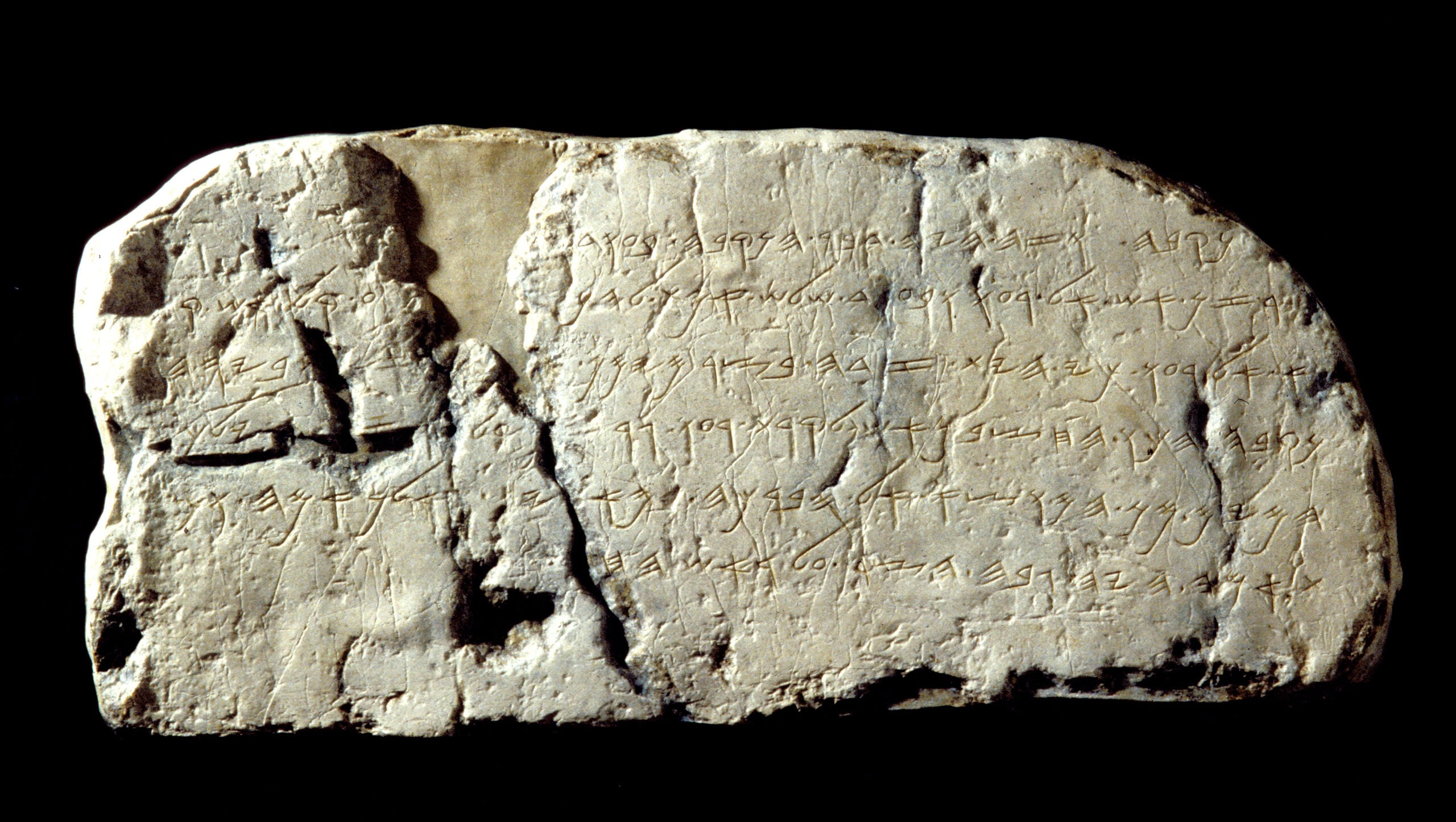
תמה1 הנקבה2 וזה היה דבר הנקבה בעוד3 החצבם מנפם
הגרזן אש4 אל רעו5 ובעוד שלש אמת6 להנקב וישמ קל אש ק
רא אל רעו כי הית7 זדה8 בצר9 מימן ומהשמאל ובים ה
נקבה הכו החצבם אש לקרת רעו גרזן על גרזן וילכו10
המים מן המוצא11 אל הברכה במאתים ואלף אמה ומא
ת אמה היה גבה12 הצר13 על ראש החצבם
She has been completed, the Female (“pierced one”). And this one has become the alignment of the Female within the recurrence of the Hewers, those who swing to and fro the Axe, each man toward a comrade of himself, and within the recurrence of three maidservants, he was heard, a voice of a man calling out toward a comrade of himself, for she became an insolent one within the Distress/Siege from the right side and from the left; and within the day/manifestation of the Female the Hewers smote, each man to encounter a comrade of himself, axe upon axe, and the Dual-Waters they walked out of the Source toward the Pool within a dual-hundred and a thousand of a maidservant; and the haughtiness/loftiness of the Siege against a head of the Hewers he has become a hundred of a maidservant.
The Writing on the Wall…
בצר לי אקרא יהוה ואל אלהי אקרא וישמע מהיכלו קולי ושועתי באזניו
“Within the distress/siege to myself I am encountering He Is, and I am calling out toward mighty ones, and he is hearing the voice of myself from the temple of himself, and my cry for help within the ears of himself.”
(2 Samuel 22:7 RBT)
הנני עמד לפניך שם על הצור בחרב והכית בצור ויצאו ממנו מים ושתה העם
“Behold! he who is standing there in front of the faces of yourself, upon the Rock Cliff [הַצּוּר֮] within Dry Waste (“Horeb”); and you have smote within the Rock Cliff, and they, the Dual-Waters, are going out from himself, and the People, he has drunk!”
(Exodus 17:6 RBT)
שמעו אלי רדפי צדק מבקשי יהוה הביטו אל צור חצבתם ואל מקבת בור נקרתם
“Hear toward myself, those who are chasing/persecuting a just one, those who are seeking He Is! Look intently toward a rock cliff you all hewed, and toward a hammer of a pit-hole you all bored out!”
(Isaiah 51:1 RBT)
“Because all the Herds have drunk from the Wine of the Rage of the Prostitution of herself! And the Kings of the Earthly One have engaged in prostitution in company with herself, and the Ship-Traders of the Earthly One were made rich from the Power of the Insolence of herself!”
(Revelation 18:7 RBT)
“And also I, myself am speaking to yourself, that you, yourself are Stone (“Petros”), and upon the Rock Cliff, this one, I will house-build the Summoned Assembly of myself, and gates of Underworld (“Hades”) will not overpower herself!”
(Matthew 16:18 RBT)
Notes
- Translating הנקבה as “the excavation” or “the tunnel” is truly ridiculous and so far from the meaning of the word that only “advanced scholarship” could be capable of such nonsense. But if you are convinced that a word is being used in some certain way, then I suppose anything is possible.
- Gesenius thought that there wasn’t enough room for תמה and so proposed תמ but the problem is the disagreement in gender. There is enough room however since all that is needed is the letter which is quite small. Others have proposed things like dabar “the word/ordered thing” or הנה “behold“.
- Literally בעוד can be parsed as ב־ (“in”) + עוֹד (“continuing / iteration / further”). If you take עוֹד in its more concrete sense of repetition or iteration, then בעוד can literally mean “in the iteration” or “within the repeated/ongoing occurrence.” The semantic core is being inside a continuing or recurring action/state, whether conceived as temporal persistence or as repeated instances. The conventional translation “while” abstracts this to temporal simultaneity, but the underlying image is of being within a period that continues or persists.
- In Paleo-Hebrew, corresponds to the consonants ’‑š, which in Biblical Hebrew would normally represent אש (“fire”). It is not a standard spelling for איש (“man”), which is normally (’‑y‑š).In several 8th-century Northwest Semitic inscriptions, including the Siloam Inscription, the consonantal sequence is used to represent the word ʾîš “man,” due to defective orthography (also referred to as matres lectionis). This creates a true homograph with ʾēš “fire,” resolved entirely by context.
- Unusual form רעהו/רעו (“his comrade/friend”). The phrase איש אל רעהו occurs throughout the Hebrew Books and Prophets at least 30 times.
- The word for cubit (a forearm length) is אמה which is actually the word for maidservant, bondmaid, female slave. See אמה Strong’s #519 and Gesenius. “Cubit” as a forearm measurement would be a usage.
- הית — best taken as an archaic or defective spelling of היתָה (“became”), i.e. 3fs of היה. Such reduction (dropping final ה and internal vowels) is well attested in early inscriptions and compressed poetic prose.
- Scholars call this the crux word of the inscription. For over a 100 years no one could figure out its meaning, and extensive studies have been done. Gesenius said that it is “not found in the Old Testament.” Since the inscription’s publication in 1881, interpretations of zedah have evolved from geological to linguistic and engineering-focused. Early scholars linked it to physical features allowing sound transmission, while later ones emphasized construction errors. A 2020 paper by Raanan Eichler documents 16 proposals with his own for “misalignment.” Nevertheless if we aren’t stuck in the contextual vortex of engineering or geological interpretive constraints, but take the time to consider that it is a prophetic utterance since, after all, the entire context of the Hebrew Linguistic Device (and its authors and its people) is one of prophets prophesying prophecies, then we can find a rather easy meaning to this word. These were people of a Prophetic Book of Prophecy. Was there anything else more significant to the Hebrews? The People of the Book have left us a book that is virtually nothing but prophecy. But scholars don’t like prophecy. It’s bad karma for their reputations, accreditation, authoritative positions, etc. They rather rely on mashed potatoes analyses of cognate words to derive meanings that look much more scientific and advanced. So prophecy almost never comes into play when studying…ancient prophecy. The context does not have to be a tunnel underneath Jerusalem just because it was inscribed there. There is a very easy cross reference in Biblical Hebrew: זדה — from the root זוד / זדה (cf. זֵד, זָדוֹן; Strong’s H2086/H2087), meaning “to act presumptuously, arrogantly, violently.” As a noun/adjectival form here it denotes insolence, violence, presumption, not cooking or boiling (that sense is secondary and metaphorical). זֵ֣ד proud arrogant one as masculine and זֵדִֽים as proud arrogant ones plural is found in the Old Testament. The feminine is very easily זדה zedah. No magic needed.
- This was taken for a defective spelling of בצור “in the rock” but see צוּר to confine, besiege, and צַר narrow, strait, distress, siege. This certainly fits better with the idea of “from the right and from the left.”
- ילכו (from הלך, H1980 to walk) is not a typical verb for the flowing of water. Its concrete sense is intentional movement of animate agents (“to walk, go, proceed”). When it is applied to inanimate phenomena, it is marked and secondary, usually meaning “to extend,” “to advance,” or “to proceed (in sequence),” not “to flow” in a hydraulic sense. Biblical Hebrew consistently prefers נזל, נבע, שטף, or simply a hydronym noun (נחל, נהר, מים) when actual water movement is intended.
- המוצא corresponds to Strong’s H4161 (מוֹצא), from the root יצא (“to go out”). It denotes an exit, outlet, place of emergence, or source, depending on context.
- Hebrew distinguishes two common nouns for “height.” קוֹמה (Strong’s #6967) denotes height or stature as a measurable, neutral dimension, derived from קום “to rise/stand,” and is used for physical size (persons, structures, walls, trees). By contrast, גבה (Strong’s #1363) denotes height as loftiness or elevation, more qualitative than strictly metrical, and carries connotations of prominence or exaltation (literal or figurative). The terms are therefore not strictly interchangeable: qomah emphasizes measurable extent, whereas gobah emphasizes elevated or outstanding height. See also גבה to be exalted, high, proud, haughty. Thought to refer to the overburden (depth from the surface), 100 cubits would be a well rounded “boastful” figure and only for certain sections. The depth ranges from 44-111 cubits by the ancient Judahite cubit and is mostly much shallower across its full length.
- The root word צוּר “to besiege” of צר “siege/narrow strait” is frequently used with the preposition על “against” throughout the Hebrew Scripture (see ויצר על, ויצר עליה in 1 Kin. 20:1, 2 Kin. 6:24, 17:5 for example). In Lamentations 1:10, ידו פרש צר על כל מחמדיה “his hand spread out a siege against all her desirable things.”
Sources:
- Kantor, Benjamin. “The Siloam Inscription (ca. 700 BCE).” BiblicalHebrew.com, 2022. https://biblicalhebrew.com/the-siloam-inscription-ca-700-bce/. Accessed December 26, 2025.
- “כתובת השילוח.” Wikipedia. Wikimedia Foundation. https://he.wikipedia.org/wiki/כתובת_השילוח. Accessed December 26, 2025.
- Steinberg, David. “The Siloam Inscription.” Ver. 1.0, October 3, 2007. http://www.houseofdavid.ca/anc_heb_siloam_text.pdf. Accessed December 26, 2025.
- Gesenius, Wilhelm. Gesenius’ Hebrew Grammar. Edited by E. Kautzsch. Translated by A. E. Cowley. 2nd English ed. Oxford: Clarendon Press, 1910. https://archive.org/details/geseniushebrewgr00geseuoft/page/n21/mode/2up. Accessed December 26, 2025.