What is a Word?
Hebrew דבר dabar #1696. To align, put in a row. #1697, an alignment/word. Hence the aligning of letters in a row: w-o-r-d to create “word.”
The word “logos” (λόγος) originates from ancient Greek. In Greek philosophy and theology, “logos” has rich and varied meanings, including “word,” “reason,” “thought,” or “principle.” It’s concrete meaning is mathematical: ratio. It has been used in various contexts by Greek philosophers such as Heraclitus, Plato, and Aristotle. In the Hebrew context it is a building block/stone, even a “living stone.” According to the Gospel of John, “In the Origin, ‘GOD’ was the Logos/Ratio.”

What is a Writing?
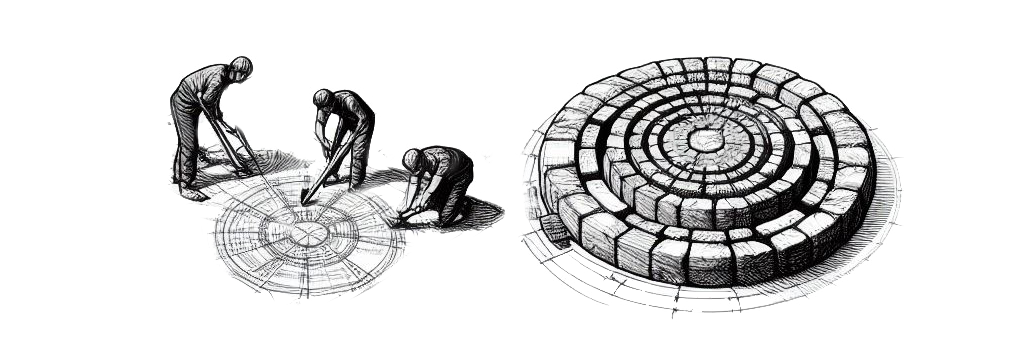
Ratios “λόγοι” (logoi), arranged in a sequential order, or in a row, builds something.
The Hebrew language, functions around both of these paradigms. The Logos/Ratio is a masculine building block of a Writing—the relationship between the two stones. A word alone, is but a thought, or principle. But many aligned together builds a writing.
Eve, as the Mother of Life is “built” (Hebrew “banah”) while the Man is “formed/moulded.” Once a word is formed, “life” and “death” can be constructed from them. Then through the writing, the words are spoken, and either words of Life or words of Death are born/realized.
The entirety of the Writing of the Logoi/Ratios is conceptually parallel to what is called “The Seed of The Woman” in that “the Logos is the (dual) seed of the Writing.”
Word order and arrangement itself within the Hebrew texts follows tradition and bias. Hence Genesis 2 is called the “Yahwist Narrative” and all sorts of weird scholarship exists around how Genesis 1 and 2 are “different creation accounts.” But the conjecture rarely goes beyond traditions, if at all. What if we were to move around the words a little bit, and assume that “Yahweh Elohim” is not a formal name, since after all, no indication is given anywhere that it is?
ויטע יהוה אלהים גן ב עדן
And He Who Is (“Yahweh”) is planting-upright mighty ones, a garden within Delight…
Genesis 2:8 RBT
Reading it in this way, אלהים is no longer a part a name, but the object of the verb. A new (re)alignment is made. And the same writing is constructed in a completely different way. The verb ויטע has more to do with planting a tree into the ground as opposed to sowing a seed into the ground, as it etymologically means “fixing upright in the ground” kind of like “staking” but in a good way…