What is self-awareness? A child doesn’t know. At least not yet.
But through a lot of tasting, making noise, and feeling about, it slowly develops a sense of self-awareness. Most notice throughout their lives how a chronological self-awareness tends to develop also. They also tend to find how it seems to move faster and faster, as though it is dilating, leading one to race toward life objectives or aims faster and faster, until all is burned out. But what if the Aeon as described by the NT authors is that “burning flame that shall never go out”?
והאש על־המזבח תוקד־בו לא תכבה ובער עליה הכהן עצים בבקר בבקר וערך עליה העלה והקטיר עליה חלבי השלמים
“And the fire upon the altar, she is burning within him, she is not extinguishing/going out, and the priest kindled upon her trees in the dawn, in the dawn, and he is arranging in order the ascending offering, and he offered in smoke the fats of the Complete Ones.”
(Leviticus 6:13 RBT)
It’s just against the laws of physics that anything “should never go out”. What magical fires were the biblical authors playing with?
A Different Science
The Second Law of Thermodynamics states that entropy in a closed system must always increase. In a strictly linear, sequential universe—where Chronos never bends, loop, or folds—time has a single, irreversible vector: the Arrow of Time.
Under pure Chronos, “eternity” or “forever and ever” leads directly to cosmic death: maximum entropy, the dissipation of all energy, heat death, and cold decay. In that linear framework, any claim of perpetual renewal, resurrection, or endless life has to sound like magical hand-waving, because it violates the fundamental physics of irreversible loss.
By introducing the geometry of Aeon—where time curves back on itself or connects to higher-dimensional topology—the need for supernatural “magic” vanishes. Instead, it becomes a structural property of the universe:
- Information and Energy Conservation in a Closed Loop: If linear time (Chronos) folds back to reconnect with its source (Aeon), the universe ceases to be a leaky bucket draining into infinite void. Instead, it becomes an iterative system. What appears as “decay” along the linear path becomes fuel or input for the return journey—much like how a Möbius strip continuously reverses orientation without ever encountering an edge or a dead end.
-
The Cyclic Cosmologies of Modern Physics: Theoretical physics constantly wrestles with this exact geometric shift to solve the thermodynamic boundary problem:
-
Conformal Cyclic Cosmology (Sir Roger Penrose): Penrose argues that at the extreme end of the universe—when all matter has decayed into light—the universe loses its sense of scale and distance. In that state, the far future of the universe (Chronos running out) becomes mathematically identical to the Big Bang (Aeon restarting the cycle).
-
Loop Quantum Gravity & Quantum Poincaré Recurrence: In quantum systems, given infinite time, a bounded system will eventually return to a state arbitrarily close to its initial state. The loop isn’t magic; it’s a statistical property of quantum phase space.
-
-
The Thermodynamic Synthesis: In this light, Chronos is local entropy (the experience of burning through fuel within a given epoch), while Aeon is global conservation (the overarching topological loop that recycles the system).
The Birth of Aeon
The ancient Greek word αἰών (aion, often rendered Aeon or Aion) began as something intimate and mortal: a person’s life-force, the span of a single existence, the vital breath that could be cut short by a spear. Over centuries it stretched into one of the most charged concepts in Western thought—boundless eternity, the unbroken cycle of the cosmos, and the arena in which Greek, Jewish, and Christian visions of time collided.
From Lifetime to Age: The Classical Roots
In Homer, Aeschylus, and Sophocles, αἰών almost never means abstract eternity. It means life itself.
- A young warrior’s aion is brief when Ajax’s spear finds him; he never repays his parents the debt of nurture.
- Calypso urges Odysseus not to let his aion waste away in grief.
- The chorus in Antigone calls those whose aion has never tasted evil “happy.”
- Electra is told to keep a certain mind “throughout her aion” (di’ aionos).
- Aeschylus can speak of an aion “inborn” with the speaker, or of a life burdened by a father’s dishonorable death.
Lexicons confirm the trajectory (cf. Logeion). The word first denotes vital force or individual lifespan, then an age or generation, then an indefinite stretch of time. Only later does it open into eternity. The movement is metonymic: from one life, to a generation’s life, to the life of the cosmos itself.
Plato’s Decisive Leap
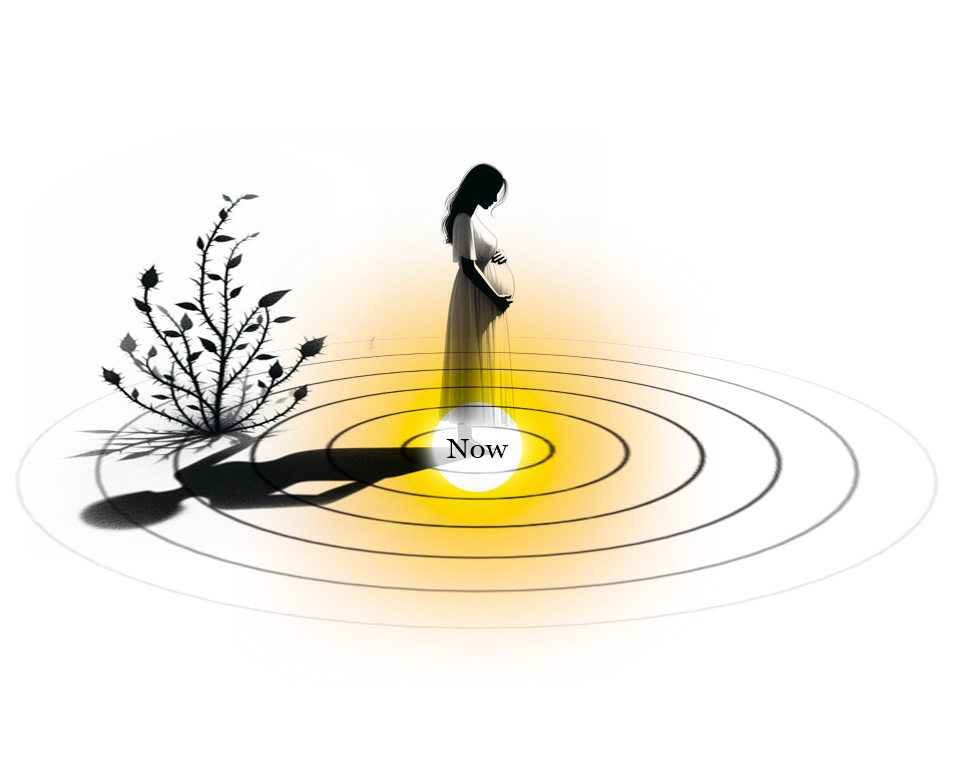 The philosophical elevation occurs in Plato’s Timaeus. There the Demiurge, fashioning the visible world, creates time as “a moving image of eternity (aion).” Eternity abides in unity, without past or future—an eternal Now. Chronos (measurable, sequential time) is its moving projection, ordered according to number so that the changing world can imitate the unchanging as closely as possible.
In this geometry, linear sequence is not the opposite of eternity; it is eternity bent into cycles—days into nights, seasons into seasons, planetary orbits returning to their starting points—so that motion itself can mirror rest. The later tradition that sometimes calls Aion the “child of Chronos” (already present in Euripides) gains a psychological resonance here: the sequential, cause-and-effect mind, by accumulating memory and pattern, eventually folds back upon itself and discovers a larger unity.
The God Aion and the Twisted Ribbon
 In the Hellenistic and Roman worlds, Aion becomes a deity of boundless duration and cosmic order, especially in Alexandria and the mystery cults. He stands inside the zodiac wheel, often holding a continuous band. The famous mosaic from Sentinum (c. 200–250 CE), now in the Glyptothek in Munich, renders that band with a half-twist. Modern eyes recognize a Möbius strip: a single-sided surface that loops endlessly into itself. Whether the Roman artist intended topological precision is secondary; the image visually declares that time is not a line with ends but a self-contained infinity, continuous renewal without rupture.
Mathematical formalization of the Möbius surface waited until 1858. The mythic intuition was already present.
The Jewish and Christian Appropriation
When the Septuagint translators rendered the Hebrew ʿôlām (distant past, distant future, unending duration) with aion, and when New Testament writers inherited the term, they did not simply adopt the Platonic or Hellenistic package. They reshaped it.
Two dominant patterns emerge:
- Discrete ages on a line. “This present age” (ho aion houtos) versus “the age to come” (ho aion ho mellon). Time is divided into successive epochs moving toward a decisive end.
- Unending duration. Phrases such as eis ton aiona (“into the age/forever”) and eis tous aionas ton aionon (“into the ages of ages”) express everlasting continuance. Eternal life is zoe aionios.
Mainstream interpreters have insisted that these constructions remain linear and vectorial. History has a beginning and a telos; the incarnation, cross, and resurrection are once-for-all events (ephapax). Scholars treated the uniqueness of these as requiring chronological fixity: these things happened once, at a particular point on a line, and therefore cannot be repeated or absorbed into an endless cycle.
If the incarnation, cross, and resurrection are understood as timeless rather than merely chronological, their uniqueness is not weakened; it is intensified. They become the eternal axis around which time itself is ordered, not just events that occurred inside time. In that framing, the “once” of ephapax (Hebrews 7:27; 9:12, 26–28; 10:10) is not the “once” of a historical accident that could in principle have happened twice. It is the “once” of something that stands outside the sequence and therefore does not need to be repeated inside it.
Oscar Cullmann and others sharpened the contrast: Greek cyclical time versus biblical linear time. The Jewish-Christian adaptation kept the word aion while largely rejecting the endless recurrence of Stoic ekpyrosis or the mythic wheel.
Yet an alternative current never entirely disappeared. Origen and Gregory of Nyssa read the aions as finite periods of purification within a larger restorative movement (apokatastasis) that returns all things to God so that God may be all in all. In that vision a kind of cosmic loop survives—not the indifferent turning of the zodiac, but a purposeful going-forth and return. Western orthodoxy, especially after Augustine, largely closed that door, preferring a static binary of everlasting heaven and everlasting hell.
But what do the writings actually say? Whether the New Testament authors themselves thought in these terms is harder to settle. They wrote in a linguistic and conceptual world already shaped by both Jewish eschatology and Hellenistic philosophical vocabulary. They did not leave us a treatise on the ontology of time. What we can say is that the transmission — the commentators, the translators, the dogmatic systems — consistently preferred the safer linear reading. They had their reasons: the fight against the pagan cosmologies, the need to defend the finality of judgment, the desire to keep salvation history from dissolving into myth. In other words, to preserve their power and influence and keep control of the Biblical texts of the prophets in an ever-changing and divided theological arena. But those reasons are not identical with the texts themselves.
Calling this “aeonic” writing is not a standard scholarly category, but its but it captures something real: the way certain biblical texts refuse to stay inside ordinary sequence. It’s also known as prophecy. Prophetic and apocalyptic writing does something similar. It does not merely predict future events on a timeline; it discloses a reality that is already true in a deeper register and presses that reality into the present. The effect is participatory. The reader is not simply informed about something that happened or will happen “out there”; the reader is addressed as someone already implicated in the disclosed reality.
That mode is harder to control than a pure chronicle. A chronological record can be managed: dates, sequences, authorized interpreters, chains of custody, and the claim that ordinary people cannot safely handle the material without guidance. A text that constantly collapses the distance between the eternal and the present invites direct participation. It threatens the monopoly of mediation. Authoritarian systems, religious or otherwise, have a structural preference for the first kind of text over the second. That incentive is visible across religious history — not only in Christianity. A prophetic text (not chronological record) invites all into it as participants, which is an authoritarian’s worst nightmare. So close it all tight, call the prophecies “fulfilled”, excommunicate any and all dissidents, and you’re good. There is just one small, tiny little caveat: if the said prophecies speak of those tampering with the prophecies and shutting people out, you’re in big trouble.
Two Minds
The deeper tension is not merely historical. It is existential.
The chronological mind lives in sequence: stimulus, reaction, memory of the past, projection of the future. It tastes, suffers, learns by cause and effect. It is always “in process.”
The aeonic mind (or eternal mind) turns the linear thread back upon itself. Through reflection, pattern recognition, and self-reference it holds the whole as a simultaneous unity. It iterates, digests, and discovers that the end was already latent in the beginning. In developmental terms it is born from chronological experience: we begin as creatures of successive moments; only later does consciousness fold the sequence into a self-aware loop.
Plato’s geometry and the Sentinum mosaic both gesture toward this possibility. Linear time is not abolished; it is curved so that it can participate in something that does not itself move.
The Collision That Remains
Αἰών therefore stands at a permanent crossroads. Greek thought offered a vision of eternity as self-contained, cyclical, and whole. Jewish and Christian thought took the same word and insisted that history is a directed story with irreversible events and an ultimate destination. One tradition sees the Möbius ribbon; the other sees a line that does not return.
Yet the word itself refuses to choose cleanly. It began as a mortal lifetime, became the measure of ages, rose into philosophical eternity, received divine personification, and then entered the vocabulary of two successive ages and “ages of ages.” The collision is not resolved by lexicon or timeline. It lives wherever a human consciousness, formed in sequential time, suddenly glimpses the possibility of standing outside the sequence and holding the entire pattern at once.
That possibility remains as open—and as contested—as the word αἰών itself.