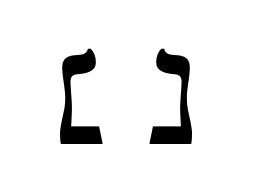
 The inverted nun (נ׆)—the nun hafukha that frames Numbers 10:35–36—is one of the few places where the Hebrew text itself marks a fold rather than merely describing one. Whatever one concludes historically, functionally the sign behaves like an intentional inversion marker, and that is where its aonic force lies.
1. Nun as “seed / continuity”
The letter נ (nun) is classically associated with continuity, propagation, offspring—already visible in its semantic field (נין “descendant,” נוּן “to sprout,” Aramaic fish symbolism, etc.). In other words, nun encodes forward extension of life. In normal orientation, it signifies generation flowing onward.
An inverted nun, then, would not negate that meaning, instead it reverses its direction. It signals seed returning to source, propagation folding back into origin. Not death, but recursion.
2. What the placement tells us
The inverted nuns surround a short liturgical unit:
“When the Chest is stood up…
And within the Resting of Herself…”
Textually, this passage is treated as a book within the book. Aonic reading: it is a self-contained loop—movement and rest, dispersion and return. The inverted nun brackets are not punctuation; they are topological markers saying: what happens here does not proceed linearly with the surrounding narrative.
Chronos reading: odd scribal sign.
Aonic reading: the seed of Israel’s motion is folded back upon itself.
3. Aeonic implication
In a Möbius or toroidal ontology, the aeon is not a straight generational line but a recursive field. The inverted nun signals exactly that:
-
seed → emergence → dispersion
-
dispersion → recollection → return
The aeon is thus not forward time, but self-renewing continuity. The seed is never exhausted because it is not consumed—it is re-entered.
So what is the inverted nun “saying” about the aeon?
That the aeon propagates by inversion, not succession.
Life is not passed on by leaving the origin behind, but by passing back through it.
4. Why only here?
Because this is where the text speaks about the ark moving and resting—presence entering time and withdrawing from it. The inverted nun marks the threshold between motion in chronos and rest in aion. It is the textual equivalent of a turning point, a tor.
5. In simple terms
If nun is the seed that grows forward, the inverted nun says:
The seed does not only grow outward; it folds inward.
The aeon is preserved not by time passing, but by return.
That is not something Hebrew needed to explain verbally.
It wrote it into the shape of the letter itself.