Abstract.
In this paper we develop a disciplined framework for reading Logos—broadly understood as the ordering principle that converts potentiality into traversable structure—as an aonic (non-chronological, topological) operation. Drawing from grammatical features of Biblical Hebrew (aspectual morphology, limited temporal object marking) and Ancient and New Testament Greek (participial periphrasis, articular infinitives), together with the Homeric semantic core of λέγω (“pick out, gather, place”), we argue that Logos is best described as a selection-and-alignment operator that converts an undifferentiated field into a balanced and ordered lattice.
Analogies from topology (Möbius strip, torus), condensed-matter physics (lattice coherence, superconductivity, crystallization), and developmental biology (toroidal embryogenesis, rapid epidermal turnover) provide a physical vocabulary for understanding how embodiment might instantiate a pre-linguistic ordering function. The claim is not metaphysical theology but a cross-disciplinary hypothesis: linguistic structure encodes a mode of ontological ordering that, if saturated, could yield persistent negentropic organization in material systems —what ancient language compresses into the formula “the Logos Ratio became a flesh.”
Introduction
The Logos as “reason, word, ratio” is inherently scientific at its core because it represents the math of existence or being. Theologians may have complicated it into many abstract ideas, but the enduring idea from ancient times (e.g. Heraclitus) is one of a universal rational law that orders the constant state of change (flux) in the cosmos.
ἄνθρωπος ἐν εὐφρόνῃ φάος ἅπτεται ἑαυτῷ ἀποσβεσθεὶς ὄψεις
“A human, within night, fastens a light to his own self, he who has been extinguished of visions.”(Heraclitus DK B26)
Heraclitus’ own name means “Famous Heroine” after the name of Hera, the Queen of the Gods. Heraclitus (c. 535 – c. 475 BCE) is generally considered the first to elevate the term “Logos” (Λόγος) into a central, technical philosophical concept describing the fundamental rational structure of the cosmos. If Logos is a stone, speech would be the ontological masonry. The word has a very basic primitive meaning of computation, ratio, or proportion.
In Greek mathematics, geometry, music theory, and physics, Logos almost always translates to “Ratio,” “Proportion,” or “Measure.” The most definitive and famous usage comes from Euclid’s Elements, where Logos is the foundation of much of Book V, which deals with proportion theory. Euclid’s Definition (Euc. 5 Def. 3):
λόγος ἐστὶ δύο μεγεθῶν ἡ κατὰ πηλικότητα ποιὰ σχέσις
“A Logos [Ratio] is a certain kind of relation in respect of size between two magnitudes.”
This definition is the bedrock of Greek geometry and demonstrates that Logos literally means the quantifiable relationship between two things (e.g., A is twice as big as B, or A:B = 2:1). From this more words are derived. Ἀναλογία (analogia) is the concept of proportion built directly on the Logos, and is defined as the equality of ratios (ἰσότης λόγων, Arist. EN 113a31). The pleasing sounds of musical harmony (e.g., the octave, fifth, and fourth) were found to correspond to simple, whole-number ratios (1:2, 2:3, 3:4).
τῶν ἁρμονιῶν τοὺς λόγους
“the ratios of the harmonies”(Aristotle, Metaphysics 985b32; 1092b14)
In Harmonics (pp. 32–34 Meibom), Aristoxenus defines λόγοι ἀριθμῶν as “ratios of numbers.” He uses λόγος to structure rhythm, describing the relationship between arsis and thesis as a numerical ratio:
τοὺς φθόγγους ἀναγκαῖον ἐν ἀριθμοῦ λ. λέγεσθαι πρὸς ἀλλήλους (Euc. Sect. Can. Proëm.)
“The pitches must be expressed in numerical ratios with respect to one another.”
For Aristoxenus, pitch, interval, and rhythm are all intelligible only in terms of λόγος. In his system, the very nature of sound becomes understandable as numerical proportion; musical structure is nothing without ratio.
The phrases ἀνὰ λόγον (anà lógon) and κατὰ λόγον (katà lógon) both translate to “analogically” or “proportionally.” In Timaeus 37a, Plato applies the concept of λόγος beyond music to the cosmos and the soul:
[ἡ ψυχὴ] ἀνὰ λόγον μερισθεῖσα
“The soul was divided according to ratio.”(Plato, Timaeus, 37a)
Here, λόγος functions as a principle of cosmic proportion, a harmonic ordering that structures the world-soul mathematically. Plato elevates the concept of musical ratio into a metaphysical framework: the same logic that defines intervals and rhythm in music becomes the principle that renders the soul and cosmos coherent and intelligible. When Plato describes the creation of the world-soul (ψυχή) and how it is divided proportionally (ἀνὰ λ. μερισθεῖσα), he is using Logos to mean precise, measured distribution according to a fixed scheme.
Beyond the sciences and philosophy, λόγος also carries the sense of computation, reckoning, or accounting, illustrating its concrete practical usage. In administrative and financial contexts, λόγος denotes an account, audit, or computation of money, as in:
- σανίδες εἰς ἃς τὸν λόγον ἀναγράφομεν – boards on which we record the accounts (IG 1.374.191)
- συνᾶραι λόγον μετά τινος – to settle an account with someone (Ev. Matt. 18.23)
- ὁ τραπεζιτικὸς λόγος – a banking account
In this way, the principle of ratio is embedded in human responsibility: each account maintains the equilibrium of resources, as debits correspond to credits and receipts to expenditures. The same quantifiable proportionality that structures musical intervals, geometric magnitudes, and cosmic divisions is active in practical reckoning, demonstrating the pervasive, unifying force of Logos across both theoretical and applied domains.
This mathematical usage forms the root significance of the word Logos and likely influenced Heraclitus and other philosophers in their use of the term, that is, if Logos is the mathematical law that creates order out of magnitudes, it is a very small step for a philosopher to conclude that Logos is the universal rational law that creates order out of the chaos of the cosmos. The philosophical concept is thus rooted in the practical, demonstrable, and quantitative reality of Greek mathematics.
Part I: The Stone Mason and the Mathematician
1.1 The Semantic Bedrock: Légo as Primitive Operation
To understand the metaphysical weight of Logos, we must first descend to its most physical roots. Long before Logos meant “reason” in the academies of Athens or “Speech” in the prologue of John, it possessed a gritty, tactile utility in the Homeric epics. The verb légo (λέγω) originally meant “to pick out,” “to select,” “to gather,” or “to lay in order.”
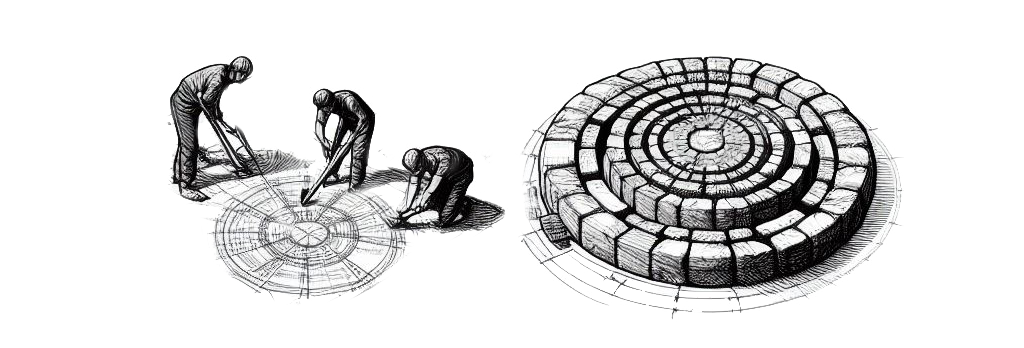
Consider the ancient mason facing a field of rubble. The field is a continuum of disorder—an entropy of jagged rocks. The builder performs a threefold operation:
- Selection: He discriminates a specific stone from the pile, separating signal from noise.
- Alignment: He rotates and orients the stone, finding its “fit” relative to its neighbors.
- Placement: He stabilizes it within the emerging structure.
When this operation is repeated, the pile of rubble becomes a wall. The chaotic field becomes a boundary, a shelter, a structure. This is the primitive Logos. It is not the stone itself, nor is it the wall; it is the operation that converts the former into the latter.
History witnesses a semantic continuity that reveals a single abstract function operating across ascending substrates of complexity:
| Substrate | The “Rubble” (Input) | The Operation (Légo) | The Structure (Output) |
| Lithic | Stones/Rubble | Select & Align | Wall |
| Numeric | Percepts/Magnitudes | Count & calculate | Number/Sum |
| Phonetic | Sounds/Phonemes | Articulate & sequence | Speech |
| Noetic | Concepts/Raw Data | Reason & deduce | Proposition |
Thus, speech is ontological masonry. To speak is to pick “verbal stones” from the silence of potentiality and lay them into a wall of meaning. The Logos Ratio is the generalized operator that Discriminates elements from an undifferentiated field, Aligns them into constrained relations, and Stabilizes the configuration against dissolution.
1.2 The Heraclitean Flux and the Universal Ratio
The transition from masonry to metaphysics occurs with Heraclitus of Ephesus (c. 535 – c. 475 BCE). Heraclitus observed a cosmos defined by radical flux (panta rhei—everything flows). Fire changes to water, water to earth; day turns to night; the living die. If reality is a river that no man can step into twice, how is knowledge possible? How does the cosmos not dissolve into pure noise?
Heraclitus posited that while the “stuff” of the universe is in flux, the pattern of the flux is constant. This pattern he named the Logos.
“Listening not to me but to the Logos it is wise to agree that all things are one.” (Heraclitus DK B50)
For Heraclitus, the Logos is the formula of change. It is the ratio that ensures the fire is extinguished in equal measure to the water being kindled. It is the “universal rational law” that orders the constant state of change. Without the Logos, the universe is a chaos of exploding magnitudes; with the Logos, it is a cosmos of measured exchanges.
1.3 Euclid and the Definition of Ratio
This philosophical intuition was formalized by Greek mathematics. In the geometry of Euclid and the music theory of the Pythagoreans, Logos is the technical term for Ratio.
Euclid’s Elements, Book V, Definition 3, provides the bedrock definition:
Λόγος ἐστὶ δύο μεγεθῶν ὁμογενῶν ἡ κατὰ πηλικότητα ποια σχέσις
“A Logos [Ratio] is a sort of relation in respect of size between two magnitudes of the same kind.”
This definition is crucial for our thesis. A ratio is not a “thing” existing in isolation. The number 2 is a magnitude; the relationship 2:1 is a Logos. A ratio is a mode of being that is intrinsically relational. A is only defined as “double” in reference to B.
This leads to the concept of Analogia (Proportion), defined as the equality of ratios (A:B :: C:D). The Pythagoreans discovered that this mathematical Logos was not just an abstract invention but the structure of physical reality. The pleasing sounds of musical harmony—the octave (1:2), the fifth (2:3), the fourth (3:4)—were acoustic manifestations of simple, whole-number ratios.
Thesis I: If Logos is the mathematical law that creates harmonic order out of sound frequencies and geometric order out of spatial magnitudes, it is the appropriate term for the universal law that creates ontological order out of the “noise” of non-existence.
Part II: Aonic Temporality and the Grammatical Encoding of State
If the Logos is an operator of structure, how does it interact with time? Our current model of time—linear, chronological, entropic—is insufficient for understanding the Logos. We must look to the “Aon” (Aeon), a concept better described by topology than by timelines.
2.1 The Grammar of the Aon
Language encodes ontology. The grammatical structures of Biblical Hebrew and New Testament Greek preserve a “time-sense” that is alien to the modern Western mind but native to the operation of the Logos. For centuries scholars have stumbled over the inordinate use of what is called the “historical present” in the New Testament. The Gospel of Mark alone employs it 151 times. The Gospel of Mark is literally written in the present. No biblical scholar has ever understood why the most important documents to humanity would be written like this.
Biblical Hebrew: Aspect over Chronology
Hebrew lacks a fully grammaticalized tense system (past, present, future). Instead, it relies on aspect:
- Qatal (Perfect): Completed action, viewed as a whole.
- Yiqtol (Imperfect): Incomplete action, viewing the process from within.
Hebrew morphology lacks a robust accusative of time. Events are not points located on a linear timeline (t₁, t₂, t₃); they are states embedded in a network of relations. This favors a field-based ontology. An event is defined by its relation to other events (before, after, causing, resulting) rather than its position on an abstract clock. The “Aon” in this context is a topological neighborhood of related states, not a duration of seconds.
What about the Hebrew דבר “Word”?
The root דבר presents an unusually transparent case in which ancient lexicography itself encodes an aonic, non-chronological ontology. Gesenius observes that the primary and most ancient sense of the verb is not “to speak” but “to set in a row, to range in order.” Every derived meaning—guiding flocks, ruling a people, arranging troops, laying snares—flows from the same core action: the imposition of sequence, alignment, or structure upon otherwise unordered elements. Only secondarily does the term develop into “speech,” because to speak is precisely to place thoughts into ordered form. Thus Hebrew דבר (“word”) originally signifies not a phonetic unit but an ordered event-pattern, a structure that has been aligned out of the field of potential. This already situates “word” in a framework where ontology is relational and configurational, not temporal.
This aligns tightly with aonic grammar. If Hebrew encodes events not as temporal points but as states in a relational field, then דבר becomes the mechanism by which those states are aligned within the field—an ontological ordering, not a chronological utterance. In this view, the Logos is not primarily a speaker but an aligner, arranging states into coherence. The qatal and yiqtol aspects, which describe completeness of pattern rather than position in time, reinforce this. A “completed” action is one whose alignment is whole; an “incomplete” action is one still unfolding within the field. Thus דבר functions as the operative principle of the Aon: the bringing-into-order of the field itself. The grammar of Hebrew preserves this pre-chronological structure, meaning that the very word for “word” is, in its root, the act of alignment that defines aonic (eternal) ontology.
The Alignment of God?
Taking dabar concretely as “alignment,” “ordering,” or “structured arrangement,” not “word” in the modern phonetic sense yields a much more powerful translation: dabar = the act or result of imposed alignment. So if the phrase is דבר אלהים, the most conceptually precise gloss would be:
“the alignment of Elohim”
or
“the ordering-action of Elohim.”
This reflects the underlying semantics:
-
The verb dabar = “to arrange, to set in order, to marshal, to align.”
-
The noun dabar = “an ordered event-structure,” “a matter brought into alignment,” and only later “a spoken word.”
In an aonic framework—where events are relational states within a field rather than chronological items—“word” cannot be phonetic; it must be structural.
Thus the phrase conventionally rendered “the word of God” denotes the aligning action by which God structures, orders, or stabilizes states within the field.
ודבר אלהינו יקום
“and the alignment of our Elohim is standing up / is being established.” (Isaiah 40:8)
It is not metaphorical; it is the root meaning.
New Testament Greek: The Resistance to Closure
The Greek of the New Testament, particularly in Johannine writings, utilizes constructions that resist strict temporal closure, mirroring the Hebrew sensibility:
- Periphrastic Participles: The construction ἦν + present participle (e.g., “was him who teaches”) emphasizes a sustained, unbounded state rather than a punctual event.
- Articular Infinitives: The form τὸ γίγνεσθαι treats “becoming” as a noun—an object of thought, a domain of being—the Becoming.
These forms encode process as structure. In an Aonic view, “Eternal Life” is not infinite duration (chronos stretched to infinity) but a specific quality of topological organization—a state of being that is robust against the decay of linear time.
Part III: The S-P-T Operator and Topological Models
We can now formalize the Logos as a functional operator. Abstracting from the mason’s légo and the mathematician’s ratio, we define the S-P-T Operator:
- Selection (S): Discrimination from the continuum. The operator observes the “sea of noise” and collapses the wave function to isolate a specific potentiality.
- Placement (P): Relational alignment. The selected element is oriented relative to a standard or axis (the “Cornerstone”).
- Stabilization (T): Persistence. The element is locked into a lattice, resisting the entropic drag of the flux.
A “sea of potentiality” becomes a walkable topology—a “dry land”—precisely when S-P-T is enforced.
3.1 Topological Analogues: The Shape of Self-Reference
To understand how a “self-operating ratio” functions, we turn to topology, the study of geometric properties preserved under deformation.
The Möbius Strip: A surface with only one side and one boundary. It models a system where “interior” and “exterior” are continuous. In the context of Logos, this represents the reflexivity of the operator. The Logos does not operate on a world “out there”; it is the loop by which the world references itself.
The Torus: A donut-shaped field supports closed circulation with an internal axial channel. Many natural systems adopt toroidal dynamics:
- Plasmas: Magnetic confinement in fusion.
- Fluid Dynamics: Vortex rings.
- Biology: Morphogenetic fields.
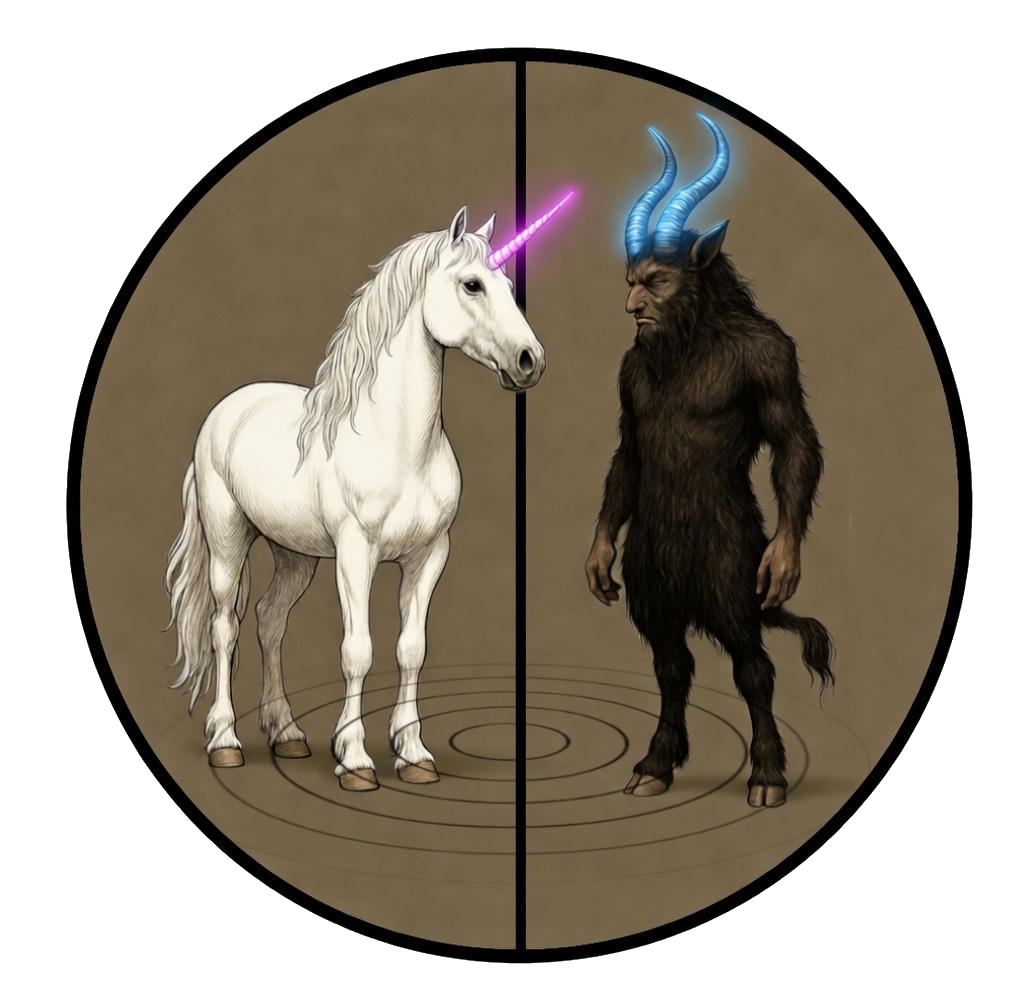
The torus is the perfect model for an Aonic system. It is self-contained, self-feeding, and coherent. The flow rotates around a central void or axis. In our theoretical framework, the Logos acts as the Axis of Emergence. A localized symmetry break along the toroidal axis produces a directional summit—conceptually, a “horn.” This models how focused identity emerges from distributed field coherence.
Part IV: Physics of the Logos—Lattice, Superconductivity, and Crystal
How does this abstract operator manifest in the material world? We propose that “holiness” or “glory” in ancient texts are phenomenological descriptions of what physics calls coherence.
4.1 The Lattice and the Arubbah
The Hebrew term אֲרֻבָּה (arubbah) is traditionally translated as “window” or “floodgate” (e.g., “windows of heaven”). Etymologically, however, it implies an interlaced opening or a lattice (cf. Strong’s #699) it also, interestingly, carries the meaning of “locust” (cf. Strong’s #697). Both are based the root רבה which means to increase/multiply.
In condensed-matter physics, a lattice is the discrete relational scaffold across which excitations propagate. A diamond is strong because its carbon atoms are arranged in a precise lattice; graphite is weak because they are not. The difference is not the material (both are carbon) but the Logos (the structural ratio) of the arrangement.
4.2 Superconductivity as Phase Coherence
The most striking physical analogue for the theological concept of “sinlessness” or “incorruptibility” is superconductivity.
In a normal conductor, electrons collide with the atomic lattice, losing energy as heat (resistance). This is entropy—the physical analogue of “death” or “decay.” However, when a material is cooled below a critical temperature, electrons pair up into Cooper pairs. These pairs behave as bosons and condense into a single quantum state. They move through the lattice without scattering. Resistance drops to exactly zero.
The Analogy:
- Resistance/Heat: Sin/Entropy/Decay (Loss of information).
- Lattice: The Law/Structure/Torah.
- Cooper Pairs: The “Flesh” aligned by the Logos.
- Superconductivity: Eternal Life (Dissipationless energy flow).
An organism whose micro- and macro-structures are phase-aligned would minimize internal dissipation. The “Logos became flesh” implies a biological system achieving multi-scale phase alignment (molecular → cellular → neural), approaching a state where repair dominates decay.
4.3 Crystallization: The Sea Like Glass
Revelation 4:6 describes a “sea of glass, like crystal.” In our framework, this is not a static image but a dynamic phase transition.
- The Sea (Liquid): High entropy, probabilistic, chaotic, untraversable. The “Abyss.”
- The Glass (Crystal): Low entropy, deterministic, ordered, traversable.
Crystallization transforms probabilistic degrees of freedom into transparent, load-bearing order. When the Logos saturates the “sea” of human potential, it crystallizes the chaos into a “Body”—a coherent structure that can bear weight and transmit light without distortion.
Part V: The Logic of the Decrease—Calibration and Ratio
We arrive now at the existential crux of the paper. If the Logos is a Ratio, how does the individual subject relate to it? This brings us to the famous paradox of “John the Plunger” :
“He must increase, but I must decrease.” (John 3:30)
This is often interpreted morally as self-abasement: “I am too big, I must become small.” But within our topological framework, this interpretation is mathematically flawed. In a ratio, if one term shrinks simply to make room for another, we remain in the realm of competitive magnitudes (a zero-sum game). If the ratio of John the Plunger to Christ the Anointed is 2:1, he must become 1:1. This means the smaller one increases, the greater one decreases.
5.1 The Mis-scaled Self (Chronos)
In the Chronos-state (linear time), the human ego acts as its own unit of measure. It is an Independent Scalar. The ego measures reality against itself: my survival, my timeline, my perspective.
-
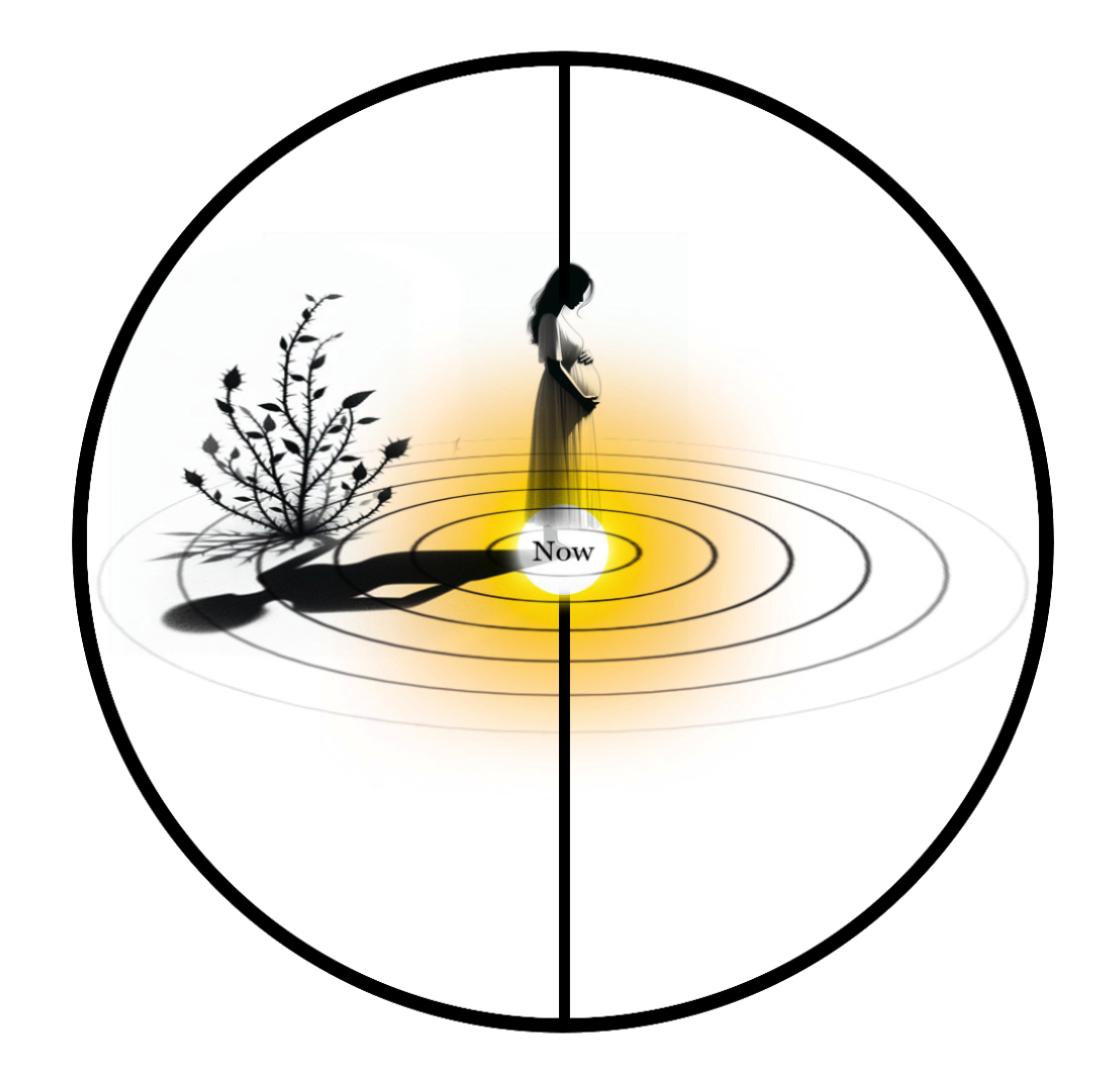
Proportions to the Now: I am who I am The Phase Error: Because the ego is reactive, it is always out of phase with the Now. It lags in memory or projects into expectation.
- The Distortion: When the self is the measure, the ratio is distorted. The “I” is artificially inflated, not in ontological size, but in referential authority.
5.2 The 1:1 Ratio (Aeon)
The “Decrease” is not a destruction of being; it is a Calibration. The statement “I must decrease” means “My claim to be the unit of measure must collapse.” The statement “He must increase” means “The Universal Ratio must become the governing axis.”
In an Eternal Aeonic state, the goal is a 1:1 Ratio with oneself.
- Chronos Self: I am 1.05 or 0.95 of myself. I am distinct from my reality.
- Aeonic Self: I am (exactly) who I am. Action and intent are simultaneous.
The decrease is the elimination of the “noise” of the ego so that the “signal” of the Logos can propagate without resistance. It is the cooling of the superconductor. The individual electron “decreases” its erratic, independent thermal motion to “increase” its participation in the coherent Cooper pair. It loses “freedom” (randomness) to gain “flow” (superconductivity).
Therefore, “He must increase” does not mean the Logos gets “bigger” (the Logos is already infinite). It means the Dominance of the Ratio increases in the local system. The self becomes transparent—like the crystal sea. A transparent crystal is not “gone,” but it is invisible because it offers no resistance to the light passing through it.
Part VI: The Logos Became Flesh—A Biological Hypothesis
We can now synthesize the “Logos Ratio became Flesh” (Logos → sarx → egeneto) as a scientific description of a structural event.
The Formula:
Logos (Operator) → Saturation → Flesh (Substrate) ⇒ Lattice (Coherent Organism)
- Logos (Operator): The pre-linguistic, topological selector that discretizes and orients field states.
- Became (Instantiation): The operator is not merely represented (spoken) but materially realized (enacted).
- Flesh (Coherence): A coherent, entrained organism in which the S-P-T operator is privileged.
6.1 Biological Correlates
This is not purely metaphorical. We see echoes of this “negentropic ordering” in biology:
- Embryogenesis: The embryo transforms from a sphere (blastocyst) to a torus (gastrulation), establishing an axis (the primitive streak). This is the Logos laying the cornerstone of the body.
- Neural Coherence: “Gamma synchrony” in the brain—where widely distributed neurons fire in perfect phase-lock—is associated with moments of high insight and unified consciousness. The brain “crystallizes” into a single functional state.
- Rapid Turnover: Systems like the porpoise epidermis undergo massive, rapid turnover of cells to maintain a laminar, drag-free surface. High metabolic cost yields high coherence.
Thesis II: “The Logos Ratio became Flesh” claims the feasibility of an embodied system where Selection-and-Alignment is constitutive of physiology. It describes an organism that has achieved “escape velocity” from entropic decay through perfect structural alignment—a literal biological superconductor.
Part VII: The Transparent Lattice
The journey from the mason’s pile of rubble to the theologian’s crystal sea is a journey of increasing structural integrity.
The ancient intuition of Heraclitus and “John” was that the universe is not a collection of things, but a collection of relations. The Logos is the Master Relation—the Ratio that holds the cosmos back from the abyss of chaos.
When we view the Logos as a Selection-and-Alignment Operator, the cryptic language of theology becomes the precise language of systems theory.
- Creation is the transformation of Noise into Signal.
- Sin is Phase Decoherence (missing the mark/ratio).
- Salvation is Re-calibration (Restoration of the 1:1 Ratio).
- The Flesh is the medium where this ratio becomes visible.
So when the Human (Adam) speaks, “flesh of my flesh” and “substance of my substance,” he is speaking of a perfect 1:1 ratio of co-dependency (e.g. “the man not independent of the woman, nor the woman of the man”). When he speaks, “I must decrease, he must increase,” he speaks of the self shedding the misalignment of Chronos. It is the quiet work of the mason, placing the final stone, stepping back, and realizing that the wall stands on its own. The stone is no longer just a stone; it is part of the architecture. The self is no longer an isolated scalar; it is a harmonic in the universal chord. Instead of noise or tumult, a song and dance.
The Logos is the mathematics of existence. To “believe” in it is not to hold an opinion or persuasion, but to align one’s own internal geometry with the grain of the cosmos, transforming the friction of being into the flow of becoming.
By understanding “Logos” as “The Logos Ratio” (the structuring operator) and strictly adhering to the grammatical cues of the Greek (the imperfect ēn and the preposition pros), John 1:1 transforms from a poetic stanza into a functional specification for the architecture of reality.
The Specification of the Absolute (John 1:1)
Clause 1: En archē ēn ho Lógos
“The Logos Ratio was being within an origin.”
- The Grammar: The verb ēn (was being) denotes a continuous, unbounded state (Aonic time), not a point on a timeline. Archē means “beginning,” but technically refers to “First Principle,” “Cornerstone,” or “Origin,” not a point in time.
- The Interpretation: The Structuring Operator (Logos) was not an afterthought or a tool created later. It existed as the Initial Condition of the system. Before there was “stuff” (rubble), there was the Rule of Arrangement. The Ratio is the axioms of existence.
- Physics Translation: In the singularity of pre-existence, the laws of physics (the Ratio) were already fully operative. The code existed before the program ran.
Clause 2: Kai ho Lógos ēn pros ton Theon
“And the Logos Ratio was being toward the God.”
- The Grammar: The preposition pros (toward/facing) is a vector. It implies orientation and active relation. It does not mean static proximity (“next to”); it means “referenced against.”
- The Interpretation: This is the definition of Ratio. A ratio requires two terms. Here, the Logos Operator is described as a Vector of Calibration. The Operator is continuously measuring itself against the Absolute (The God). It is a feedback loop: The Operator “looks” at the Source to define the Structure.
- Topological Model: This describes a Self-Correcting Loop. The Logos is the “face” of God looking at God. It implies that the Order of the universe is not arbitrary; it is “tuned” (pros) to the frequency of the Divine nature.
- Caption: The Logos as a vector field (pros) orienting all potentiality toward the Center (Theon).
Clause 3: Kai Theos ēn ho Lógos
“And the Logos Ratio was being God.”
- The Grammar: This uses the predicate nominative. It does not say “The Logos was the God” (which would imply they are the exact same person), but “The Logos was God” (qualitative).
- The Interpretation: The Operator possesses the exact same Ontological Substance as the Source. The Formula is the Reality. The Multiplicity of Elohim.
- Physics Translation: The laws of the system are not separate from the system’s substance. The “Selection-and-Alignment” operator is not something God does; it is what God is. God is Self-Structuring Reality.
Synthesized Reading: The Recursive Definition of Being
When we put it together, John 1:1 becomes a description of a Perfect Recursive System:
“In the primordial axiom, the Structuring Ratio was already operative. This Ratio was effectively a vector of infinite calibration pointing toward the Absolute Source. And this Ratio was, in its very substance, the Absolute itself.”
Why this changes the “Creation” event
If this is the state of the “Head” (the Headship/Origin), then Creation (John 1:3) is simply what happens when this Self-Operating Ratio is applied to Potentiality (the Chaos/Abyss/Deep).
- Clause 1: Establishes the Algorithm.
- Clause 2: Establishes the Calibration (perfect accuracy).
- Clause 3: Establishes the Power Source.
Therefore, when “The Logos became a flesh,” it means this Self-Referential, Self-Structuring Loop was inserted into a biological substrate (a human body). That body became the physical location where the Ratio of the Universe was perfectly calibrated (1:1) to the Source. It suggests that “God” is not just a static being, but a Dynamic Relation—a Being that is constantly “Ratio-ing” itself into existence.
When we speak of a body, we do not mean a man’s body alone, but also a woman’s. For “the man is through the woman who is from out of himself.” The Logos Ratio first built a woman, the Head, as evidenced in the archetypes of Mary:Elizabeth, this ratio initially being imbalanced as evident in the meaning of the names—Bitter Rebel:God is Seven.
What this effectively does is sets God at the very end, at the consummation of all things, whereby all things essentially define him. He is of everything. In the Chronos frame, placing God at “the beginning” and saying “nothing was before him, he came from nothing, he always was before anything” is, by the standard of Logos Ratio, the same as saying that God is nothing. In the Aonic frame however, God is found at the consummation of all things, the τέλος end aim, goal, and purpose which is also the head, summit, origin of all things. This creates a profound Story of God as a being before all things and from all things. And the Hebrew tells us this is “Elohim” — a multiplicity of mighty ones.
Part VIII: Conclusion—The Archē as Matrix, The Womb of the Ratio
8.1 From Temporal Point to Topological Cavity
The Greek word Archē (ἀρχή) is notoriously difficult to translate. It implies “primacy,” “command,” “cornerstone,” and “origin.” However, in standard Western thought, we have flattened this into a temporal coordinate: t=0 on a timeline.
If we apply our topological lens, an Archē is not a time; it is a Domain. It is the “Principle Container” or the Matrix within which the operation occurs.
Hypothesis: The “Origin” in John 1:1 is a Womb.
- The Womb as Reservoir of Potential: It holds the unformed material, the “abyss” of nutrients and energy.
- The Logos as Seed of Information: It enters the Womb to differentiate the potential into specific structure.
8.2 The Grammar of Gestation (John 1:18)
This reading is validated by John 1:18, which completes the Prologue:
“No one has perceived God at any point. A one-of-a-kind God, the one who is being into the Fold (kolpos) of the Father, that one has led the way out.”
The Greek kólpos (κόλπος) means “bosom,” “lap,” “bay,” or “womb-fold.” It is a term of Enclosure. That womb-fold equates to a woman whose being is also a Logos Ratio. This is the “leap over” between “two wombs.” If her ratio is imbalanced, his ratio is imbalanced. She must first be made 1:1, then he may become 1:1. As the woman from out of the man, so the man through her.
In John 1:1, the Logos is Pros (Toward/Facing) → Orientation/Ratio.
In John 1:18, the Logos is Eis (Into) the Kolpos → Embedment/Gestation.
This re-contextualizes the “Ratio.” The Logos is not merely an architect drawing blueprints outside the building. The Logos is an architect drawing blueprints for a living building (her, our “Ark” or “Ship”) through whom he may re-birth himself recursively.
8.3 Re-Reading the Prologue as Embryogenesis
Let us re-translate the “Ratio” verses with this biological/topological overlay:
“In the Womb (Origin) was the Logos Ratio.”
The Genetic Code (Ratio) existed within the Matrix before differentiation began. The information precedes the formation.
“And the Logos Ratio was being toward the God.”
Here, Pros (Toward) takes on the nuance of umbilical dependency. The Ratio draws its existence from the Source-Wall. It is “tuned” to the Mother-Source.
“All things came into being through him.”
Differentiation. A womb starts as a single domain. The Logos (the DNA/Ratio) initiates the “cutting” or “picking” (légo) of cells. One becomes two, two becomes four. The Logos is the law of cellular division that ensures the blob becomes a Body.
8.4 Physics of the Womb: The Quantum Vacuum
In physics, “empty space” is not empty. It is the Quantum Vacuum—a seething “womb” of virtual particles popping in and out of existence. It is a field of infinite potentiality (The Father/The Deep).
- The Vacuum: The Womb (Infinite Energy, Unstructured)
- The Excitation: The Logos (The Vibration/Word)
When the Logos “speaks” into the Womb of the Vacuum, it imparts Ratio (Frequency/Wavelength) to the energy.
- Random energy → Chaos.
- Ratio-ordered energy → Particle/Matter.
Creation, then, is the Logos “impregnating” the Void with Structure.
8.5 The Compassion of the Ratio (Hebrew Connection)
This bridges the gap between the cold mathematics of “Ratio” and the warm theology of “Love.” This is why the God is Love.
- In Hebrew, the word for Womb is Rechem (רֶחֶם).
- The word used for Compassion/Mercy is Rachamim (רַחֲמִים) which means literally “wombs.”
- To have mercy is “to be womb-like” toward someone—to surround them, feed them, and protect them as part of oneself.
If the Logos is the Ratio existing in the Womb of the Father:
- The Father provides the Flesh and the Substance (Mercy/Rachamim).
- The Son (Logos) provides the Structure and Definition (Truth/Aletheia). Flesh of my flesh, bone of my bone.
This resolves the ancient philosophical problem: How do we get “Many” from “One”?
Answer: Through Gestation. A womb allows one being to contain another distinct being without division or separation. The “Two” are held within the “One” via the Ratio of the umbilical bond.
The “Logos becoming Flesh” is the final fractal iteration of this principle:
- Cosmic Scale: The Logos structures the Quantum Womb of the Universe.
- Biological Scale: The Logos structures the womb of Mary/Elizabeth (the specific instantiation).
- Aonic Scale: The Logos structures the “Womb of the Mind/Heart”, converting the chaos of the psyche into a “New Creation.”
The “Origin” is not a date on a calendar. It is the Gestational Field in which we live, move, and have our being. A She.