ἀφίημι – “send-away/hurl”
The primary unanimous meaning as given by the lexicons of A Lexicon of the Greek Language by Henry George Liddell and Robert Scott, A Homeric Dictionary for Schools and Colleges by Henry Autenrieth, A Manual Greek Lexicon of the New Testament by George Abbott-Smith, A Lexicon of the Homeric Dialect by Richard J. Cunliffe, Dictionnaire grec-français by Alfred Bailly, and the comprehensive and authoritative Liddell-Scott-Jones Greek-English Lexicon, is to let go, send away, throw [far].
1. Throwing/Hurling/Launching:
- General meaning: The primary translation of ἀφίημι in this context is “to throw” or “to launch.” It can refer to various specific objects being thrown and seems to be used when the sense is throwing far:
- ἔγχος (spear): Il. 10.372
- βέλος (arrow): Hdt. 9.18
- κεραυνόν (thunderbolt): Il. 8.133
- δίσκον (discus): Il. 23.432
These references indicate the action of launching various projectiles, primarily in combat or athletic contexts. Different words are generally used for “tossing” and “casting”.
- Throw someone into the sea:
- The phrase ποντίον ἀφ. τινά (to throw someone into the sea) is cited from Euripides’ Hecuba (Eur. Hec. 797), illustrating the verb’s use in a figurative sense regarding people.
- In a military context, the verb can refer to launching an expedition (e.g., Hdt. 4.69).
- Be thrown into battle: The passive form can mean “to be thrown (against the enemy),” as seen in Hdt. 6.112.
- Throw oneself: It can also imply engaging in an activity or undertaking, such as ἑαυτὸν ἐπί or εἴς τι (to throw oneself into something), as mentioned in Plato’s Republic (Plat. Rsp. 373d).
2. Emitting or Letting Go:
- In this context, ἀφίημι refers to the act of allowing something to flow or escape:
- δάκρυα (tears): Esch. 75.23, meaning “to shed tears.”
- ἔπος (word): Soph. O.C. 731, meaning “to utter a word.”
- φθογγήν (sound): Eur. Hipp. 418, referring to producing a sound.
- γόους (moans): Eur. El. 59, meaning “to let out moans.”
- Fluid context: It can describe letting fluids flow, as seen in Aristotle’s works, where it might refer to letting a liquid ooze or flow out (e.g., Arist. H.A. 1.1.13).
- Colors and emotions: The verb can also describe the act of producing various colors or allowing emotions to surface, such as θυμόν (spirit) or ὀργήν (anger) in works by Sophocles and Demosthenes.
3. Derived or Metaphorical Meanings:
From these primary meanings, several metaphorical uses developed:
- “Leave alone/permit”: To allow something to remain undisturbed, stemming from the idea of sending it away.
- “Forgive”: This implies letting go of a grievance or offense, which metaphorically relates to the act of dismissing a charge against someone, i.e. throw it out.
- “Put away”: This can refer to setting aside something, again relating back to the idea of sending something away.
- “Divorce”: This reflects a more profound metaphorical application of the idea of sending away a spouse. This would be an “extended” or “tropical” meaning. Most might agree that one is throwing out a spouse in divorce rather than merely “sending them away”.
Overall, ἀφίημι is a versatile verb in Greek literature, commonly associated with the physical act of throwing or launching objects, as well as metaphorically allowing things to escape or flow out, whether they be words, tears, or emotions. The concepts of “divorce” and “forgive” did not have distinct stand-alone words as in modern English, so this word might be used in such a sense, like any word could be poetically or metaphorically used.
 “ὅσσα δὲ δίσκου οὖρα κατωμαδίοιο πέλονται, ὅν τ᾽ αἰζηὸς ἀφῆκεν ἀνὴρ πειρώμενος ἥβης.”
“And far is the range of a discus swung from the shoulder, which a young man hurled [ἀφίημι], making trial of his strength…” (Homers Iliad 23.429-435)
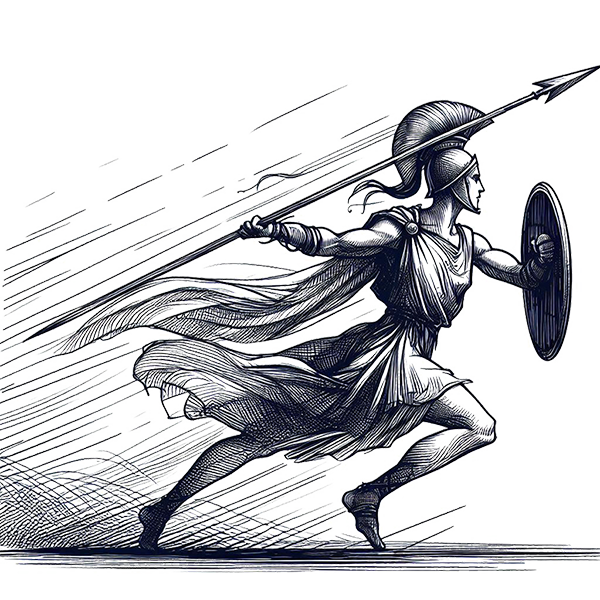 “ἦ ῥα καὶ ἔγχος ἀφῆκεν, ἑκὼν δ᾽ ἡμάρτανε [sinned] φωτός: δεξιτερὸν δ᾽ ὑπὲρ ὦμον ἐΰξου δουρὸς ἀκωκὴ ἐν γαίῃ ἐπάγη:”
“So he indeed hurled [ἀφῆκεν] the spear, and he missed [hmartane – sinned] the man willingly: and the point of the spear stuck in the earth, over the right shoulder.” (Homers Iliad 10.372)