
Strongs Definitions gives:
אֵת ʼêth, ayth; apparent[ly] contracted from H226 in the demonstrative sense of entity; properly, self (but generally used to point out more definitely the object of a verb or preposition, even or namely):—[as such unrepresented in English].
It is a curious thing that James Strong gives the precise representation in English and then goes on to say that it is “unrepresented in English” but of course he means its apparent usage. This “apparent usage” was enough for scholars and translators of the Bible to literally wipe out over 10,000 instances of this word.
The fuller form H226 אות is the mark, or sign, as turning or spinning:
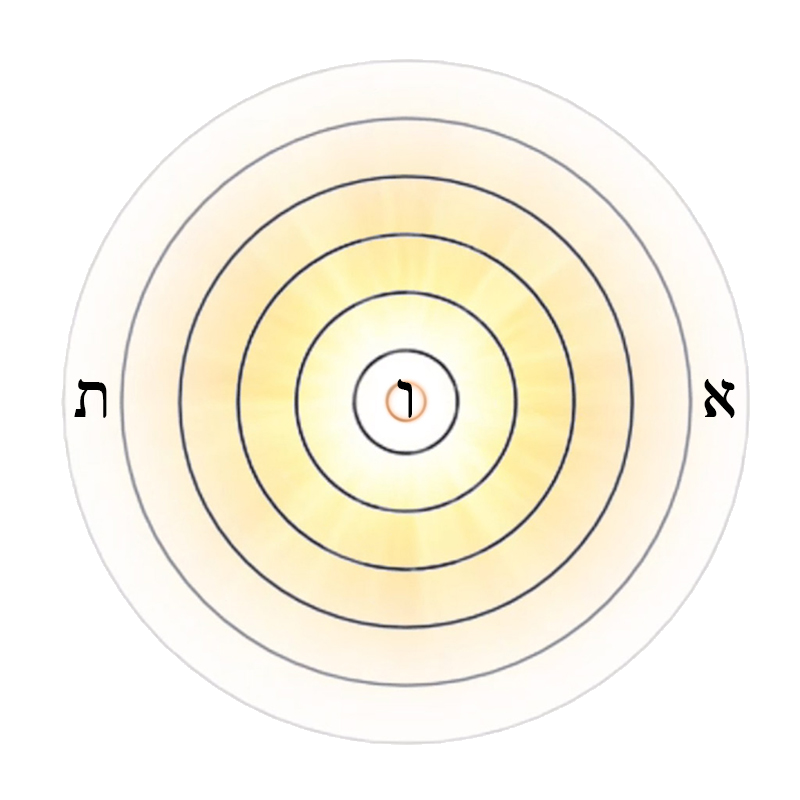

The Sign: The Man in the Middle, Marked Off by Boundaries
It is another curious thing how common it is for a man to find himself marked off, cut off, shut out, or blockaded from reaching his own self. Nothing kills off a man more, and this has been known since ancient times—the Greeks had an axiom, Γνῶθι σεαυτόν, “Know your own self.” One thing is certain: for a man who would look into the “mirror of the law” in the hopes of finding and understanding himself, because the scholars have so thoroughly locked up and quarantined the word את he will never see these 11,000 occurrences of the word self.
Strongs #226. Hebrew אות, a sign, mark. The Hebrew letter ו is the letter/number for “man” or “peg”. The “Man” is in the middle and is surrounded by the Eternal Self (a.k.a. “the hidden man of the heart” 1 Pet. 3:4 RBT), the “first” and the “last”, the “alpha” and the “omega”, in Hebrew the א and ת. This first instance of this appears in the context of Cain (Man of the Spear), i.e. “mark of Cain.”
A “first one” and a “second one”
את Strong’s #853 et. This is has been called “the untranslatable mark of the accusative” but it has never been fully understood. It constitutes the first and last letter of the Hebrew alphabet. Surely there is a reason?
This mark has perplexed rabbis and scholars for ages as to its origins. Rabbi Akiva, a Jewish scholar of the 1st century AD, is known to have called it a “mark of the divine hand”.
The “O”
Revelation gives a hint to its meaning in the Greek: “I, Myself am the A and the Ω, the origin and the end…” (Revelation 1:8 RBT). The “O”? In the Greek the letter itself is given a definite article, “The O.” Why?
It’s About Her
This crucial word את occurs over 11,000 times, mostly in the Torah (nearly all deleted by translators). Hence, the Torah plays a central role in the eternal Life, the eternal Now, and the eternal Self. Not as a dispensation, not as old rules or regulations, but as a cast seed to be completed, consummated within the uttermost Day. But what does it all mean? There are actually several more meanings to ponder:
- את. Strong’s #854 is a meaning rendered “with” or “near”. #854 “with” is listed as occurring over 800 times. We are told it denotes “proximity” but what is particularly notable is that the #854 meaning “with” is always used with people (i.e. near-him) with a few rare exceptions to localities (i.e. with Kadesh). It is never used with objects (i.e. near-the tree).
- את. Strong’s #855 is a meaning rendered “plowshare” and “mattock.” This meaning is listed for only five instances.
- את. Strong’s #859 Last is the primary meaning “you/yourself” feminine singular. Interestingly, the feminine suffix is added to create the masculine singular אתה (atah) “you” but the same construct אתה also means “her” (yourself is herself, herself is yourself). This seems to follow the interesting pattern of the 2nd masculine singular verb construct “you are” being identical to the 3rd person feminine verb construct “she is” in the imperfect/incomplete form. Is it by design? And what kind of translation mishaps might this fact have caused?
In other places with feminine nouns, the same word אתה (atah) apparently means the feminine “her/it.” If all of this is merely a matter of the language evolving via conventional usage then the word could be taken as a rather meaningless “particle” of no real relevance, and can be scratched out of the Bible as all translations have done. If it is merely an accusative marker, it is quite pointless as anyone can see the action of the verb in Genesis 1:1, “He created את the heavens and את the earth.” As if the reader wouldn’t understand what was created?
The sign representing her can be seen in the straightforward definition of את at as the feminine “you”:
Behold, now I have perceived a beautiful woman of sight of את…
Genesis 12:11 RBT
…daughter, who is את ?
And she is speaking toward himself, “A daughter of the House of God, Myself [אנכי].”
Genesis 24:23 RBT
The Hebrew אנכי (anoki) is what we might call the stand-alone “myself” or “myself” as there is already an emphatic אני (ani), which is a more typical “I” or “myself.” This also has caused some interesting translation mishaps.
While the masculine singular “you” (atah) is listed by morphologists as occurring over 1000 times. Only 50 times out of 11,000 occurrences is את at given the feminine singular “you.”
| Ref | Heb | Morphology |
|---|---|---|
| Gen.12.11-17 | אָתְּ | HPp2fs |
| Gen.12.13-04 | אָתְּ | HPp2fs |
| Gen.24.23-04 | אַתְּ | HPp2fs |
| Gen.24.47-06 | אַתְּ֒ | HPp2fs |
| Gen.24.60-07 | אַתְּ | HPp2fs |
| Gen.39.9-14 | אַתְּ | HPp2fs |
| Jdg.9.10-05 | אַתְּ | HPp2fs |
| Jdg.9.12-05 | אַתְּ | HPp2fs |
| Jdg.13.3-10 | אַתְּ | HPp2fs |
| Rut.3.9-03 | אָתּ | HPp2fs |
| Rut.3.10-03 | אַתְּ | HPp2fs |
| Rut.3.11-18 | אָתְּ | HPp2fs |
| Rut.3.16-06 | אַתְּ | HPp2fs |
| 1Sa.25.33-04 | אָתְּ | HPp2fs |
| 1Ki.2.15-02 | אַתְּ | HPp2fs |
| 1Ki.2.22-07 | אַתְּ | HPp2fs |
| 1Ki.14.2-10.K | אַתִּי | HPp2fs |
| 1Ki.14.2-10.Q | אַתְּ | HPp2fs |
| 1Ki.14.6-15 | אַ֚תְּ | HPp2fs |
| 2Ki.4.16-06.K | אַתִּי | HPp2fs |
| 2Ki.4.16-06.Q | אַתְּ | HPp2fs |
| 2Ki.4.23-03.K | אַתִּי | HPp2fs |
| 2Ki.4.23-03.Q | אַתְּ | HPp2fs |
| 2Ki.8.1-12.K | אַתִּי | HPp2fs |
| 2Ki.8.1-12.Q | אַתְּ | HPp2fs |
| Neh.9.6-05.K | אַתְּ | HPp2fs |
| Job.1.10-02.K | אַתְּ | HPp2fs |
| Pro.7.4-04 | אָתְּ | HPp2fs |
| Ecc.7.22-09.K | אַתְּ | HPp2fs |
| Sng.6.4-02 | אַתְּ | HPp2fs |
| Isa.51.9-13 | אַתְּ | HPp2fs |
| Isa.51.10-02 | אַתְּ | HPp2fs |
| Isa.51.12-06 | אַתְּ | HPp2fs |
| Jer.2.20-19 | אַתְּ | HPp2fs |
| Jer.2.27-06 | אַתְּ | HPp2fs |
| Jer.15.6-01 | אַתְּ | HPp2fs |